
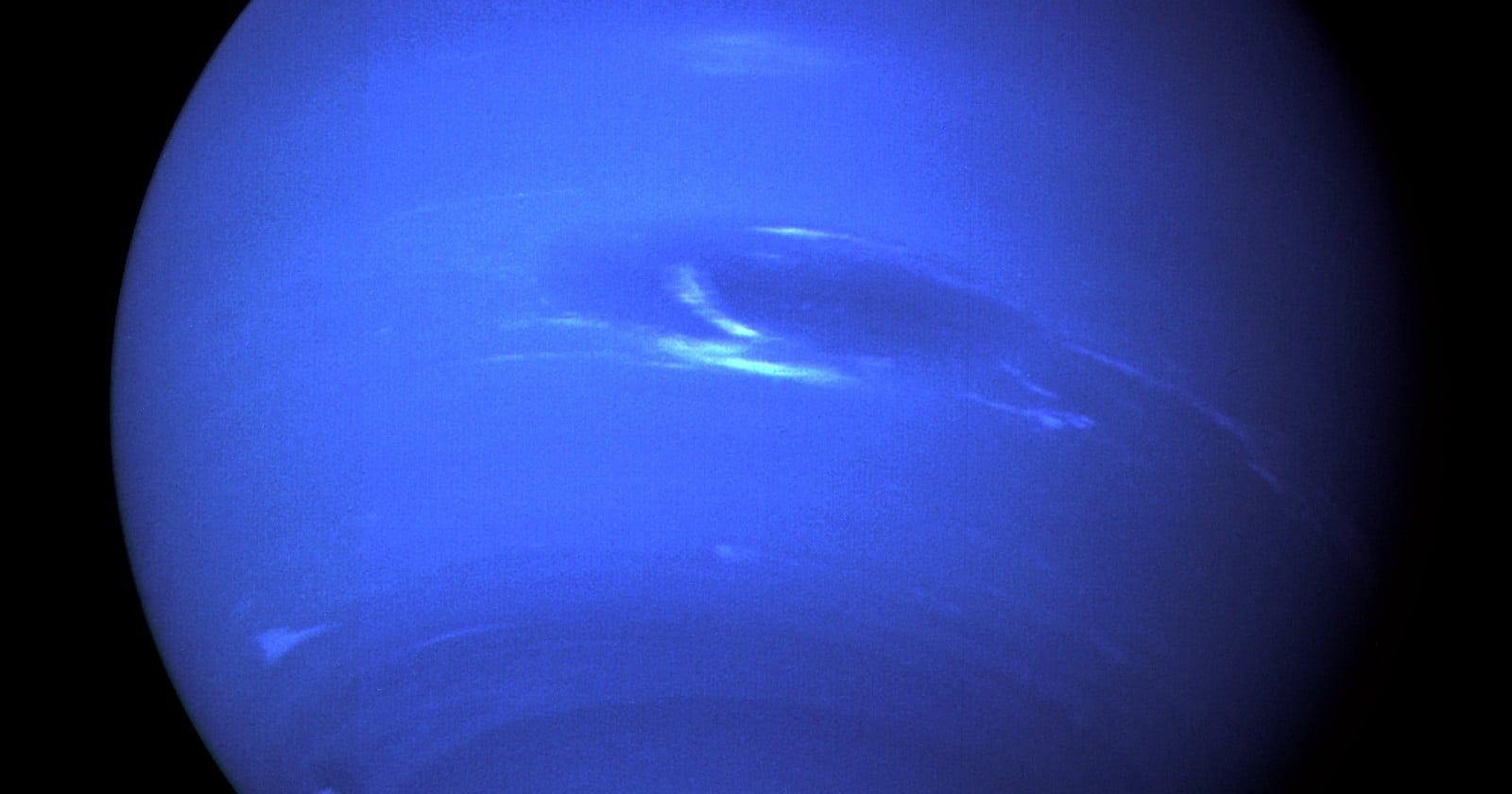
The most violent winds anywhere in the solar system do not blow on the largest planet or the one closest to the Sun. They blow on Neptune, the small, dark, distant world at the far edge of the planetary system, where NASA measures storm winds at more than 1,200 miles per hour (2,000 kilometers per hour). By comparison, the strongest winds ever recorded on Earth top out around 250 miles per hour.
What makes the number strange is where it happens. Neptune sits about 30 times farther from the Sun than Earth does, and the sunlight that reaches it is roughly 900 times fainter than the light warming our own planet. High noon on Neptune would look to us like dim twilight. There is almost no solar energy out there to stir the air, and yet Neptune, in NASA’s words, is “our solar system’s windiest world”.
The one time anyone got close
Nearly everything we know about Neptune’s weather comes from a single encounter. In 1989, NASA’s Voyager 2 became the first and only spacecraft to fly past Neptune, and its cameras caught bright white clouds of frozen methane racing around the planet, along with two enormous storms.
One of them, an oval large enough to hold the entire Earth, was named the Great Dark Spot. It has since vanished, and new storms have appeared elsewhere, so the spot was not a permanent fixture like Jupiter’s Great Red Spot but a passing system. The clouds Voyager tracked were the markers scientists used to time the winds. Watch a bright patch of methane ice move from one image to the next, measure how far it traveled and how long it took, and you have a wind speed.
Those measurements are what put Neptune at the top of the solar system’s wind chart.
Neptune has never been easy to study. It is the only planet in the solar system invisible to the naked eye, and it was the first found through calculation rather than a telescope search. Astronomers in 1846 used the unexplained tug on Uranus’s orbit to predict where an eighth planet must lie, and located Neptune close to that spot on the first night they looked. A single spacecraft pass, more than three decades ago, is still the closest anyone has come.
Faster than sound, on almost no fuel
NASA describes Neptune’s winds as supersonic. At high altitudes the speeds can exceed 1,100 miles per hour, about 1.5 times the speed of sound. The winds do not all blow the same way; they move in broad east-west bands at different speeds, which is why the planet’s cloud features seem to slide past one another.
The winds are visible only because of what they carry. The bright streaks Voyager photographed are clouds of methane ice crystals, and it is those features, blown along at more than a thousand miles an hour, that let scientists measure the speed at all. Without them, the fastest weather in the solar system would be invisible.
Stacked against the other planets, Neptune stands out even among giants:
- On Earth, the strongest winds reach roughly 250 miles per hour (400 kilometers per hour).
- Neptune’s winds, NASA says, can run about three times stronger than Jupiter’s and nine times stronger than Earth’s.
- At more than 1,200 miles per hour, they are the fastest sustained winds measured on any planet in the solar system.
The puzzle is the power source. On Earth, weather is ultimately driven by heat from the Sun. Neptune receives so little sunlight that, by that logic, it should be nearly still. Instead it is the most turbulent planet we know of. Researchers suspect the energy comes largely from inside the planet rather than from above, but the full accounting of what sustains winds this fast on so little sunlight remains unsettled.
The contrast with Earth sharpens the puzzle. Our planet sits close enough to the Sun that solar heat drives the entire weather system, and even so the strongest winds ever clocked at the surface rarely pass 250 miles per hour. Neptune runs on a tiny fraction of that energy, yet it sustains winds several times faster. Whatever stirs its atmosphere, sunlight cannot be doing most of the work. That is why the planet keeps turning up in questions about what else could power weather on a world this cold.
A single flyby, more than thirty years ago
The 1,200-mile-per-hour figure rests almost entirely on one spacecraft’s pass in 1989, not on continuous monitoring. Voyager 2 measured the winds by tracking cloud features across a handful of images over a few days, which captures the fastest visible gusts at particular latitudes rather than a steady, planet-wide average.
Wind speed on a giant planet is also measured relative to how fast the planet itself rotates underneath the clouds, and Neptune’s interior rotation is not directly observable; it has to be estimated. Change that baseline and the wind numbers shift with it. That is part of why NASA’s own pages quote the top speeds slightly differently, from “more than 1,200 miles per hour” on one page to “exceed 1,100 miles per hour” on another. Both are describing the same extraordinary planet, but the precise ceiling depends on the method.
The word supersonic deserves a footnote too. It means the winds move faster than the speed of sound in Neptune’s own cold, hydrogen-rich atmosphere, which is not the same as the speed of sound in the air we breathe. The comparison is real, but it is measured against Neptune’s conditions, not Earth’s.
Even at the conservative end, Neptune’s winds outrun anything measured on any other planet, and they do it in near-darkness.
Why it still matters
Neptune is the densest of the giant planets, and it has no solid surface to stand on. Its atmosphere of hydrogen, helium and a little methane simply thickens with depth until it merges into hot, dense fluid over a small core. The blue we see is methane absorbing red light and reflecting blue. A day there lasts about 16 hours, and a single year runs roughly 165 Earth years, so Neptune completed only its first full orbit since discovery in 2011.
Its other extremes are almost as striking. Neptune’s axis tilts about 28 degrees, close to Earth’s, so it runs through seasons, though each one lasts more than 40 years. Its largest moon, Triton, circles the planet backwards relative to its spin, a sign it was probably a passing world that Neptune captured rather than one that formed alongside it. Voyager 2 even caught geysers venting icy material several miles above Triton’s frozen surface.
The winds are the part that keeps drawing scientists back. A planet that cold and that starved of sunlight has no business being the stormiest world in the solar system, and the fact that it is tells researchers their models of how planets make weather are missing something. Understanding Neptune’s engine may help explain the many Neptune-sized planets now being found around other stars, worlds too far away for any camera to watch a cloud move.
The fastest winds anywhere blow on a planet almost no one has seen up close. The only spacecraft ever to measure them, Voyager 2, is now far beyond Neptune, crossing interstellar space.
