

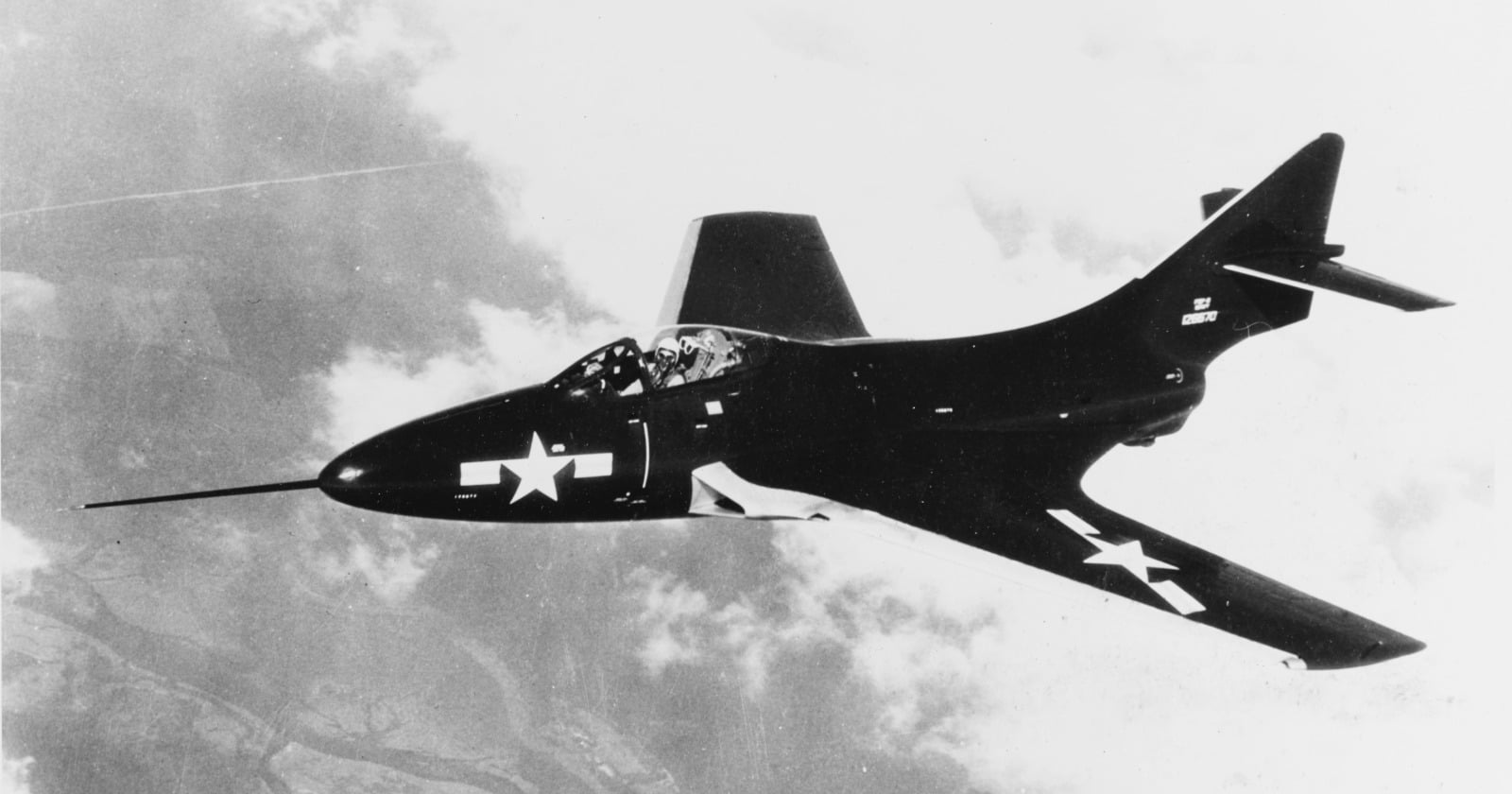
During a survey of jet pilots in the mid-1950s, two researchers heard the men use a term for something that happened to them at altitude. The word was break-off. The pilots used it for the sensation of being physically separated from the earth at high altitude.
In April 1957, Brant Clark, a professor of psychology at San Jose State College, and Captain Ashton Graybiel, a Navy medical officer, published what came of asking about it directly. They interviewed 137 Navy and Marine jet pilots, all of whom had flown solo above 30,000 feet. Forty-eight of them, 35 per cent, said they had felt it. Only a third of those men had ever raised it with a colleague.
The men who would not raise it
Thirty-two of the 137 pilots, 23 per cent, had heard break-off discussed among aviators at all. Sixteen of those thirty-two had never experienced it themselves and knew of it only from conversation, which puts the share of pilots who had either felt the thing or heard it mentioned at 47 per cent.
Asked why they kept quiet, several pilots told the interviewers the experience was intensely personal and simply not the sort of thing flyers talk about. One put it flatly.
“You don’t discuss things like this.”
Others admitted they expected to be thought ridiculous, and the transcripts suggest the worry was well founded. One pilot who had never felt anything of the kind dismissed the question with a line the researchers recorded verbatim: “. . . I haven’t got that poetic yet.”
One of the younger men expressed some relief at learning that others had felt it too. He had never heard another pilot describe it, and had been reluctant to bring it up in case he was taken for peculiar.
Exhilaration in one cockpit, dread in the next
Some pilots reached for something close to rapture. “It seems so peaceful; it seems like you are in another world,” one said. Another: “I feel like I . . . have broken the bonds from the terrestrial sphere.”
Two men described a kind of enlargement. “In an FJ, I feel like a giant.” “I feel something like a king.” Three pilots said they felt nearer to God.
For others the same sensation arrived as fear: eighteen of the forty-eight explicitly reported anxiety or fear. One interview protocol records a pilot who “feels alone, light, remote, and insecure,” unhappy until he could get back down, needing an objective to occupy him.
More common than fear was loneliness, reported by thirty-eight of the forty-eight men, and sharpened by losing radio contact with base. One pilot: “It’s very lonely alone at high altitude. I’d rather fly at 20,000 or 25,000 feet . . . at 44,000 feet you are pretty lonely up there alone.” Clark and Graybiel were careful with this one, treating loneliness as commonly associated with break-off but not a crucial part of it, and at least one pilot separated the two cleanly. He felt the detachment and never felt lonely at all.
Getting rid of it took nothing exotic. Descend, or join up with another aircraft, or make yourself interested in some problem to do with the flight, and it lifted. More hours in the air did not reliably see it off.
Almost all of them were flying alone
Forty-three of the forty-eight men who reported break-off had experienced it while flying solo, and twenty-four of the forty-eight said having time on their hands mattered. As one pilot described the mechanism, “You get break-off when you have a chance to be free about your thoughts.” The three conditions the authors settled on were flying alone, at high altitude, “with relatively little to do.”
Altitude itself proved hard to pin down. Only thirty-three pilots were willing to name a specific height, and their estimates ran from 15,000 to 45,000 feet, with a median of 33,250. It did not appear to happen on tactical flights.
Pilots flying the highest-performance type in the sample, the FJ-3, reported the largest share of experiences. The authors declined to lean on that, saying the small number of men flying each aircraft type did not warrant statistical analysis and the pattern was merely suggestive.
Experience turned out to predict nothing. Because the flight-hour distributions were heavily skewed, the two men used a rank test that compares groups without assuming their data form a bell curve, and found no difference between their break-off and non-break-off groups on hours in propeller aircraft, hours in jets, estimated hours above 35,000 feet, or greatest altitude ever flown. None of the differences was significant at even the 5 per cent level of confidence. In their words, the data appear to show unequivocally that break-off does not depend on the pilot’s flight experience.
A second test found the same nothing on a different axis. Among 101 naval pilots who answered questions about how they felt toward jet flying, the thirty-three who reported break-off did not differ from the sixty-eight who did not.
A definition read aloud before the question
Before a pilot was asked whether he had experienced break-off, the interviewer read him a statement defining it as a feeling of physical separation from the earth. Only then came the question of whether he had ever had such an experience. The interviews otherwise followed a modification of the critical incident technique, a method designed for collecting accounts of specific remembered events. What the 35 per cent figure records, then, is agreement with a supplied description rather than a symptom volunteered unprompted, and current survey practice would call that a leading question. It was not bare assent, though: a pilot who answered yes was then asked for a description of the incident and for answers to specific questions to clarify the account.
The population is narrow too: Navy and Marine jet pilots with a median age of 27.4, interviewed once, sixty-nine years ago. Nothing in the study measured the experience itself. No instruments, no physiology, no in-flight recording, and no follow-up. It is a content analysis of 137 retrospective interviews, and its authors said so.
They were candid about the rest as well. Frequency could not be established, in part because the pilots found the thing difficult to describe and were unsure themselves how often it happened. On causes they wrote that the predisposing factors had not been identified, though they suspected these were related to the personality of the flyer, which is a hypothesis rather than a result.
Two claims now attached to the paper are not in it. Modern summaries often report that most pilots found break-off peaceful, where the paper tallies exhilaration for some men, fear or anxiety for eighteen, loneliness for thirty-eight, and no majority verdict on whether the sensation was pleasant. Break-off is also presented now as an early sighting of the overview effect, the shift in perspective astronauts describe after seeing the whole Earth at once, a term the writer Frank White coined in 1987, three decades after this paper appeared. Clark and Graybiel make no such link, and their pilots were not contemplating a planet from orbit. Whether the two experiences share a mechanism is an open question this study was never built to answer.
The briefing they recommended
Some of the pilots had suggested that break-off simply be described to men going alone to high altitude for the first time. Asked directly whether it should be described to pilots going to altitude for the first time, though, the men split about evenly three ways between yes, no and don’t know. The authors endorsed the idea anyway, as valuable. It is a modest thing to ask for at the end of a paper about a phenomenon nobody would admit to: not a design change or a screening protocol, but a sentence said out loud in a briefing room before a young pilot climbs.
On flight safety their judgment was measured. By itself, they thought, break-off was probably not a major factor, though coupled with anxiety or fear it could matter for individual pilots. Most of the men who had felt it rated it of little or slight importance to their own flying.
They ended by looking further up. Two years earlier the test pilot William Bridgeman had published a memoir, The Lonely Sky, and Clark and Graybiel quoted from it a passage describing a climb through 61,000 feet, noting that Bridgeman held both speed and altitude records and could describe his reactions without embarrassment. He never used their word for it.
“Fifty-nine thousand, sixty thousand, reeling off sixty-one thousand. I have left the world. There is only the ship to identify myself with, her vibrations are my own, I feel them as intensely as those of my body.”