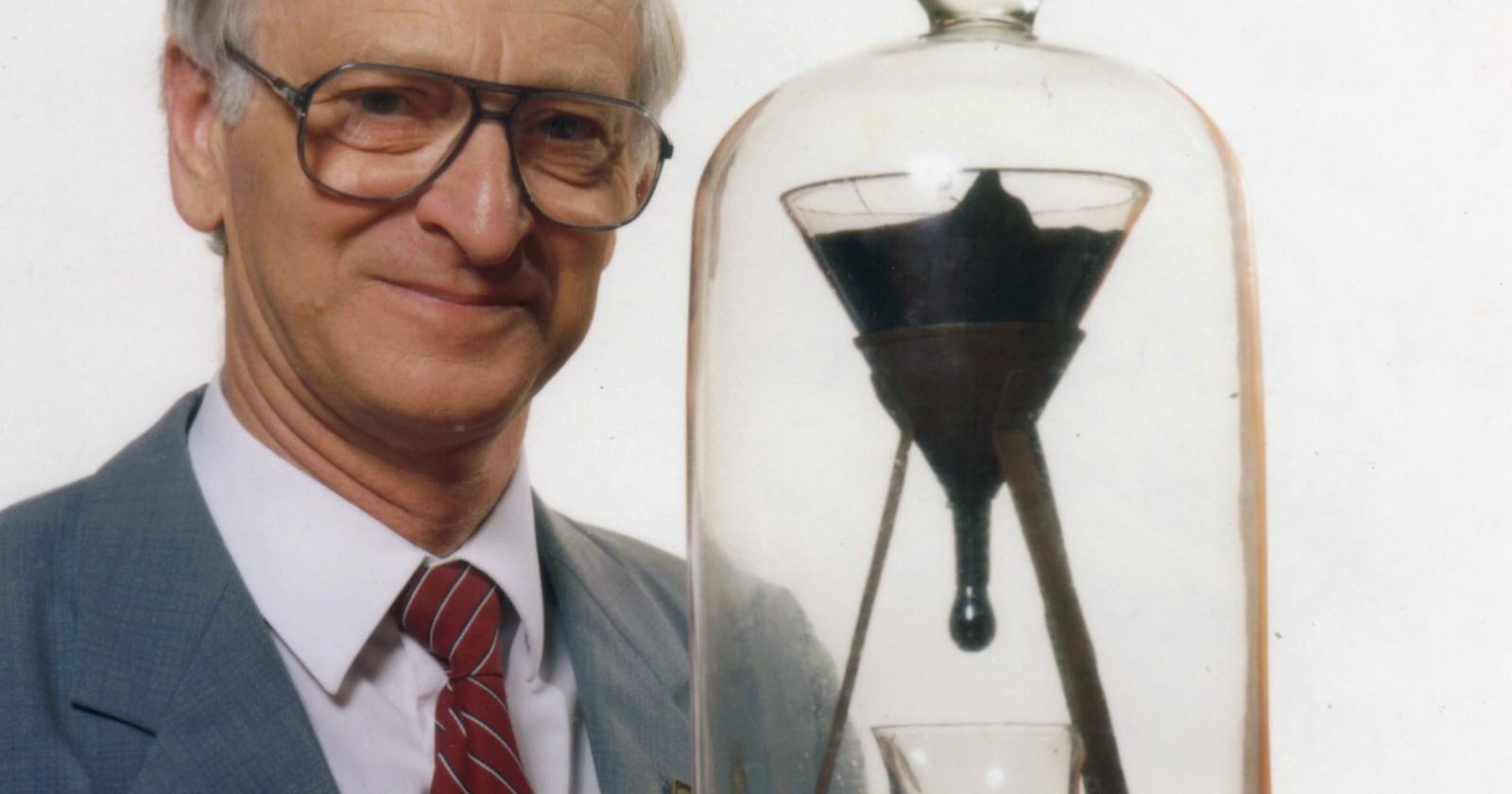
In 1927, a physics professor in Brisbane named Thomas Parnell heated a lump of pitch, a black tar left over from distilling coal or oil. He poured the molten pitch into a glass funnel with the bottom of the stem sealed, and let it settle for three years. In 1930 he cut the stem open and waited to see what the pitch would do. Almost a century later, the answer is still arriving. The pitch has dripped just nine times, and the tenth drop is still forming.
That single sealed funnel is now recognized by Guinness World Records as the world’s longest-running laboratory experiment. It sits in a display case at the University of Queensland, doing almost nothing, very slowly, on purpose.
A solid you can shatter that is secretly a liquid
The point Parnell wanted to make to his students was that some materials are not what they look like. At room temperature pitch seems completely solid. It is hard to the touch. Hit it with a hammer and it shatters into shards, the way a piece of dark glass or hard candy would.
But pitch is not a solid. It is a liquid of staggering thickness, flowing so slowly that a human lifetime is barely long enough to watch a single drop form, swell, stretch, and finally fall. The University of Queensland estimates the pitch is about 100 billion times more viscous than water. Water poured from a jug empties in a second. This pitch takes years to ooze the length of a funnel stem.
The published account of the experiment, written up by R. Edgeworth, B. J. Dalton and Parnell himself in the European Journal of Physics in 1984, put a number on it. Using the rate of flow and the dimensions of the funnel, they calculated a viscosity of roughly 230 million pascal-seconds. Water, for comparison, sits at about one-thousandth of a pascal-second. The authors noted that the figure is close to the geometric mean of the whole range of viscosities physicists deal with, with water near one end and the slow churning interior of the Earth near the other.
That comparison is worth sitting with. The effective viscosity of the Earth’s deep interior, the rock that creeps over geological time to drive continents apart, is something like a trillion trillion times that of water. The pitch in Parnell’s funnel lands roughly midway between the two on that vast scale. It is thick almost beyond intuition, and yet, given enough time, it behaves exactly as a fluid should. Gravity pulls on it, and it answers. It just takes years to do so.
A record of patience
The funnel keeps a clock that almost no one is alive long enough to read in full. The dates of the drops, recorded since the stem was opened, read like a thin family tree spread across generations.
The first drop fell in December 1938, eight years after the stem was cut. Five more followed over the next four decades, in 1947, 1954, 1962, 1970, and 1979. The pace stayed glacial through the turn of the century. The ninth and most recent drop touched the one below it, and so counted as fallen, on the 24th of April 2014. A tenth is forming now, and the university expects it to fall sometime this decade.
That works out to roughly one drop every eight to thirteen years, though the rhythm is not fixed. The pitch is not kept at a steady temperature, so it flows faster in Brisbane’s summer heat and slower in winter. When the university air-conditioned the nearby lecture theatres in the mid-1990s, the cooler air slowed the eighth drop’s descent even further. The experiment, in other words, is sensitive enough to register a change in the building around it.
The drop no one has ever seen fall
For most of its history the experiment carried a strange footnote: across decades of dripping, no one ever managed to watch a drop actually let go. As the University of Queensland puts it, various glitches kept foiling the attempts.
The man who came closest was the physicist John Mainstone, who became the experiment’s second custodian in 1961 and looked after it for fifty-two years. Like Parnell before him, he died without ever seeing a drop fall.
Mainstone and Parnell were jointly awarded the 2005 Ig Nobel Prize in Physics, the tongue-in-cheek award for research that makes people laugh and then think, for starting and patiently maintaining the experiment. Today a live webcam keeps watch on the funnel around the clock, followed by more than thirty-five thousand registered viewers in some 160 countries. A physicist named Andrew White is now its third custodian, still waiting, like everyone before him.
What the experiment does and does not prove
It is easy to oversell a curiosity like this, so it is worth being careful about what the pitch drop actually shows.
It is a genuine demonstration that pitch flows, and a striking one. But the precise viscosity figure should be read as an estimate, not a measured constant. The 1984 paper is candid about its own limits. The internal diameter of the funnel stem could not be measured accurately for fear of damaging the exhibit, and that single uncertainty limits the precision of the whole result. The temperature history of the funnel across decades is, in the authors’ own words, largely guesswork. Their calculated viscosity did not even match the values predicted from older laboratory measurements of pitch, which they attributed to the simple fact that different batches of pitch differ in composition.
So the experiment is better understood as a vivid teaching tool than as a precision instrument. It proves that a substance can look solid, behave like a solid on the timescale of a hammer blow, and still be a fluid on the timescale of a decade. It does not pin down the viscosity of pitch to a fixed number, and it was never really designed to.
There is also a common myth worth retiring. The pitch drop is sometimes described as proof that ordinary window glass is a slowly flowing liquid that thickens at the bottom of old panes over centuries. That claim is false. The uneven thickness of medieval glass comes from how it was made, not from flow, and glass at room temperature does not measurably sag. The pitch drop demonstrates slow flow in pitch. It says nothing about glass.
Why it still runs
There is no scientific result waiting at the end of the pitch drop experiment. No one expects the next drop to overturn a theory. Its value is harder to name than that.
It is a measure of time on a scale that outlasts the people tending it. Parnell never saw more than a few drops. Mainstone gave it most of his career and never caught one falling. The funnel will likely keep dripping for generations of students who were not born when it started, each drop a small proof that patience can be a form of evidence. The tenth drop is forming now, somewhere above a fresh beaker, in no particular hurry.