
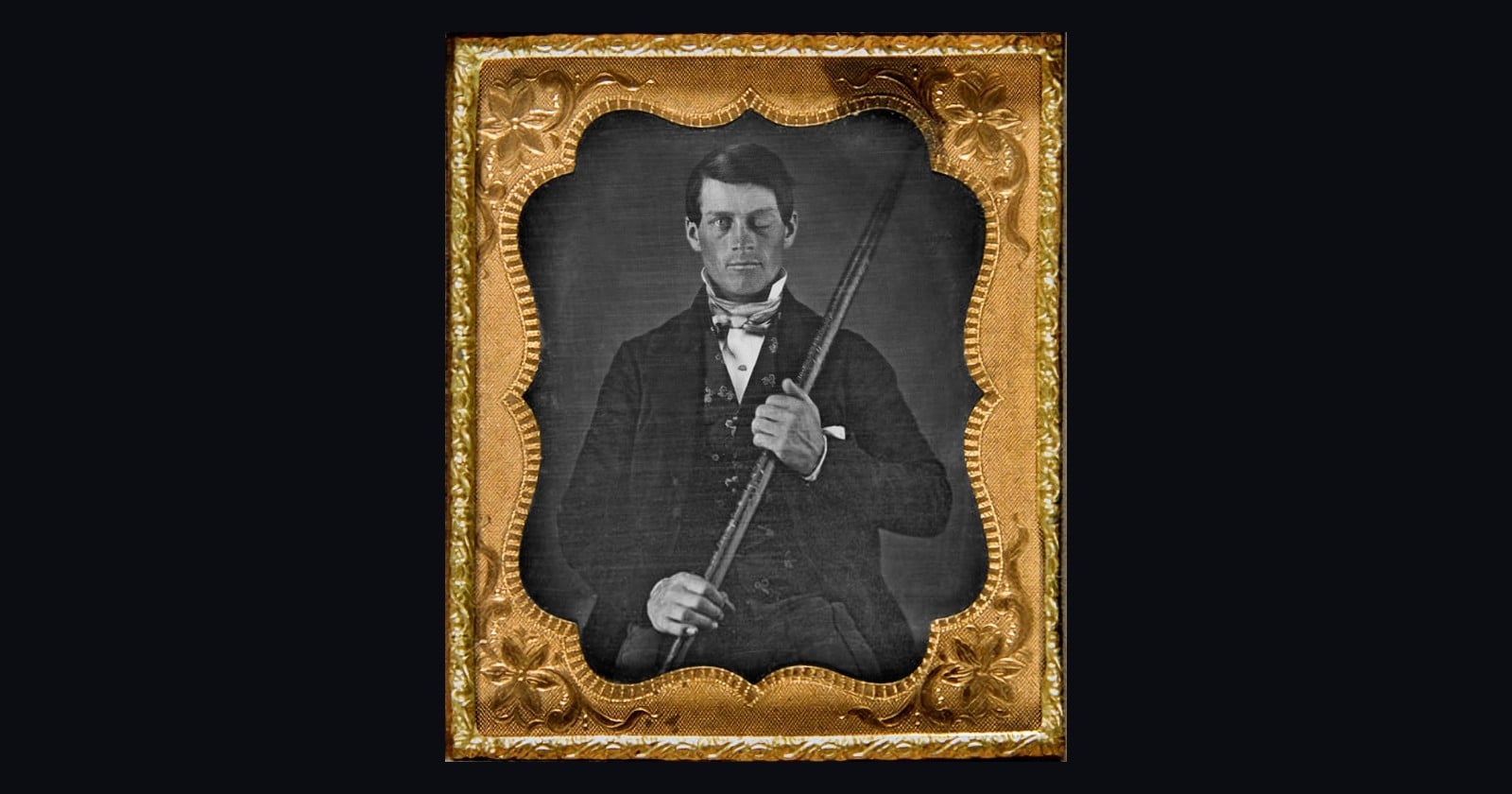
On the afternoon of 13 September 1848, on a rail line being cut through Cavendish, Vermont, a foreman named Phineas Gage was packing blasting powder into a hole drilled in rock. The tool in his hands was a tamping iron, three feet seven inches long, an inch and a quarter thick at its widest, and weighing thirteen and a quarter pounds. He looked away for a moment, the iron struck a spark, and the powder went off.
The bar entered point first below his left cheek, near the angle of the jaw, passed behind his left eye, drove up through the front of his brain, and burst out through the top of his skull before landing several rods, some fifty feet, behind him. Gage was thrown onto his back. According to the physician who treated him, John Harlow, he gave a few convulsive movements and then spoke within a few minutes. His men carried him to an ox cart, in which he rode sitting upright for three quarters of a mile to his lodgings. He climbed out with a little help, and about an hour later walked up a long flight of stairs.
A wound that should have been fatal
Harlow’s record of the days that followed reads like a catalogue of everything that should have killed his patient. The opening in the skull was an irregular hole more than three inches across. An ounce or more of brain tissue had been lost. Within days a severe infection set in, the wound discharged foul matter, and Gage sank into a stupor so deep that those tending him had a coffin made ready.
He did not die. By the time Harlow lanced a large abscess on the fourteenth day, the tide had turned. By the fifty-sixth day Gage was walking in the street. By the following January the opening in his head had closed over. In April 1849, seven months after the blast, he returned to Cavendish carrying the iron, which he kept beside him for the rest of his life.
That part of the story is well documented, because Harlow wrote it down twice: first in a short report for the Boston Medical and Surgical Journal weeks after the accident, then in a fuller account read to the Massachusetts Medical Society twenty years later. Even his colleagues struggled to believe it. Harlow noted that many physicians refused to accept that the man had survived until they had, in his words, thrust their fingers into the hole in his head. Some would not credit the report at all until the country doctor produced sworn statements from local clergymen and lawyers attesting that the accident had happened as described.
The disbelief was strong enough that the case needed an outside witness to be taken seriously. Henry Bigelow, a professor of surgery at Harvard, had Gage brought to Boston and examined him for eight or nine weeks before declaring himself convinced the iron really had passed through the skull. At the time, the case still had very few believers. Bigelow published his own report of it in 1850. One distinguished surgeon, Harlow recalled, had dismissed the whole affair as a “Yankee invention,” a charge the physical evidence would eventually put to rest.
How a man becomes a textbook
What turned Gage from a medical curiosity into one of the most cited patients in the history of neuroscience was not the survival. It was Harlow’s claim about the change in him afterward.
Before the injury, Harlow wrote, Gage had been a capable, level-headed foreman his employers valued. After it, Harlow described a man who was “fitful, irreverent, indulging at times in the grossest profanity,” impatient of advice, full of plans he abandoned as fast as he made them. His contractors would not give him his job back. Friends said he was “no longer Gage.”
For a young science arguing over whether different parts of the brain did different jobs, this was extraordinary. Here was a man whose body worked, whose memory and speech were intact, but whose character seemed to have shifted after a specific part of the front of his brain was destroyed. The neurologist David Ferrier later traced the iron’s path through what we now call the prefrontal cortex and connected Gage’s case to his own experiments on the frontal lobes. Gage became the evidence that the front of the brain helps govern personality and judgment, a region we now know is central to planning and the control of impulse.
Where the famous version gets slippery
The trouble is that the dramatic personality story rests on a very thin record, and most of what people now “know” about Gage was added later by other hands.
Harlow’s actual description of the changed Gage runs to a few paragraphs. He never administered anything like a psychological test, and for years after the accident he lost track of his patient entirely, reconstructing the later life only after Gage had died, through letters with the family. Across the twentieth century, retellings steadily filled the gaps, recasting Gage as a drunken, brawling, dishonest drifter who could hold no job and lurched from disaster to disaster. Almost none of that is in Harlow. The historian Malcolm Macmillan, who assembled the surviving evidence, found that many “facts” about Gage’s ruin cannot be traced to any contemporary source at all.
The documented later life points the other way. Gage held steady work in a livery stable, then spent years in Chile driving a stagecoach, handling a heavily laden six-horse team. That is not the resume of a man incapable of planning or self-control, and Macmillan has argued it suggests a substantial recovery in the years after the injury, the kind of regaining of function the early accounts leave out. Harlow himself was careful on this point. Mentally, he wrote, the recovery was only partial, the faculties “enfeebled in their manifestations,” but there was “nothing like dementia.”
There is even confusion about the ending. Harlow gives the date of death as 1861 and the survival as twelve years and some months, but the date now established by later researchers is May 1860, which puts the survival closer to eleven years and eight months. Gage died in San Francisco after a series of seizures, probably late consequences of the old head injury. No autopsy was performed. His skull and the iron were later recovered at Harlow’s request and remain at Harvard.
What is left when the legend is set aside
Strip away the embellishments and the case is, if anything, more interesting. A man took a metal bar through the front of his brain, stayed awake through it, and walked within the hour. He lived more than a decade longer, worked, traveled, and was changed in ways his doctor recorded honestly and without exaggeration. The specifics of how he was changed, and how much, are thinner and more human than the monster of the retellings.
That gap between the careful record and the story it grew into is its own kind of lesson. The question worth sitting with is not how badly the iron ruined Phineas Gage. It is how little of what everyone is sure they know about him ever made it into the careful record, and how much accumulated in the retelling.
