
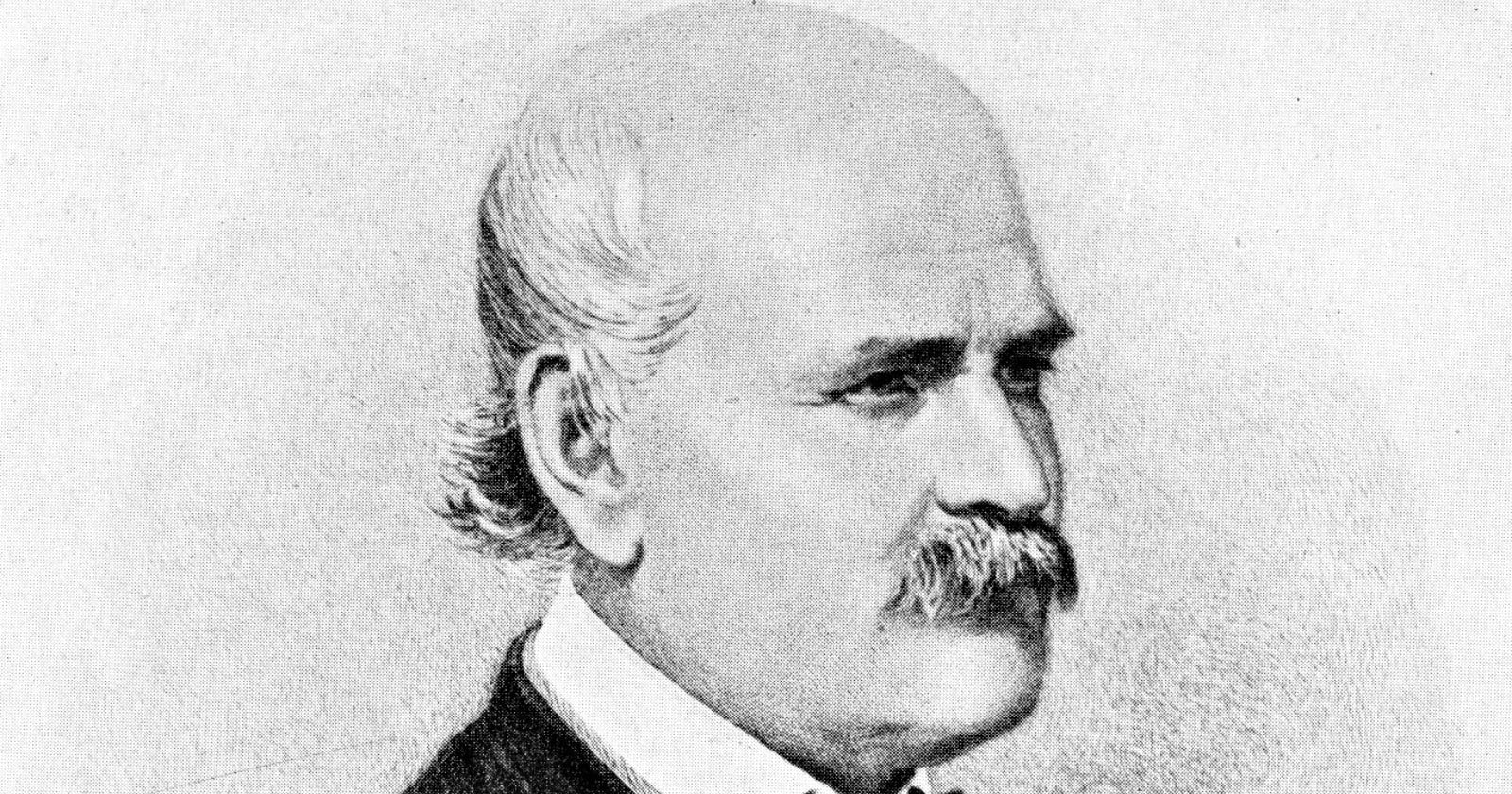
In 1847 a Hungarian obstetrician working in Vienna noticed something his colleagues had learned to live with. At the Vienna General Hospital, the maternity ward run by doctors and their students was killing far more mothers than the ward next door run by midwives. Over the previous six years the doctors’ clinic had lost about one mother in ten to childbed fever, while the midwives’ clinic lost closer to one in thirty. Women knew the difference and begged to be sent to the midwives.
The obstetrician was Ignaz Semmelweis, and by the end of that year he had done something almost no one else in medicine had managed. He had found a way to make the dying stop. After he ordered the doctors to wash their hands in a chlorine solution, deaths on their ward fell from roughly eighteen percent in 1847 to just over one percent the following year. He could not explain why it worked. That gap, between a result he could prove and a cause he could not name, would cost him everything.
The two wards
The puzzle sat in plain sight. The hospital’s First Obstetrical Clinic trained medical students; the Second trained midwives. The two took women on alternating days, more or less at random, yet the First Clinic buried mothers at several times the rate of the Second. The women who ended up in the doctors’ ward were not sicker or poorer in any way that explained it.
The prevailing explanation of the day blamed miasma, a vague bad air thought to rise from the sick and the dead. Semmelweis could not make it fit. Bad air should have fallen equally on both wards, and it should have reached the women who gave birth at home or were caught by labour on the way to the hospital. Yet those women contracted the fever far less often than the ones delivered on his own ward. Something the doctors were doing, rather than something in the atmosphere, looked like the likelier cause.
Semmelweis worked through the possible causes and discarded them one by one. Overcrowding, climate, even the route the priest walked through the ward: none held up. What separated the two clinics was the doctors themselves, and above all what they did before they arrived. Medical students spent their mornings dissecting the dead, then walked to the delivery room to examine living women, often without washing in between.
A colleague’s death points the way
The insight came from a death that had nothing to do with childbirth. In 1847 Semmelweis’s friend Jakob Kolletschka, a professor of forensic medicine, cut his finger during an autopsy and died soon after. The illness that killed him looked, to Semmelweis, exactly like the fever carrying off the mothers.
If a small wound could deliver whatever came off a corpse into Kolletschka’s blood and kill him with the same disease, then the students were carrying that same something on their hands into the bodies of women in labour. Semmelweis called it “cadaverous particles.” He had no microscope image to show, no organism to name. He had a suspicion and a hospital full of data.
The order, and the numbers
In the spring of 1847 he required everyone on the First Clinic to scrub their hands in a solution of chlorinated lime until the smell of the dissecting room was gone. He had chosen chlorine because it destroyed the odour of decay, reasoning that whatever carried the smell might carry the danger too.
The death rate on the ward collapsed. In the months after the order, mortality that had run in the high teens dropped toward one and two percent, and stayed there. When Semmelweis later moved to a hospital in Pest and imposed the same rule, maternal deaths again fell below one percent. He kept the ledgers obsessively, because the numbers were the whole of his argument. He had no theory a physician of 1847 could accept, only columns showing that mothers stopped dying when hands were clean.
Where the clean story breaks down
The version usually told casts Semmelweis as a lone genius crushed by fools, and it flatters the modern reader more than it should. His figures were real, but they came from a busy hospital, not a controlled experiment. The two clinics differed in more than handwashing, and Semmelweis was reading a pattern out of records rather than isolating a single cause the way a trial would. He was almost certainly right, but the evidence he had was messier than the legend allows.
The deeper reason his colleagues resisted was not simple stupidity. Germ theory did not yet exist. “Cadaverous particles” named an effect without a mechanism. Asking established physicians to accept that their own hands were killing their patients, on the strength of a cause no one could see, was a genuinely hard sell in 1847. Semmelweis did not make it easier. He published his findings late, in a dense and combative 1861 book, and answered doubt with fury rather than persuasion. Powerful figures in European medicine, among them the pathologist Rudolf Virchow, lined up against him. Closer to home, his own superior on the ward stayed loyal to the bad-air theory, could not see why clean hands should change anything, and was the man who eventually dismissed him. Nationalist friction between Vienna and Hungary, where Semmelweis had sided with the 1848 revolution, did not help.
He was pushed out of his Vienna post and grew increasingly erratic through the late 1850s. In 1865 he was committed to an asylum, where he died within weeks. Even the ending resists tidy telling. The cause of his breakdown, and the exact circumstances of his death, are still argued over; by one widely cited account he died of an infection after a beating by his attendants. The man who fought to stop one kind of preventable death may have died of another.
The proof arrives too late for him
What Semmelweis lacked was supplied within a generation of his death. Louis Pasteur’s work established that living microbes cause infection, and Joseph Lister built antiseptic surgery on the same idea from 1867 onward. Once there was a mechanism, the death rates that Semmelweis had tabulated stopped looking like a coincidence and started looking like proof.
The lag was not harmless. In the years between Semmelweis’s ward and Lister’s operating theatre, mothers kept dying of an infection that a basin of chlorine could have prevented, in hospitals that held his figures and set them aside. The hard part of his story is not only that he was ignored. It is that being right, and being able to show it in columns of numbers, still was not enough to make the dying stop.
His name now sits on a university and, since 2015, on a global day devoted to hand hygiene. The mothers on his ward did not have to wait for the theory. They only needed the doctors to wash, which is the strange, difficult lesson of his life: that a thing can be demonstrably true, and life-saving, and still be refused for years because no one can yet say why it works.
