
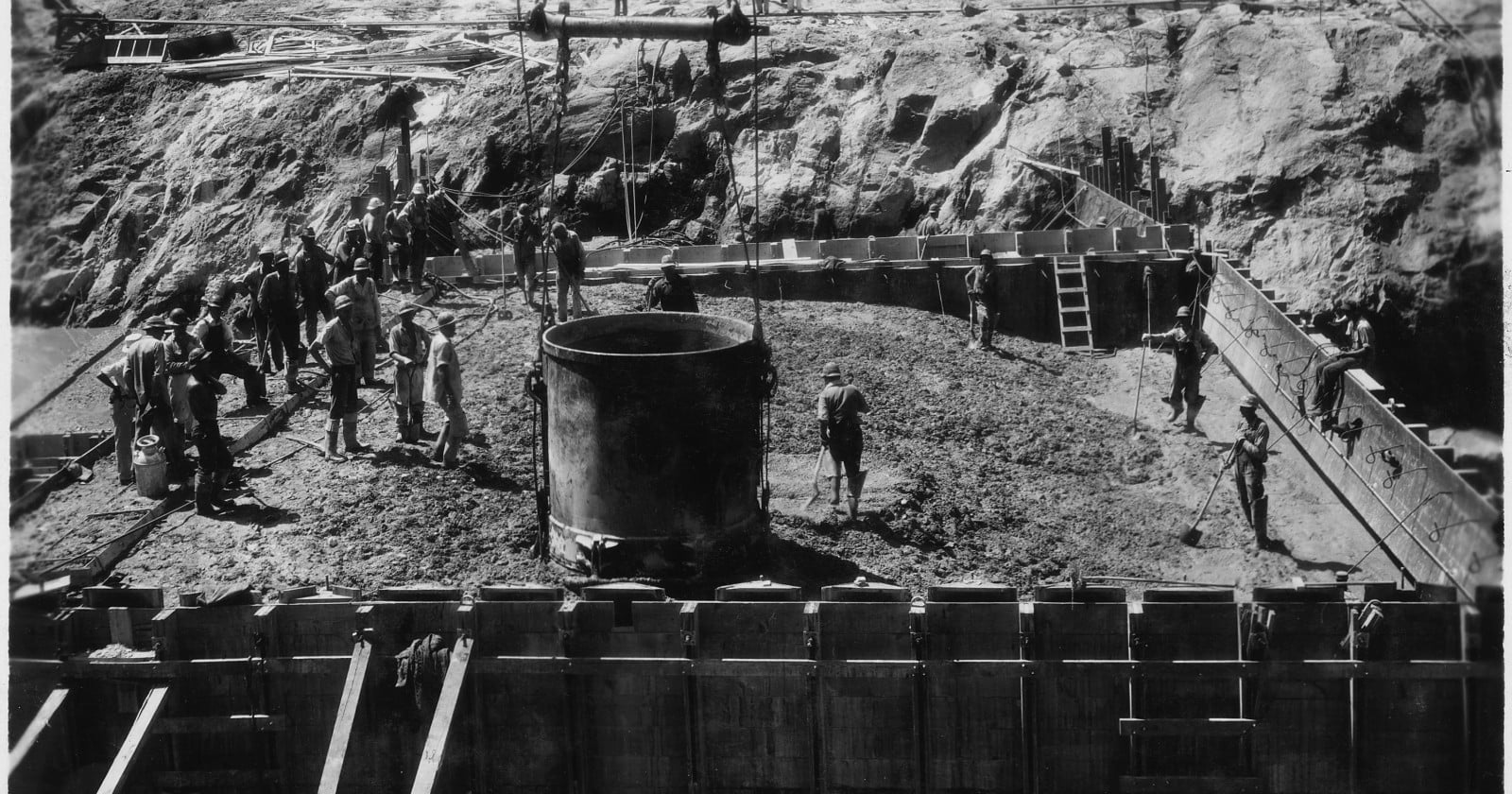
A bucket holding eight cubic yards of concrete swung out over Black Canyon on a cable, dropped into a form, and opened. Seven men went in after it with shovels, rubber boots and pneumatic vibrators, spreading a mix so dry that it would take its initial set inside the bucket if the crane operator was slow. Threaded through the form, waiting, were coils of one-inch steel pipe.
The pipe was there because Bureau of Reclamation engineers had worked out what would happen if the dam were built the obvious way. Their calculation is published in Reclamation’s own account of the construction. A single continuous pour would have got so hot, it says, that the concrete would have taken 125 years to cool to the temperature of the air around it. The resulting stresses would have cracked the dam and crumbled it away. So the dam went up as a stack of separate columns instead, each one chilled from the inside while it set.
Heat with nowhere to go
Concrete does not dry. It reacts, and the reaction gives off heat, and in a thin slab that heat leaves as fast as it arrives. In a mass the size of Hoover Dam there is nowhere for it to go. The centre of a large pour stays hot long after the surface has cooled, the two parts of the same block try to change size by different amounts, and the concrete tears itself.
Reclamation puts the scale of the heat in the only unit its readers would feel. If the heat produced by the curing concrete could have been concentrated in a baking oven, its page says, it would have been enough to bake 500,000 loaves of bread a day for three years.
Three and a quarter million cubic yards of concrete went into the dam itself, and more than five million barrels of Portland cement went into that concrete. During construction the daily demand ran from 7,500 to 10,800 barrels. For comparison Reclamation offers its own institutional history: in the 27 years of construction work before 30 June 1932, the whole agency had used 5,862,000 barrels.
A dam built as vertical columns
The solution was to stop treating the dam as one object. It was built as a series of individual columns, trapezoidal in shape, rising in lifts of five feet. Reclamation’s construction answers say the blocks varied in size from about 60 feet square at the upstream face of the dam to about 25 feet square at the downstream face. An estimated 215 blocks make up the finished structure.
Concrete placement in any one block was limited to five feet in 72 hours. That is a rate rule rather than a volume rule: it caps how fast heat can be added to any one part of the dam. Reclamation puts placement in the dam at roughly 160,000 cubic yards a month. The peak day was 10,462 cubic yards, a figure that includes some concrete placed in the intake towers and the powerplant, and the peak month slightly over 275,000 cubic yards.
Adjacent columns were keyed to one another as well as stacked. Vertical keys ran along the radial joints and horizontal keys along the circumferential joints, and the upstream and downstream faces of each block were formed with interlocking grooves. Reclamation’s own comparison for the arrangement is a giant set of Lego.
A number about a dam nobody built
The 125 years is the most quoted figure in this story, and what it measures is narrower than the retellings suggest. It describes cooling to the temperature of the surrounding air. It says nothing about when the chemical reaction inside the cement finishes, and the two are different processes running on different clocks.
It is also a calculation. Nobody poured Hoover Dam in a single lift and watched it cool. Reclamation’s engineers computed what would have happened if anyone had, and then designed the job so that nobody would. Reclamation’s construction answers record the cooling of the dam as completed in March 1935. That is about 21 months after the first concrete went into the dam on 6 June 1933, and two to three months before the last was placed on 29 May 1935. That timing is our arithmetic on Reclamation’s dates.
This matters because of what has grown up around it. The claim that the concrete in Hoover Dam is still curing today circulates widely, and it is not a claim either of these two Reclamation pages makes. The construction answers close the cooling programme in March 1935, the construction essay gives no completion date at all, and neither page follows the concrete past that point.
Two of Reclamation’s own figures also disagree with each other, on the same page. One answer gives 4,360,000 cubic yards of concrete in the dam, powerplant and appurtenant works; another, a few answers further down, gives 4,400,000 cubic yards of concrete placed. The gap is 40,000 cubic yards, and the two answers do not state identical scopes. The page does not reconcile them, which is why the figure used above is the narrower and consistent one, the 3.25 million cubic yards in the dam proper.
A third figure does not reconcile either. Set against its own 3.25 million cubic yards in the dam and its own placement dates of 6 June 1933 to 29 May 1935, Reclamation’s roughly 160,000 cubic yards a month works out nearer 137,000. The 137,000 is our arithmetic; the gap is Reclamation’s.
The 215 is looser than it looks. Reclamation describes the dam as built “in vertical columns of blocks” and then gives an estimated 215 blocks, while its construction essay describes columns rising in five-foot lifts. Neither page defines which unit the 215 counts, although it cannot be a count of five-foot lifts, since a single 726-foot column would take about 145 of those on its own. Both pages carry a last-updated date of 12 March 2015.
Ice water in thin steel pipe
Splitting the dam into columns slowed the heat down, and enough of it was still there to matter. Each form also carried cooling coils of thin-walled one-inch steel pipe, and Reclamation’s construction answers put the total embedded length at more than 582 miles.
The cooling ran in two stages. When a block was first poured, river water was circulated through its coils, which the essay calls a first initial cooling. Once that was done, chilled water from a refrigeration plant built on the lower cofferdam was circulated through the same coils to finish the job. Reclamation records that the plant could produce 1,000 tons of ice in 24 hours.
The 582 miles is a total of pipe embedded. The coils worked block by block and were retired block by block, so on the sequence Reclamation describes, coils were retired as each block finished; the pages do not say whether the whole network was ever in service at once.
The concrete itself had to be handled at a pace set by the same problem. A very dry mix was needed to reach the required strength, which left very little time to get it from the mixing plant into the form. If too much time was taken it set in the dump buckets and had to be chipped out by hand. That is why the men who operated the cranes moving the buckets into place were among the highest paid on the site at $1.25 an hour. Nine cableways carried the four and eight cubic yard bottom-dump buckets, five of them slung from movable towers so they could be repositioned to work on different parts of the dam when necessary.
Two mixing plants fed them. A river-level plant approximately three quarters of a mile upstream went into operation on 3 March 1932. Nearly all of its first year’s output, almost 400,000 cubic yards, went into the linings of the diversion tunnels. Later a fully automated plant on the canyon rim, capable of 24 cubic yards every three and a half minutes, produced everything placed above the 992-foot level.
Grout under 300 pounds of pressure
Cooling a block shrinks it, and the contraction opens gaps between the columns. Closing those gaps was the part of the design that turned the columns back into a dam.
As each block finished cooling, the pipes of its coils were cut off and pressure grouted shut at 300 pounds per square inch with pneumatic grout guns. Then a mixture of cement and water was forced into the spaces that the contraction of the cooled concrete had opened between the columns, bonding the separate blocks into what Reclamation calls a monolithic structure. The keys on the joints gave that grout something to grip.
The result is a concrete arch-gravity dam, carrying its water load by gravity action and horizontal arch action together. It weighs more than 6,600,000 tons, stands 726.4 feet from foundation rock to the roadway on its crest, and sits on rock of volcanic origin that Reclamation says is geologically called andesite breccia. At the base the maximum water pressure is 45,000 pounds per square foot. It was the first structure built by people to exceed the masonry mass of the Great Pyramid of Giza.
Contractors were allowed seven years from 20 April 1931. Concrete placement in the dam finished on 29 May 1935 and all features were complete by 1 March 1936. In total 21,000 men worked the site, an average of 3,500 at a time and a maximum of 5,218 in a single day in June 1934.
Reclamation’s own record of the cooling ends in March 1935, with the coils cut and grouted shut block by block and the last concrete still to be placed. Ninety-one years later the dam stands on its andesite with a maximum water pressure of 45,000 pounds per square foot at its base, and the pipes are still inside it. Is a mass of concrete that size ever finished?
