
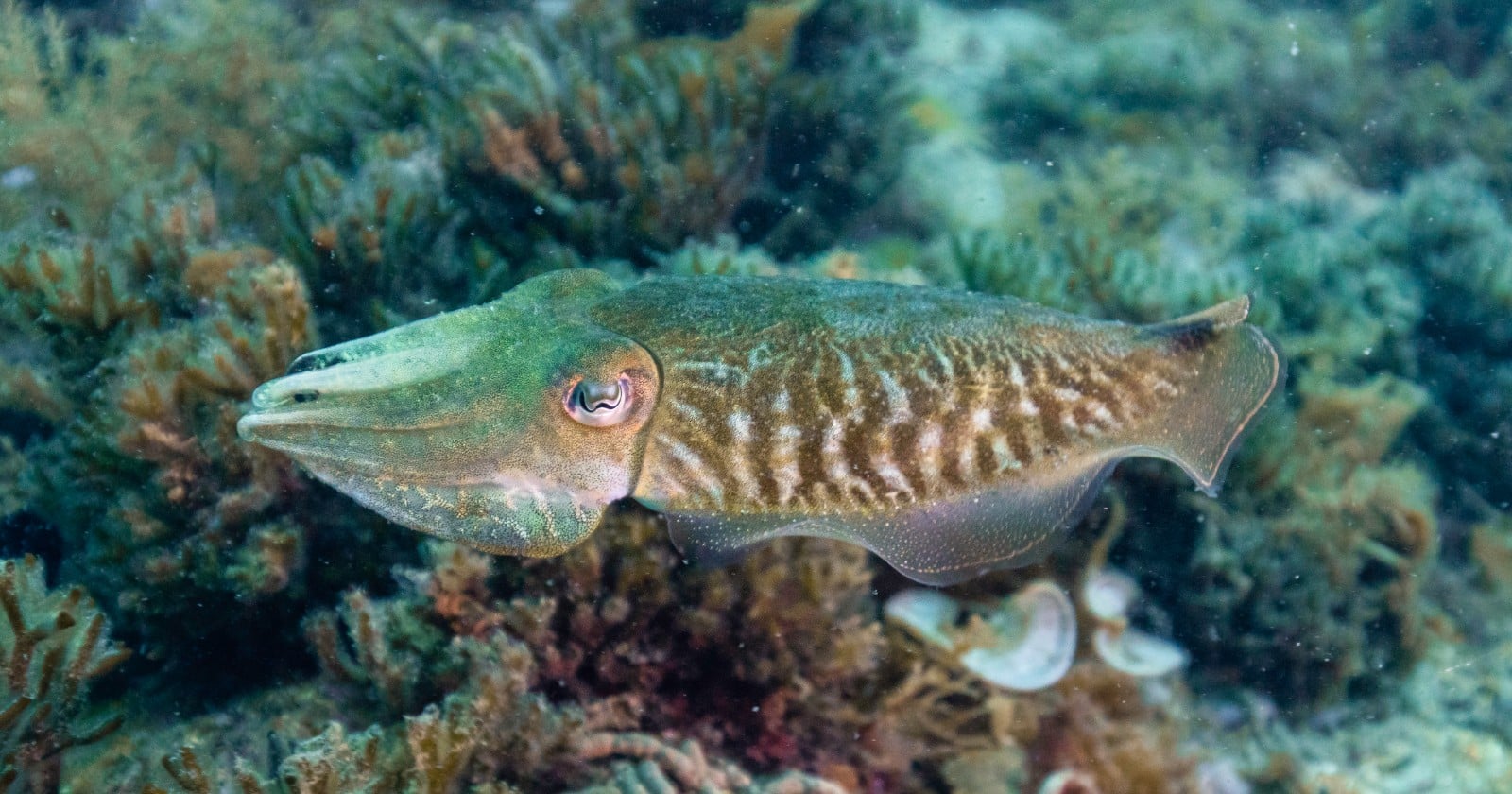
A common cuttlefish hovers at the far end of a glass aquarium, its skin rippling, two sealed drawers in front of it. One drawer holds a piece of raw king prawn, available right away. The other holds a live grass shrimp, the animal’s favorite, but the door will not open for another minute or more. The cuttlefish looks at the immediate snack, then turns its body away from it, and waits.
In a 2021 experiment, cuttlefish did this again and again, holding out for as long as 50 to 130 seconds to reach a better meal rather than settle for the mediocre one within reach. The behavior is a version of the marshmallow test, the classic measure of self-control once thought to mark out only large-brained animals such as apes and crows. And there was a second result the researchers did not expect: the individuals that waited the longest were also the ones that learned fastest in a separate task.
The work, published in Proceedings of the Royal Society B by Alexandra Schnell and colleagues, is the first time self-control and learning ability have been linked in any animal outside the primates. That it turned up in a cuttlefish, a soft-bodied mollusc more closely related to a snail than to a chimpanzee, is what makes it strange.
Inside the two-drawer test
Six sub-adult common cuttlefish, all about nine months old, ran through the task. Each animal first showed the team a clear ranking of its dinner options: live grass shrimp first, raw king prawn second, live shore crab a distant third. The experiment then pitted the top two against each other.
The immediate drawer always held the prawn, the less-preferred food, and it opened at once. The delayed drawer always held the shrimp, the favorite, and it opened only after a set wait that started at ten seconds and climbed in ten-second steps. The design’s key feature is easy to miss: the prawn stayed visible and reachable the whole time, so a cuttlefish could give up and eat it at any second. Waiting was therefore not a single up-front choice that locked the animal in. It was a continuous act of holding back, which is what the researchers were after. A one-time choice can be a guess or a preference; sustaining the restraint while an easy reward sits in plain view is closer to what people mean by self-control.
The cuttlefish sustained it. Their maximum waits ranged from just under a minute to a little over two minutes, depending on the individual, before they gave up and took the prawn. As the required delay grew longer, they grew more likely to cave, the same pattern seen in self-control studies of chimpanzees, parrots and corvids. Some animals even turned to face away from the tempting prawn while they waited, a trick that apes, dogs and grey parrots use to distract themselves. The team could not measure that behavior reliably, though, and treats it only as an observation.
The part that links waiting to learning
The second experiment set the food aside and tested how quickly each cuttlefish could learn a rule. The animals were shown two panels that differed in brightness, one of them rewarded, and had to work out which. Once an animal had it, the researchers flipped the rule, so the previously wrong panel became the right one, and timed how long it took to catch up.
The faster learners and the longer waiters were the same animals. An individual’s average waiting time tracked closely with how quickly it mastered both the first rule and the reversal. In humans and chimpanzees, self-control and general intelligence rise together, and here that coupling appeared in a mollusc. The researchers describe the evidence for the link as moderate rather than overwhelming, a distinction worth keeping in mind, but the direction was consistent across the six animals.
Why a creature like this would ever need patience
In apes and crows, self-control is usually explained by their social and foraging lives. Animals that share food, cooperate, use tools or hide caches for later have obvious reasons to resist an immediate grab. Cuttlefish do almost none of that. They live less than two years, burn energy fast, hunt alone, store nothing and do not cooperate with their own kind. The standard explanations do not fit them.
The team’s suggestion is that the patience grew out of how cuttlefish eat. In the wild they spend long stretches motionless and camouflaged, waiting in ambush, then strike in short bursts when prey drifts close. An animal built to sit still and pick its moment may already carry the machinery for holding back a response. If so, patience in the ape and patience in the cuttlefish would be a case of convergence rather than shared inheritance. Their last common ancestor lived more than 500 million years ago, so two very different kinds of life would have arrived at the same ability on their own.
The limits of a six-animal result
The finding rests on six cuttlefish of a single species, a small group by any measure, and the study does not claim otherwise. Its headline comparison, that cuttlefish match some large-brained vertebrates, is about the length of the waits, not a broader verdict on intelligence.
There is a subtler caveat the authors raise themselves. Both tasks were taught through association, the animal learning which cue or drawer pays off, and association alone can look like self-control without being it. The researchers argue their design guards against that reading, because the animals faced fresh choices at new delay times that had never been rewarded or punished, so the restraint was not simply a trained habit. That argument is reasonable, but it is an argument, not a closed case, and the paper says as much.
The phrase “marshmallow test” also does more work in headlines than in the lab. This was a delay-of-gratification task modeled on the human version, a loose analogy rather than the same experiment, and nothing in it shows a cuttlefish consciously planning or imagining a future meal. What it shows is that the animal will forgo a sure thing, while that sure thing sits in front of it, to get something better. Whether that reflects anything like deliberation is a separate question the study does not try to answer.
Even read at its most cautious, the finding moves a line. Self-control had been catalogued mostly in the animals people already expect to be clever. Finding it in a mollusc, with a nervous system built nothing like a mammal’s, and finding it tied to how fast that mollusc learns, says less about cuttlefish in particular than about how often, and along how many unrelated branches of life, the ability to wait has quietly appeared.
