
Two trillion, and most of them out of sight
In 2016 a team led by Christopher Conselice at the University of Nottingham put the number of galaxies in the observable universe at about two trillion, roughly ten times the figure astronomers had been working with. The twist sits inside the result: the great majority of those galaxies are too faint for any telescope now operating to detect.
The paper states it plainly. There are “at least 2 × 10¹² (two trillion) galaxies in the currently visible universe, the vast majority of which cannot be observed with present day technology as they are too faint.” In other words, the count is less a tally of dots in our images than an estimate of how many dots the images are missing.
How you count galaxies you cannot see
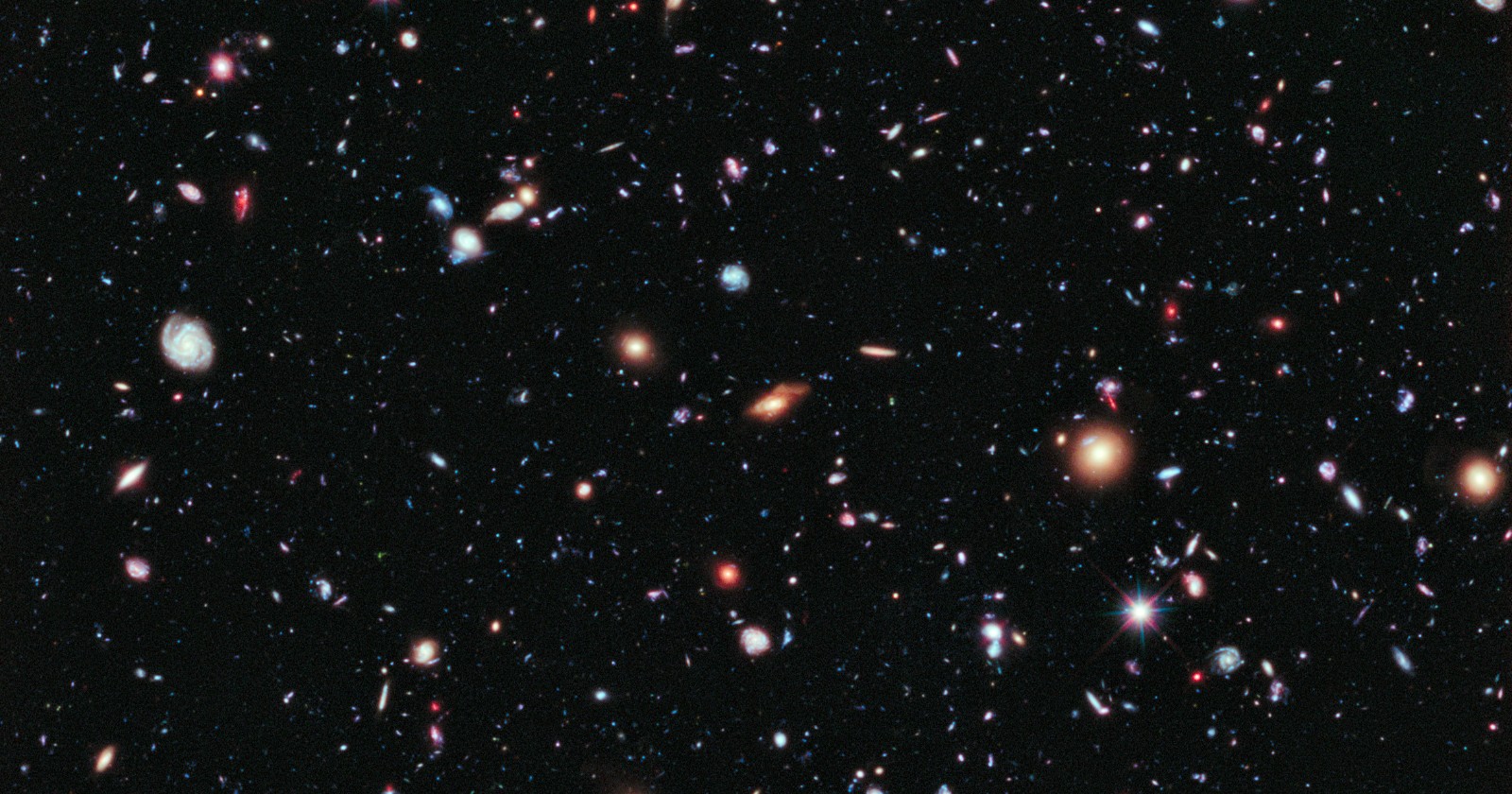
The team did not add up galaxies one by one. Instead they used galaxy stellar mass functions, which describe how many galaxies of each mass exist in a given slice of space. They measured these at many points in cosmic history, reaching back to within roughly 650 million years of the Big Bang. Much of the deep data came from the Hubble Space Telescope, whose narrow, long-exposure images act like core samples drilled through the universe.
Fitting those measurements with a standard mathematical curve, the researchers worked out the density of galaxies at each epoch, then integrated across the whole observable volume and the whole age of the universe. The arithmetic ran down to galaxies as small as a million times the mass of the Sun, faint dwarfs that no survey can see at great distance.
Working with colleagues at Leiden Observatory in the Netherlands and the University of Edinburgh, the team turned narrow, deep images of the sky into three-dimensional maps. From those they measured the volume and the galaxy density of one small slice of space after another. Conselice likened the effort to an intergalactic archaeological dig, a way of estimating how many galaxies had been missed rather than counting the ones already on the photographic plates. The faintest galaxies the model implies would shine at around magnitude 29 on the astronomers’ brightness scale, far below the reach of the unaided eye and beyond all but the deepest exposures ever taken.
Two independent versions of the calculation gave 1.2 trillion and 2.8 trillion. The University of Nottingham reported the averaged figure of two trillion as the headline result, the product of what Conselice described as roughly fifteen years of work.
“We are missing the vast majority of galaxies because they are very faint and far away,” Conselice said when the study appeared. “It boggles the mind that over 90 percent of the galaxies in the universe have yet to be studied.”
The early universe was more crowded
The count is high partly because the young universe was busier than the present one. When the team tracked how galaxy numbers changed over time, the trend ran backward. A given volume of space held about ten times more galaxies when the universe was a few billion years old than it does today.
That sounds backward, since the universe has only grown older and larger. The explanation is that small galaxies have spent billions of years merging into bigger ones, so the population thins even as individual galaxies grow. Most of the missing multitude are low-mass systems, no larger than the dwarf galaxies that orbit the Milky Way, and they are exactly the ones too dim to register at great distance.
Why the number jumped tenfold
Before this work, the count was usually put in the hundreds of billions, with the often-quoted figure around 100 billion. Even careful counts from the deepest direct images, such as the Hubble Ultra Deep Field, reached only a couple of hundred billion galaxies. The 2016 model put the true total at almost ten times that direct-count number, roughly two trillion. That implies about ninety percent of galaxies are fainter than current telescopes can register, below an apparent brightness of about magnitude 29.
That gap is not just bookkeeping. The number of galaxies feeds into the total amount of starlight filling space, and into the centuries-old puzzle known as Olbers’ paradox, which asks why the night sky is dark if the universe is full of stars. A sky packed with two trillion galaxies might seem to make the paradox worse, not better.
The team’s answer is that the light of those distant galaxies never reaches us at full strength. Most of it is absorbed by gas in intergalactic space, and the expansion of the universe stretches the rest toward redder, fainter wavelengths. So the universe can be far more crowded than telescopes show while the night sky stays dark, with most of its contents waiting in the gloom for sharper eyes.
What this does and does not prove
The two-trillion figure is a model-dependent extrapolation, not a head count, and the authors are careful about its limits. The result hinges on two choices: the smallest galaxy mass they counted and the earliest epoch they reached. They note that pushing the mass limit lower would multiply the total by about seven, which is why they frame two trillion as a floor rather than a ceiling.
The bigger caveat arrived later. In 2021 a team used NASA’s New Horizons spacecraft, far enough from the Sun to escape the dust glow that brightens the sky near Earth, to measure the cosmic optical background, the summed light of all galaxies. From out there the sky was about ten times darker than the darkest view Hubble can manage. The researchers argued in public that the faintness of that glow points to a total closer to the hundreds of billions than to trillions. “We simply don’t see the light from two trillion galaxies,” one of them, Marc Postman, told reporters.
So the famous number is one side of an open argument, the high end of a range that newer data has pulled downward. What survives the dispute is the underlying lesson rather than the digit: most of the universe’s galaxies, on any of these estimates, are fainter than we can currently observe.
A number that keeps moving
The galaxy count has climbed and fallen as instruments changed, from a few hundred billion in the 1990s to two trillion in 2016 and back toward the hundreds of billions in the New Horizons reading. Each revision says as much about the reach of the telescope as about the universe itself.
That may be the honest takeaway. The number of galaxies is not a settled fact carved into the sky but a running estimate, one that shifts every time a new instrument sees a little deeper into the dark.
