
For five years, the leading story about Kamoʻoalewa, a small asteroid that travels alongside Earth, was that it might be a stray piece of the Moon. A new peer-reviewed study argues it is probably something far more ordinary: a fragment of a distant asteroid family, weathered until its surface only looks lunar.
The timing is sharp. On or around June 7, after a 13-month cruise, China’s Tianwen-2 spacecraft slipped into orbit around Kamoʻoalewa, a maneuver tracked by independent radio astronomers even before China’s space agency formally confirmed it. Sample collection is expected within weeks. The asteroid that may decide a long-running debate about its own origin is now being circled by the machine built to bring a piece of it home.
Why the Moon theory took hold
Kamoʻoalewa was found in 2016 by the Pan-STARRS survey in Hawaiʻi, and it is one of a small set of asteroids called quasi-satellites: rocks that orbit the Sun but stay close enough to Earth to seem like loose companions. This one is the most stable of the bunch, expected to linger near us for a few hundred years. It is small, somewhere between roughly 40 and 100 metres across, and it spins fast, turning about once every 28 minutes.
Quasi-satellites are faint and awkward to observe, which is part of why this one drew such outsized attention once a clue to its makeup appeared. It sits close, it stays put for centuries, and it is bright enough to study with large telescopes during its annual passes. For an object that might preserve a record of the early Solar System, that combination is rare.
In 2021, astronomers reported that its reflected light was a closer match to lunar-like silicates than to any common asteroid type, with an unusual extra redness. That resemblance was the spark for the lunar-fragment idea. A 2024 study went further, proposing a specific birthplace: the young Giordano Bruno crater on the Moon’s far side, from which an impact could have flung debris into an Earth-like orbit.
It was a tidy and romantic picture. A souvenir of the Moon, looping around its parent planet, waiting to be collected.
What the new study actually did
Writing in Nature Communications, a large international team led from the Chinese Academy of Sciences reopened the case from three directions. First, they reanalyzed the asteroid’s spectrum and pinned down a key absorption feature at a wavelength of 1.001 micrometres, a value they report as consistent not with lunar material but with LL chondrites, a common type of stony meteorite.
Then they tested whether ordinary meteorite could be made to look like Kamoʻoalewa. In the lab, the team blasted LL chondrite samples with laser pulses to mimic space weathering, the slow darkening and reddening that solar wind and tiny impacts inflict on any airless surface over millions of years. Heavily weathered chondrite powder, they found, reproduced the asteroid’s spectrum. Solid chips of the same meteorite did not.
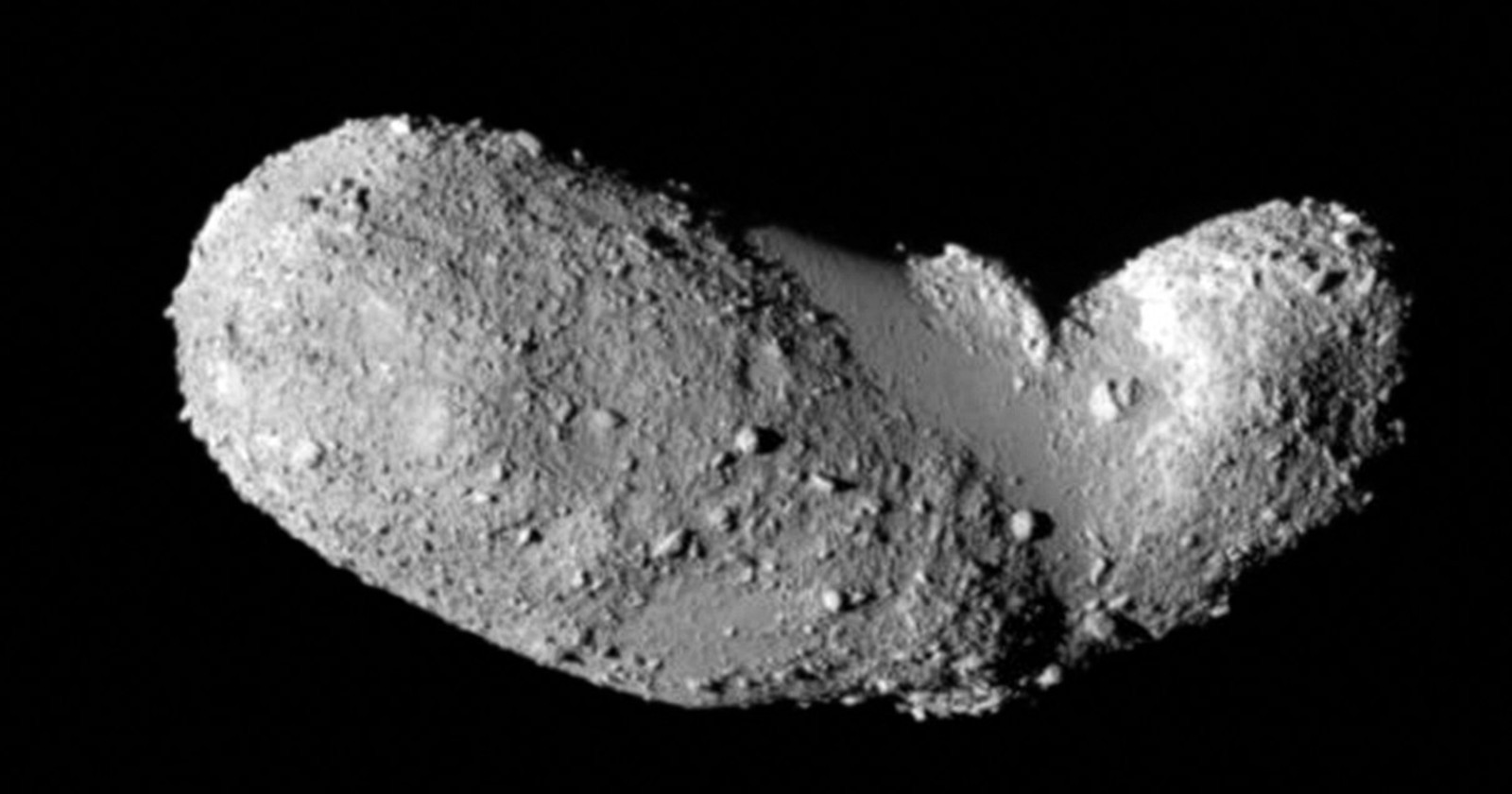
Finally, they traced where such an object could have come from. Their modeling points to the ν6 secular resonance, a gravitational escape route in the inner asteroid belt, and more specifically to the Flora family, a cluster of asteroids born from an ancient collision. Kamoʻoalewa’s makeup, they write, resembles the well-studied asteroid Itokawa and seven Flora-family members, only more weathered.
The resonance matters because it offers a plausible delivery route. Rocks that drift into it can have their orbits stretched until they cross Earth’s path, which is one way an inner-belt fragment could end up as a quasi-satellite rather than a lunar one. The argument, in short, is that you do not need the Moon to explain Kamoʻoalewa. An ordinary asteroid nudged out of the Flora family and aged in sunlight can account for the same colour, the same orbit, and the same odd companionship with Earth.
Why a powder, not a slab, is the key detail
That powder-versus-chip result is the quiet heart of the paper. A fresh asteroid surface and a deeply weathered one can be the same rock and still reflect light differently, and grain size matters as much as chemistry. The team’s reading is that Kamoʻoalewa is coated in fine, long-exposed dust, which is exactly what would redden an ordinary asteroid until its colour drifts toward the lunar range.
If that holds, the redness that first suggested the Moon is not a fingerprint of lunar rock at all. It is what time does to a small, slow-tumbling asteroid that has been left out in the solar wind for ages. The comparison with Itokawa carries weight here, because Japan’s Hayabusa mission already returned grains from Itokawa and confirmed it as an ordinary chondrite body. The new study places Kamoʻoalewa in that same broad company.
What this does and does not prove
This is a competing explanation, not a verdict. The authors are careful to say Kamoʻoalewa probably came from the Flora family, and the hedge is doing real work. Reflectance spectra are notoriously slippery; weathering, grain size, viewing angle and composition can all nudge an asteroid’s colour in similar directions, which is why two capable teams can look at the same faint object and reach different conclusions.
The lunar-origin case has not been withdrawn, and the dynamical argument for a recent lunar escape still has its defenders. It is also worth noting that the new paper is an early-access version of an accepted manuscript, released ahead of final editing, so small details may still change. What the study does is weaken the single strongest pillar of the Moon theory, the matching red spectrum, by showing that a plain meteorite can be pushed to look the same.
In other words, the resemblance to the Moon is real. The new work simply argues it is a coincidence of weathering rather than a sign of shared birth.
The sample that will end the argument
What makes this debate unusual is that it has an expiration date. Most arguments about an asteroid’s origin are settled, if at all, by ever-finer remote measurements. This one will be settled by holding the rock.
The stakes are not trivial. If the grains turn out to be lunar, Kamoʻoalewa becomes a free sample of the Moon’s far side, delivered to Earth’s neighbourhood without a crewed landing. If they are ordinary chondrite, the asteroid becomes a well-preserved relic of the early Solar System and a test case for how badly space weathering can disguise a familiar rock. Those are two very different prizes, and the same capsule settles which one we get.
Tianwen-2 is expected to collect material from Kamoʻoalewa within weeks and send a capsule back toward Earth in 2027, after which the spacecraft heads onward to a comet. A returned sample can be measured for the isotopes and minerals that distinguish lunar rock from a chondrite asteroid, the kind of test no telescope can perform from afar. For once, a question about where a space rock came from will be answered by the rock itself, and the answer is already on its way.
