

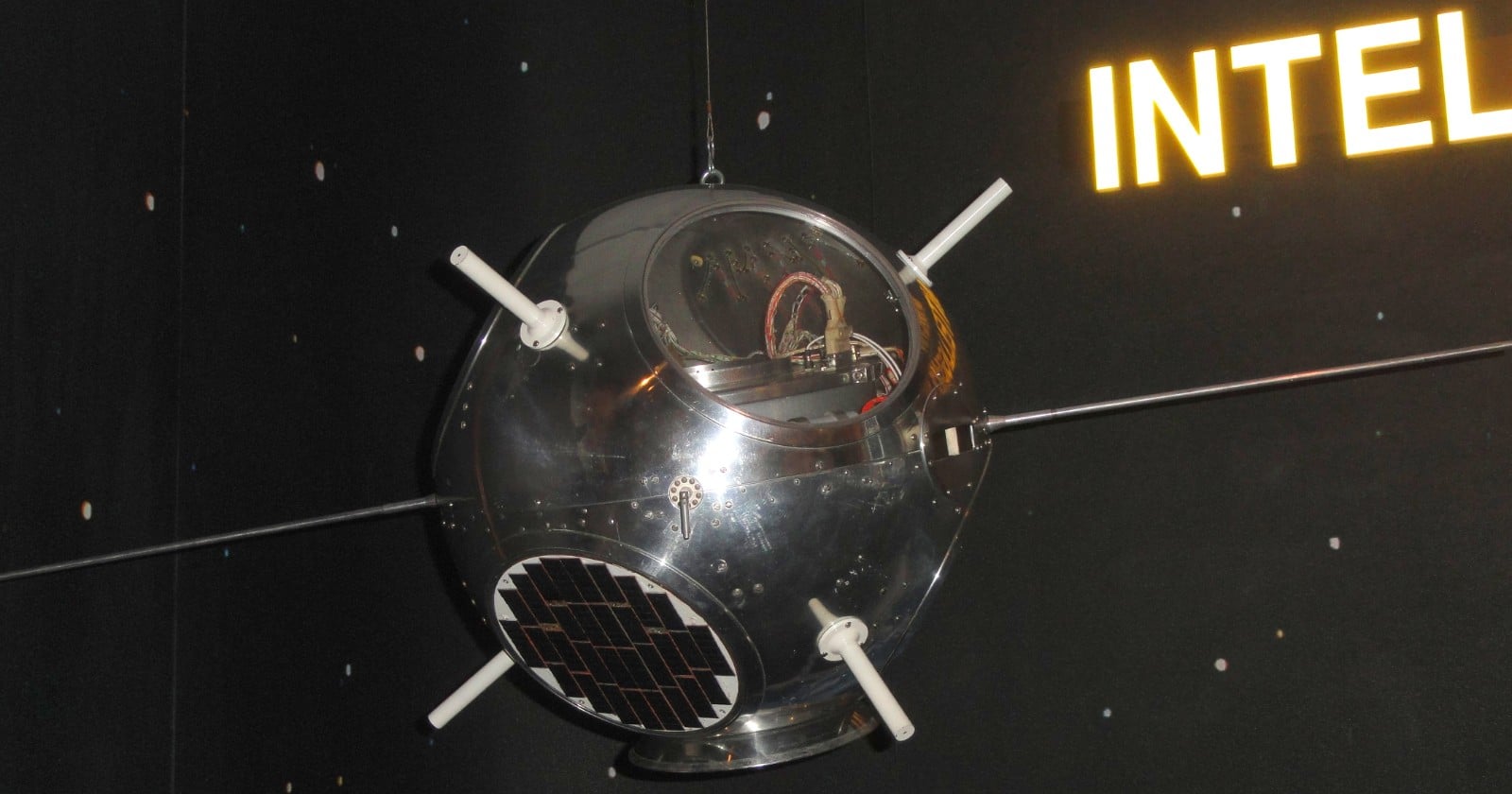
The National Reconnaissance Office has published its own account of how the United States put a reconnaissance satellite in orbit before anyone else, and the pamphlet opens on a claim it makes in one sentence: “The United States was the first nation in space with a reconnaissance satellite,” and “that satellite, designed to intercept Soviet radar signals, was a 20-inch-diameter metal ball packed with electronic equipment.” The satellite launched on 22 June 1960. Its classified name was Tattletale. Its public identity was a scientific experiment, and that experiment was real.
The pamphlet also records where the idea came from, and it is not a laboratory. A research engineer at the Naval Research Laboratory named Reid D. Mayo was stranded in a Pennsylvania restaurant during a March blizzard, where, in the document’s words, “he pondered the application to space reconnaissance of crystal video technologies he had developed for submarines.” He “penciled range calculations on a paper placemat and determined that such a system could in fact intercept Soviet radar signals up to an altitude of 600 miles.”
The pamphlet dates the concept to 1958 and the satellite’s development to “early 1958,” and gives the blizzard only as “a March blizzard,” with no year. If that storm was March 1958, the launch came two years and three months later.
From a periscope receiver to a twenty-inch sphere
The document is precise about what Mayo was actually asking. He “wondered if the submarine periscope system could be modified so that a solid-state version of this intercept system could be mounted in a 20-inch solar-powered Vanguard satellite.”
The Vanguard bus is the point: he was not proposing a new spacecraft, but a solid-state version of a receiver he already knew, riding in a sphere of an existing design. The pamphlet says nothing about whether such a sphere was already in orbit when he sketched the idea.
Back in Washington he took it to Howard Lorenzen, chief of the laboratory’s countermeasures branch, described in the same document as “in the front rank of the nation’s electronic warfare program.” Lorenzen “agreed it could work and championed the idea within the Department of Defense and the Intelligence Community.”
The names multiplied from there, and they are easy to tangle. The classified project was Tattletale, later Canes. The satellite is better known by the acronym of the thing it was pretending to be.
The cover story was a real experiment
Grab stands for Galactic Radiation and Background. The cover mission carried other names first: the pamphlet says it “initially was referred to as Galactic Energy Balance-Experiment (Greb-E) and later became known as SolRad.” The single load-bearing sentence about it in the NRO’s account insists the cover was not a fiction: “The Greb/SolRad cover mission was a real scientific experiment whose purpose was to measure solar radiation (Lyman-alpha and X-ray).”
It had a working programme behind it. The solar mission “focused on the effect of solar radiation on high frequency (HF) communication propagated via ionospheric reflection.” Navy scientists “discovered that solar flares produced ionospheric disturbances, such as sudden short wave fading and cosmic noise absorption.” The work also had a practical purpose in view: the data “would be used to predict propagation conditions for HF communications.” The laboratory went on to build Navy and NASA satellites “dedicated to solar radiation measurement and related experiments,” and applied the SolRad name backwards onto Greb, the progenitor.
The deception therefore ran the opposite way from the way deception usually runs. There was no fabricated science. The programme the public was told about was doing real work with a practical use in view, while the classified project quietly intercepted Soviet air-defence radar. The pamphlet does not describe how the two shared the hardware, and says only that the satellites “featured ELINT antennas” plus “a larger and separate turnstile antenna” that “received commands, transmitted telemetry, and transmitted ELINT data.”
What the claim covers, and what kind of document says so
What the pamphlet records is worth quoting, but only alongside a description of where it comes from.
The pamphlet’s own claim is carefully bounded, and its footnote hands the more famous record to somebody else: “Corona, a joint CIA and USAF project with its first successful mission on 18 August 1960, was the world’s first imagery satellite reconnaissance system.” Grab was first as a reconnaissance satellite, and specifically as a signals collector. It was never the first satellite to photograph anything, and the pamphlet does not say it was. Nor does the pamphlet present Grab as the only option available after the U-2 came down; it lists Grab and its successor Poppy “along with their imagery cousin, Corona,” as the means then to hand.
The document was produced by the NRO’s Center for the Study of National Reconnaissance for a September 2005 ceremony that honoured alumni of the Poppy programme. Its preface says the history “represents the scope of programmatic details that former Director of Central Intelligence George Tenet authorized the Director of National Reconnaissance to declassify,” and that it was prepared “based in large part on early draft manuscripts researched by” five earlier agency researchers, supplemented from the centre’s own reference collection. It carries a reference list, and that list includes unpublished institutional material. What it does not do is tie any statement about Grab or Poppy to a specific record: no footnote among its fourteen identifies a specific file, message or interview, the closest being one that gestures at “classified NRL and NRO historical records,” and the only document a footnote names by title is a 1946 RAND report cited for background.
Its figure references also point in the wrong direction. The body says the Air Force launched Grab 1 and sends the reader to a figure whose caption identifies the vehicle as carrying Grab 2. The body says Grab 1 “launched in ‘piggyback’ fashion with a second satellite, Transit 1B,” and sends the reader to a figure whose caption describes a different launch entirely, Grab 2 mated with Injun and Transit 4A. Both of those may be correctly captioned photographs of the wrong launch rather than errors of fact.
One mismatch is a straight internal contradiction. Poppy 1’s launch is 13 December 1962 in the body and again in the appendix, and 12 December in a figure caption. Two smaller wobbles sit alongside it: a footnote announces “four alpha-designated programs areas” and then lists three, and the acronym itself alternates between “Galactic Radiation and Background Satellite” and “Galactic Radiation and Background.”
The placemat is not among the wobbly parts. It appears once, in a single sentence, with no competing version anywhere in the document. But a launch date or an acronym drawn from this pamphlet alone should travel with the pamphlet’s own inconsistency attached to it.
Eisenhower approved it twice
The approval chain in the document is short and pointed. “President Eisenhower approved full development of Grab on 24 August 1959; four days after the U-2 shootdown, he approved the first Grab launch.”
The pamphlet dates the shootdown of Francis Gary Powers’ aircraft to 1 May 1960 and places the launch approval four days after it. It never prints that second date.
The context explains the hurry. The laboratory “had completed its development of the Grab satellite system by the time” Powers was shot down. Eisenhower then “cancelled all further U-2 overflights of the Soviet Union,” and, in the pamphlet’s phrasing, “in order to access the heartland of the Soviet Union, the U.S. had to turn to space.”
A proposal from a man with a placemat had become urgent.
Tapes dispatched from the huts to NSA and SAC
Grab relayed rather than stored. When a ground radar “emitted its pulsed-radar signals above the horizon,” the satellite “collected each pulse of a radar signal in a specified bandwidth and transponded a corresponding signal” down to laboratory receiving and control huts inside its field of view. The huts’ antenna masts held “two upper bays of 10-element yagi antennas that received telemetry (108 MHz)” and “four lower bays” that “transmitted commands and received ELINT (139 MHz).”
Staff at the huts “recorded data from the satellites and then dispatched tapes with these data, initially to NRL, and then to the National Security Agency (NSA) and the Air Force Strategic Air Command (SAC).” Grab 1’s “initial collection of data on 5 July 1960 far exceeded Mayo’s expectations,” thirteen days after launch. It operated for three months. Grab 2 went up on 29 June 1961, began collecting on 15 July and ran for 14 months. By October 1961 the NSA had built an automatic system to speed up processing.
What the intelligence bought is stated plainly. Before these satellites, technical intelligence on Soviet air-defence radar came from aircraft and ground sites, “often limiting collection to radar sites less than 200 miles inside the Soviet Union.” Grab and Poppy “dramatically increased the capability of U.S. intelligence to acquire ELINT data deep within the Soviet Union.” The take also gave the Strategic Air Command “characteristics and locations of air defense equipment to support building the U.S. Single Integrated Operations Plan,” the American nuclear war plan.
It never quantifies that increase. A text search of the document turns up no figure for intercepts, for radars located or for data volume. Its language about yield is qualitative throughout: the first take “far exceeded Mayo’s expectations,” the data kept the intelligence analysts at the National Security Agency “busy until the next mission,” and Grab 2 “produced a large volume of radar intercept data.”
The programme that vanished into Program C
The flight record is thinner than the achievement sounds. “The NRL attempted five Grab missions between 1960 and 1962; two were successful.” The appendix dates three failures to 30 November 1960, 24 January 1962 and 26 April 1962, the last of them on a Scout from Point Arguello. The body’s separate count of “two unsuccessful attempts at a third Grab mission” refers to the two 1962 failures; the November 1960 failure fell between Grab 1 and Grab 2, so the two counts reconcile. The appendix offers nothing against each of the three but “Failure,” and no failure mode appears anywhere in the document. In 1962 the new National Reconnaissance Office “assimilated NRL’s ELINT satellite activities and associated multi-agency infrastructure” into its Program C, and Poppy took over, flying seven times through December 1971.
The fact of the ELINT mission stayed classified for a long time after that. Measuring from the pamphlet’s own date for the concept, 1958, the Director of Central Intelligence authorised the release of limited information about Grab forty years later, in 1998, timed to the laboratory’s 75th anniversary. Poppy waited until May 2004.
The story therefore ends back at the restaurant table it started from. Mayo’s placemat arithmetic said a receiver of that kind could pick up Soviet radar from as high as 600 miles up. The sphere that carried it operated for three months, its twin for fourteen, and three more launches failed. The document never returns to the 600-mile figure, and it never says what altitude the satellites actually flew. What it does record about that placemat is that the idea it produced was taken up by the chief of the countermeasures branch, who “agreed it could work” and “championed the idea within the Department of Defense and the Intelligence Community,” and that President Eisenhower approved full development of Grab in August 1959.