
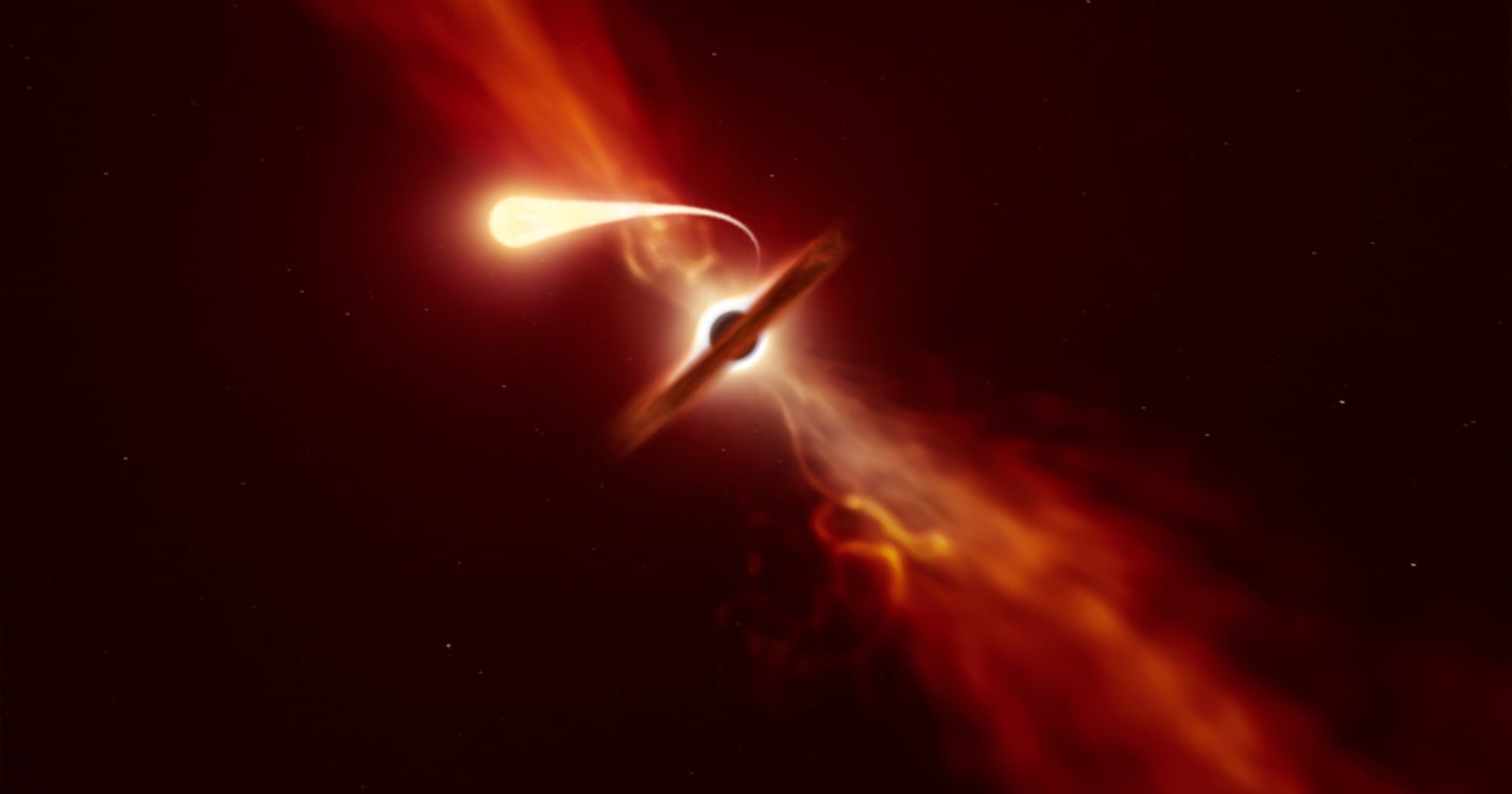
A bright blue point of light sits off to one side of a massive quiescent galaxy, well outside its bulge, in a patch of sky where archival survey images show nothing down to about 24th magnitude. The point of light is a star being torn apart, and the black hole tearing it apart lies 9.5 arcseconds from that galaxy’s center, a projected 9.3 kiloparsecs, which works out to about 30,000 light-years.
Astronomers have catalogued roughly 200 of these flares, called tidal disruption events, and the great majority turned up in optical sky surveys pointed squarely at galactic centers. That is where black holes heavy enough to shred a star are known to live. This one is not at a center, and the team that found it, led by Robert Stein of the University of Maryland and NASA’s Goddard Space Flight Center, reported TDE 2025abcr on 27 July in The Astrophysical Journal Letters as the first optical tidal disruption event discovered in the outskirts of a host galaxy.
The galaxy it appears to belong to is WISEA J014656.04-152214.7, at a redshift of 0.0498. The cosmology the paper assumes puts that roughly 720 million light-years away.
How anyone knows a star was eaten
A flare in the outskirts of a galaxy is exactly where a supernova would be expected, so the classification had to be earned.
Nine spectra were taken over six weeks at six facilities, from the Palomar 60-inch through the 4.1-metre SOAR telescope and the Nordic Optical Telescope up to the 10-metre Keck I. They show a blue continuum with broad hydrogen and helium emission lines at the galaxy’s redshift, which places the object in the class the field labels TDE-H+He. The lines run narrow for that class, around 2,500 kilometres per second against a median nearer 10,000 in a 16-object comparison sample, a width the paper flags as unusual while noting that a few comparison objects match it.
Timing is what closed off the supernova possibility. An automated comparison found a single match for the late spectrum, a pre-peak spectrum of a Type IIn supernova showing what is called a flash ionisation feature. Features of that kind rarely survive ten days, and seeing them a full month after peak would be completely unexpected.
Swift’s X-Ray Telescope added something a supernova does not do. Soft X-rays were already present at the telescope’s first look, roughly five days before optical peak, then dropped by a factor of about three in some four hours, a collapse the paper calls exceptional. X-ray emission from interacting supernovae tends to run hard, in contrast to the soft emission here, and the brief X-ray flashes core collapse can produce arrive within minutes of the explosion.
A harder X-ray component did stay constant throughout. At Swift’s angular resolution the team cannot rule out that most of it comes from the host galaxy rather than from the flare.
An active galactic nucleus is excluded on four counts, among them the absence of any point source at that position in archival imaging down to an absolute magnitude of minus 12.8. A luminous fast blue optical transient is excluded because this flare runs an order of magnitude fainter than any known example and evolves far more slowly.
The summary is firm and precisely bounded: the observations “confirm unambiguously that the source is indeed a TDE rather than an AGN flare or SN.”
That firmness does not extend to the more interesting question.
The shape of the flare
The flare rose over about four weeks to a peak on 14 November 2025 and has been fading slowly since. At peak it reached an apparent g-band magnitude of 18.9, faint enough that the automated programs which skim the brightest transients for follow-up passed it over.
A blackbody fit to the ultraviolet and optical points gives a peak temperature of 30,220 kelvin, give or take 2,120, around 53,900 degrees Fahrenheit. The inferred peak bolometric luminosity is 4.7 times ten to the 43rd power ergs per second, roughly 12 billion times the Sun’s output.
Against other tidal disruption events, though, this one is dim. Its peak absolute magnitude of minus 17.6 leaves it fainter than 93 percent of the comparison sample, and the paper calls it notably underluminous. For this interpretation the dimness helps, since a black hole out in the suburbs should be lighter than the giant at a galaxy’s core, and a lighter black hole makes a fainter flare.
Where these numbers are thin
Start with the offset, since it is the figure in the headline. The 9.3 kiloparsecs is a projected separation, measured on the plane of the sky, so the true distance between the black hole and the galaxy’s center can only be larger. The discovery paper publishes no uncertainty on it. A separate team, working from later JWST and Keck observations and posting a preprint that has not yet been peer reviewed, measures the same separation as 9.08 kiloparsecs give or take 0.02, a shade under 30,000 light-years, and reads an infrared excess at the position as an underlying star cluster, which would favour the stripped-dwarf history over ejection without closing it off. What the figure does support is a comparison: the Sun sits about 8.2 kiloparsecs from the center of the Milky Way, so this black hole is further out from its galaxy’s center than we are from ours.
The mass is softer. It comes from a scaling relation between peak g-band luminosity and black hole mass, and that relation carries an intrinsic scatter of 0.53 dex. No dynamical measurement exists. Unpacked, the one-sigma range on this black hole runs from about 360,000 to about 4.2 million solar masses, a span of more than an order of magnitude. “About a million times the mass of the Sun” is the middle of a wide bracket, and it can be pinned down later by watching the late ultraviolet and optical plateau the flare should settle onto.
The word “first” needs its adjective kept. This is the first tidal disruption event an optical survey has found out in a galaxy’s outskirts. Off-nuclear events discovered in X-rays already sit further out, at 12.5 and 34.7 kiloparsecs in the paper’s own comparison table. The paper claims no distance record, and its own table would not support one.
The word “wandering” gets scare quotes in the abstract, which calls this “this apparent ‘wandering’ black hole.” The hedge does real work, because the surviving stripped-dwarf scenario would mean the black hole is not wandering anywhere. It would be sitting where it has always sat, at the heart of a galaxy being disassembled around it.
NASA’s own write-up of the discovery rounds the flare’s temperature to 30,000 degrees Celsius and drops the give or take of 2,120 kelvin the paper prints alongside it. The same release says the flare outshone its entire host galaxy in ultraviolet light, and no such comparison appears anywhere in the paper.
One absence matters more than any of that. When the earlier off-nuclear event AT 2024tvd was studied, radio emission from its host galaxy’s central black hole was detected, which confirmed the nucleus still had an occupant and the offset object was a second one.
Nothing was detected in radio here, from either position, so the team cannot prove a black hole is still present at the center of this galaxy. That limit rests on a single observation two days before optical peak, and AT 2024tvd was invisible in radio early on too before brightening months later.
Getting a black hole to the suburbs
A tidal disruption event marks the position of a massive black hole the way a flare marks a position on a map. Something heavy is out there. The question is how it arrived, and the paper lays out five candidate histories:
- an inspiralling black hole from a major merger of two comparable galaxies
- an inspiralling black hole from a minor merger with a much smaller one
- a black hole from an earlier merger, kicked out of the nucleus by a three-body gravitational encounter
- a recoiling central black hole, ejected from a nucleus that would now be empty
- an intermediate-mass black hole living inside a globular cluster
Three of the five fail on arithmetic. The galaxy’s own central black hole is estimated at roughly 660 million solar masses from one scaling relation and about four times that from a second, while the black hole that shredded this star comes out near a million. A major merger and a recoil both require those two figures to describe the same object. The globular cluster option fails from the other direction, since a cluster faint enough to escape detection in archival imaging should host a black hole of at most tens of thousands of solar masses, well short of what this flare implies.
The two survivors have one affirmative clue between them. Residuals from the galaxy model show a visibly disturbed morphology in the bulge, the kind of thing a merger leaves behind for something like a billion years. So the black hole may have been thrown out of the core by a three-body encounter, which would make it a genuine wanderer. Or it may still be at the center of a small galaxy that the big one is swallowing, one whose stars have been stripped away so thoroughly that nothing shows up in the archival images.
What a deep image will show
Flares like this one cannot be common. The paper holds the rate of highly offset events under 10 percent of the rate at galactic centers, while its abstract expects many dozens a year once the Vera C. Rubin Observatory is surveying. A first case tends to arrive shortly before a population.
The test for this particular black hole depends on the flare going away. Once TDE 2025abcr has faded, a deep image of that same patch of sky will show either a very faint smudge or nothing, and the paper says that finding nothing there would push it toward the ejection story.
A smudge would mean the black hole still sits at the heart of a small galaxy being pulled apart around it. An empty frame would mean it was thrown clear of a much bigger one.
