
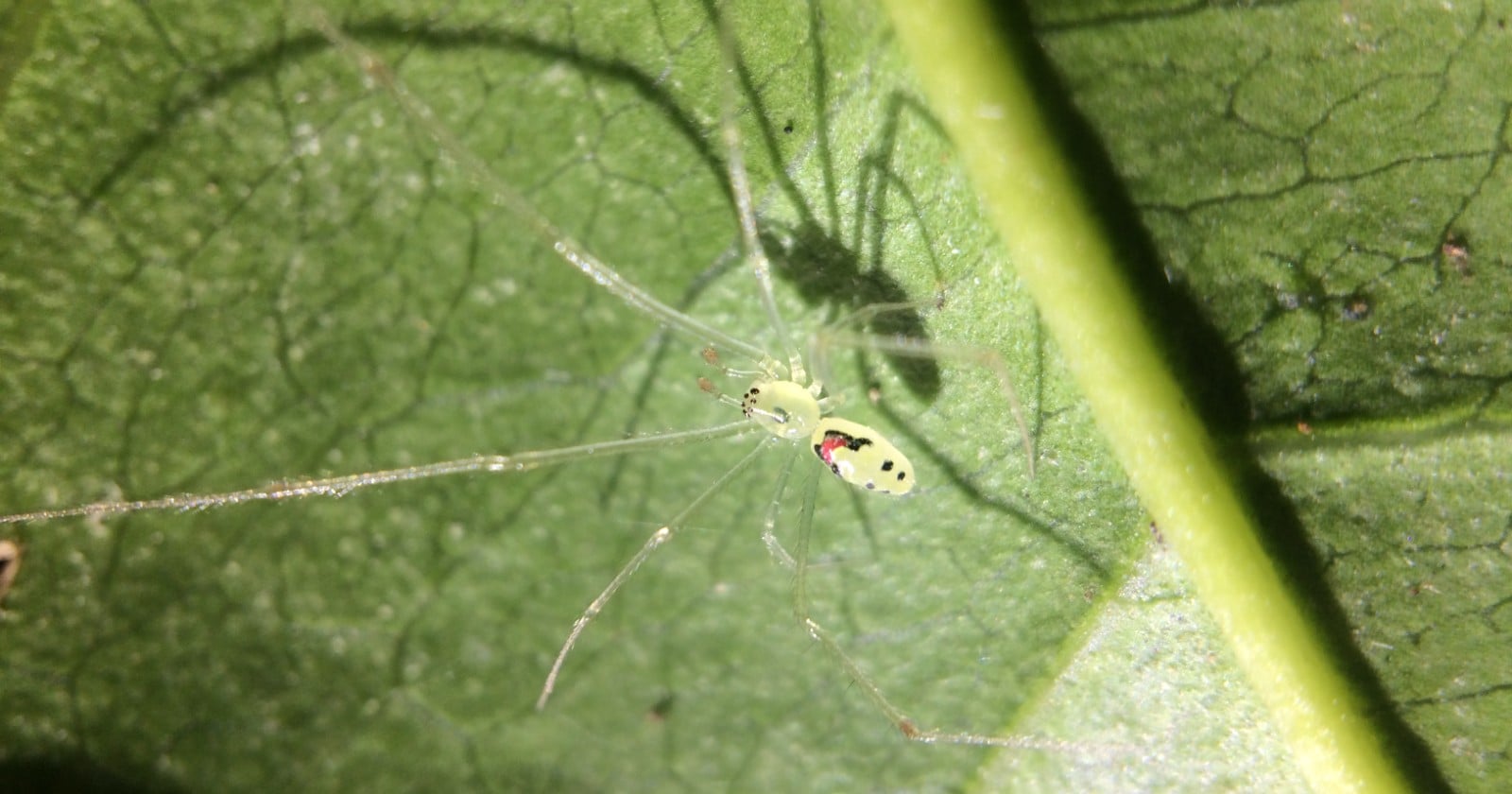
On the underside of a leaf more than two kilometers up in the mountains of Uttarakhand, a tiny spider carries a bright smile on its back. Two dark dots for eyes, a red curve for a mouth, the whole cartoon face painted across its abdomen. It is the same expression that made the Hawaiian happy-face spider one of the most recognizable arachnids on Earth, and for more than a hundred years that face was thought to belong to Hawaii and nowhere else.
That century-old assumption has just broken. Writing in the open-access journal Evolutionary Systematics, two Indian researchers have described the smiling spiders of the western Himalayas as a species new to science, Theridion himalayana. A stretch of its DNA sits about 8.5 percent away from the Hawaiian happy-face spider, Theridion grallator, a gap wide enough to mark it as a separate lineage that grew up on its own side of the world. The grin has a second home.
A spider found while looking for ants
The discovery was an accident. Devi Priyadarshini of the Regional Museum of Natural History in Bhubaneswar and Ashirwad Tripathy of the Forest Research Institute in Dehradun were surveying high-altitude ants when Tripathy began sending images of spiders from the mountains for identification. One photograph, taken from beneath a Daphniphyllum leaf, stopped Priyadarshini cold. She had seen the Hawaiian happy-face spider during her master’s studies, and the resemblance was immediate.
The pair collected specimens across the 2023 and 2024 field seasons, working three sites in Uttarakhand named Makku, Tala, and Mandal, all above 2,000 meters. What they found was not a single look but a wardrobe of them. The paper documents 32 distinct color forms, or morphs, in a palette of red, black, and white, with the dots and lines arranged into different versions of the same smiling motif. Both males and females carry the polymorphism, and like their Hawaiian counterparts the spiders build small webs and hang upside down beneath the leaves they live on.
Confirming that all that variation belonged to a single species took more than photographs. Priyadarshini identified the specimens and carried out the dissections and the molecular work, both authors added scanning electron microscopy of the finer anatomy, and the paper closes with a dichotomous key to the Theridion species so far described from India, a step-by-step guide the next surveyor can use to separate this smiling spider from its plainer relatives. In the field the spiders kept to the undersides of leaves, where the team photographed one immature female gripping a booklouse, a speck-sized insect, as prey.
For Priyadarshini the discovery was also an opening. High-altitude forests differ so sharply from the lowland plains in their plants and their terrain that she had long wanted to comb them for polymorphic spiders, and the Himalayan happy-face spider, she said, felt like a gateway to whatever else those mountains are keeping.
The species name honors the mountains that shelter it. The authors chose himalayana, they wrote, for the range that holds so much of the country’s biodiversity, and they note this is the first polymorphic spider of its kind recorded from the region.
One gene, one lineage, and the gaps
The case for a new species leans almost entirely on one mitochondrial gene. The team read a stretch of DNA called COI, the standard barcode for telling animal species apart, and compared the Himalayan spiders against relatives from Asia and the Americas. Against the Hawaiian happy-face spider the difference came to roughly 8.5 percent, and the paper describes the new species as phylogenetically isolated from its relatives across Eurasia and North America.
That is enough to say the Himalayan spider is not simply a wandering population of the Hawaiian one. It is a distinct lineage that evolved in Asia. But a barcode is a narrow instrument. It measures how far two lineages have drifted apart; on its own it does not reconstruct the branching order of a family tree or date when the paths split. The authors keep their language measured, calling the divergence moderate and the spider’s position isolated without fixing it to a particular branch.
So the solid part and the open part sit side by side. The DNA establishes that the smile now has at least two separate owners. How it came to have two is a different question, and the genetics alone cannot answer it.
Why two spiders share a face
Two spiders separated by the width of a hemisphere wear nearly the same face, and no one can yet say why. One reading is that each lineage evolved the pattern on its own, two distant species arriving at the same design. The paper raises that possibility directly, listing the parallel evolution of color polymorphism among the questions its find opens.
The authors also leave room for the opposite. Priyadarshini has wondered whether the Himalayan spider might be, in her phrase, an elder cousin of the Hawaiian one, which would make the shared smile something inherited from a common ancestor rather than invented twice. The current data cannot decide between those stories, and the researchers say tracing any missing links is work still ahead.
Even the purpose of the pattern is unsettled. The marks are assumed to help the spiders survive, perhaps by breaking up their outline against a predator’s view, but why a single species should carry so many versions of the same face is what Priyadarshini calls a deeper genetic mystery. The Hawaiian species has drawn decades of study and still holds some of its color secrets. The Himalayan spiders arrive with the same open file.
One more overlap deepens the puzzle. The Himalayan spiders turn up again and again on ginger plants of the genus Hedychium, the same plants the Hawaiian happy-face spider favors. The two do not share a habitat, and ginger is not native to Hawaii, yet both animals keep choosing the same kind of plant to live on. The authors note the coincidence, flag it as a thread worth pulling, and leave it for later work.
What the western Himalayas have handed science, then, is a face it already knew on an animal it did not, and a set of questions sharper than the answers. Wider surveys of these high forests will likely turn up more morphs, and perhaps the relatives that would show at last whether the two smiles are cousins or coincidence. So far the grin has kept that to itself.
