
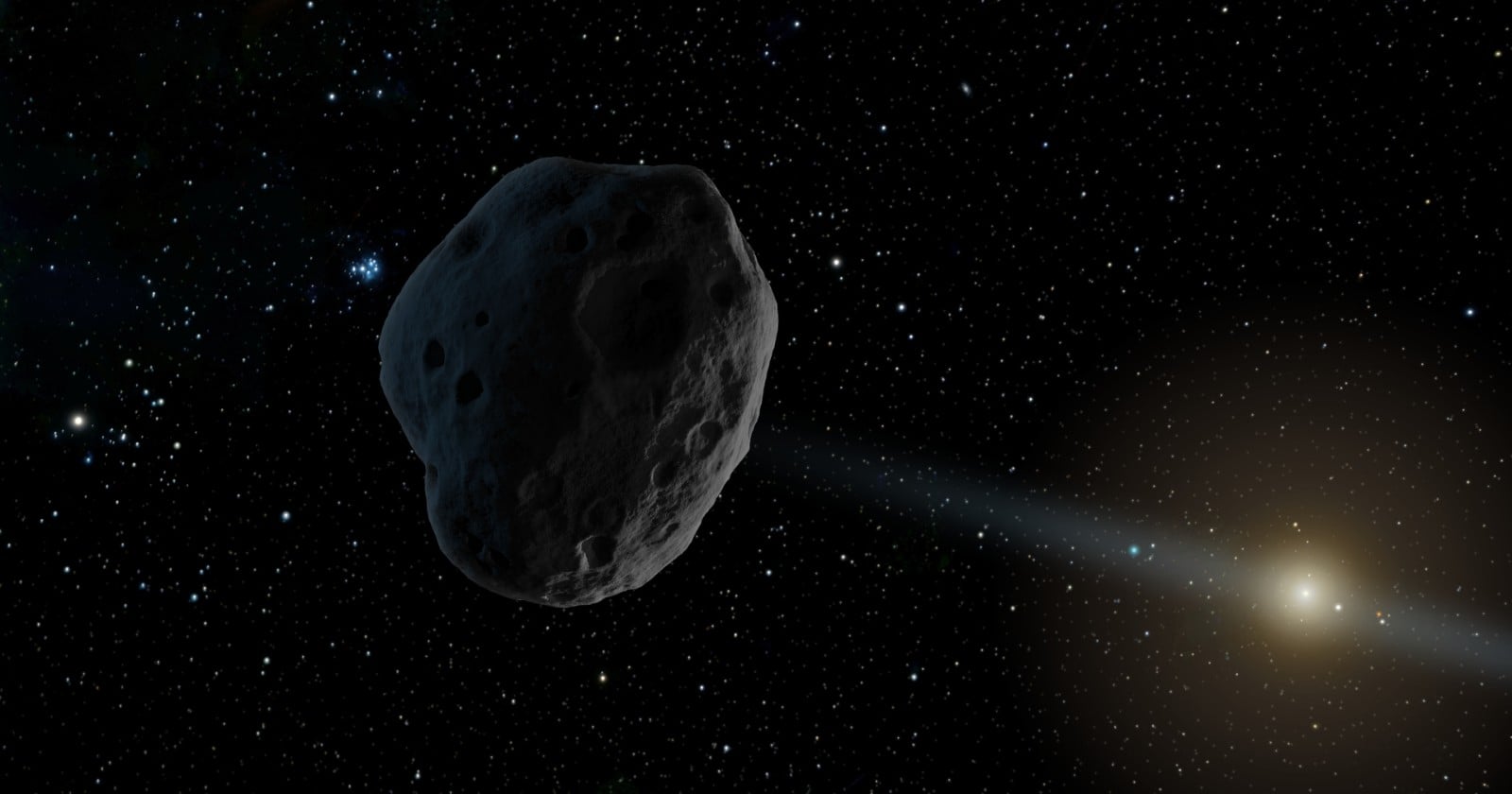
The radar team at NASA’s Goldstone complex knew exactly where to point. Their target, a near-Earth object called 1998 SH2, had been discovered in 1998 and tracked until 2016, and in late August 2025 it was passing within 0.02 astronomical units of Earth, about 3 million kilometers. The 70-meter antenna swept the predicted position, and the echo never came back.
The reason, published this month in Nature Astronomy, is that 1998 SH2 is not the asteroid everyone had assumed. It is a comet, leaking just enough gas to push itself measurably off the orbit that gravity alone would carve, while producing a tail so faint that no survey telescope had ever registered it. The Minor Planet Center has now given the object a second identity, the comet designation P/1998 SH2, and the discovery marks a first: no comet had ever before been identified from perturbations in its motion and only then confirmed by targeted imaging.
A miss measured in arcseconds
The object had failed to appear in the radar beam on August 26, 2025. The answer came from the optical sky: on August 31, an observatory in Serra da Piedade, Brazil, recovered 1998 SH2, providing the first tracking data since 2016. It sat 153 arcseconds from the gravity-only prediction, roughly a tenth of the full Moon’s width, a 19-sigma offset that explained the failed radar detection.
Something had been steadily steering the object between observations. The team, led by navigation engineer Davide Farnocchia of NASA’s Center for Near-Earth Object Studies at the Jet Propulsion Laboratory, fit a small transverse acceleration to the full 1998 to 2025 data arc and measured it at about 1.4 hundred-billionths of a meter per second squared.
That number carried the argument. Sunlight can nudge asteroids too, through an effect called the Yarkovsky effect, in which a rotating body absorbs sunlight and re-radiates it as heat unevenly. But for an object of this size, the largest push the Yarkovsky effect could plausibly supply is about ten times smaller than what was measured. The remaining explanation was the one comets use: ice warming in sunlight, turning to gas, and venting into space like a thruster too gentle to see.
The tail in the big telescopes
A prediction that specific invites a test. The Asteroid Terrestrial-impact Last Alert System, a survey network built to spot incoming objects, collected 53 images of 1998 SH2 from early September into early October 2025, and in every one of them the object looked like an ordinary dot, indistinguishable from an asteroid.
The big telescopes told another story. On September 17, the 3.6-meter Canada-France-Hawaii Telescope on Maunakea recorded a low-surface-brightness tail stretching about 20 arcseconds westward. On September 30, the European Southern Observatory’s 8-meter Very Large Telescope in Chile captured a long, narrow tail of its own, and a re-examination of images taken on September 13 and 14 with the 1.54-meter Danish Telescope at La Silla showed the tail was already in those frames. A faint halo of dust, a coma in miniature, extended at least 10 arcseconds around the nucleus.
“The images we collected from these observatories showed a weak but clear tail, thus confirming that 1998 SH2 is, in fact, a comet,” said Olivier Hainaut, an astronomer with the European Southern Observatory and a coauthor of the study.
There was a radar postscript, too. When Goldstone re-aimed on September 2 using the corrected orbit, an echo came back within two minutes. At an estimated 380 meters across, the study reports, 1998 SH2 is the smallest comet ever observed by radar, and its surface reflects radio waves weakly in a way that resembles comet nuclei more than typical asteroids. Infrared measurements had already hinted at an outsider: the object is dark, reflecting only about 6 percent of the sunlight that hits it, which fits comets as well as several dark asteroid types.
Measured motion, inferred ice
The drift in the sky is measured. The tail is photographed. Much of the rest of the story is careful inference, and the paper is explicit about which is which.
The water figure comes from a model. If the acceleration is driven by water vapor, the required production rate works out to roughly 1.2 septillion molecules per second, but the paper reports no direct detection of water or any other gas at 1998 SH2. The dust analysis, likewise, infers grains of about 400 micrometers from the tail’s shape rather than from samples, and the idea that the ice sublimates below the surface rests on the timing of the activity, which picked up weeks after the object’s closest pass by the Sun, together with laboratory simulations of how buried ice ejects large particles.
The images constrain the activity to a window from late August into September 2025 and cannot say when it began or whether it has happened before. Even the apparent brightening of the coma across September, from a 0.06-magnitude excess to 0.24, comes with a stated alternative: part of that rise could be the spin of the nucleus rather than growing activity. The evidence establishes something smaller and still remarkable, a real tail on an object filed as an asteroid for 27 years.
An asteroid catalog with comets hiding in it
The reclassification lands in a live debate about so-called dark comets, objects that accelerate like comets while looking like inert rock. Since the first was recognized in 2016, fourteen near-Earth objects have been identified as inactive yet subject to perturbations seemingly inconsistent with the radiation forces that nudge asteroids, split into two families: small ones on orbits near Earth’s, and larger ones, hundreds of meters across, on elongated orbits like those of Jupiter-family comets.
1998 SH2, which loops around the Sun roughly every four and a half years, belongs with the second group, and the study’s authors argue that many of its siblings could turn out to be ordinary comets awaiting a sufficiently deep image. One precedent already exists: the object 2001 ME1 was caught outgassing in archival spacecraft images years after its odd motion was flagged. The puzzle extends all the way to the interstellar visitor ‘Oumuamua, which accelerated without any detected tail and inspired years of competing explanations.
The census makes the stakes concrete. As of late 2025 there are 2,009 known near-Earth asteroids on comet-like orbits by one standard dynamical measure, and 285 of them, including 1998 SH2, are classified as potentially hazardous asteroids, meaning orbits that come within 0.05 astronomical units of Earth’s and estimated sizes of at least 140 meters. For 1998 SH2 itself the paper is plain that the probability of an Earth impact over the foreseeable future remains zero. The concern lies with the wider category: a comet’s outgassing perturbs its path more strongly than sunlight perturbs an asteroid’s, so any hidden comets in that group have futures slightly blurrier than their catalog entries suggest, and comets differ from asteroids in ways that would shape a deflection mission like NASA’s DART.
The team’s answer is the method this discovery just validated. Track everything, fit the orbits precisely, and let the misbehavior of a single point of light tell you what it is. “That’s how science works,” Hainaut said. “You form a hypothesis, and you set out to test it.”
