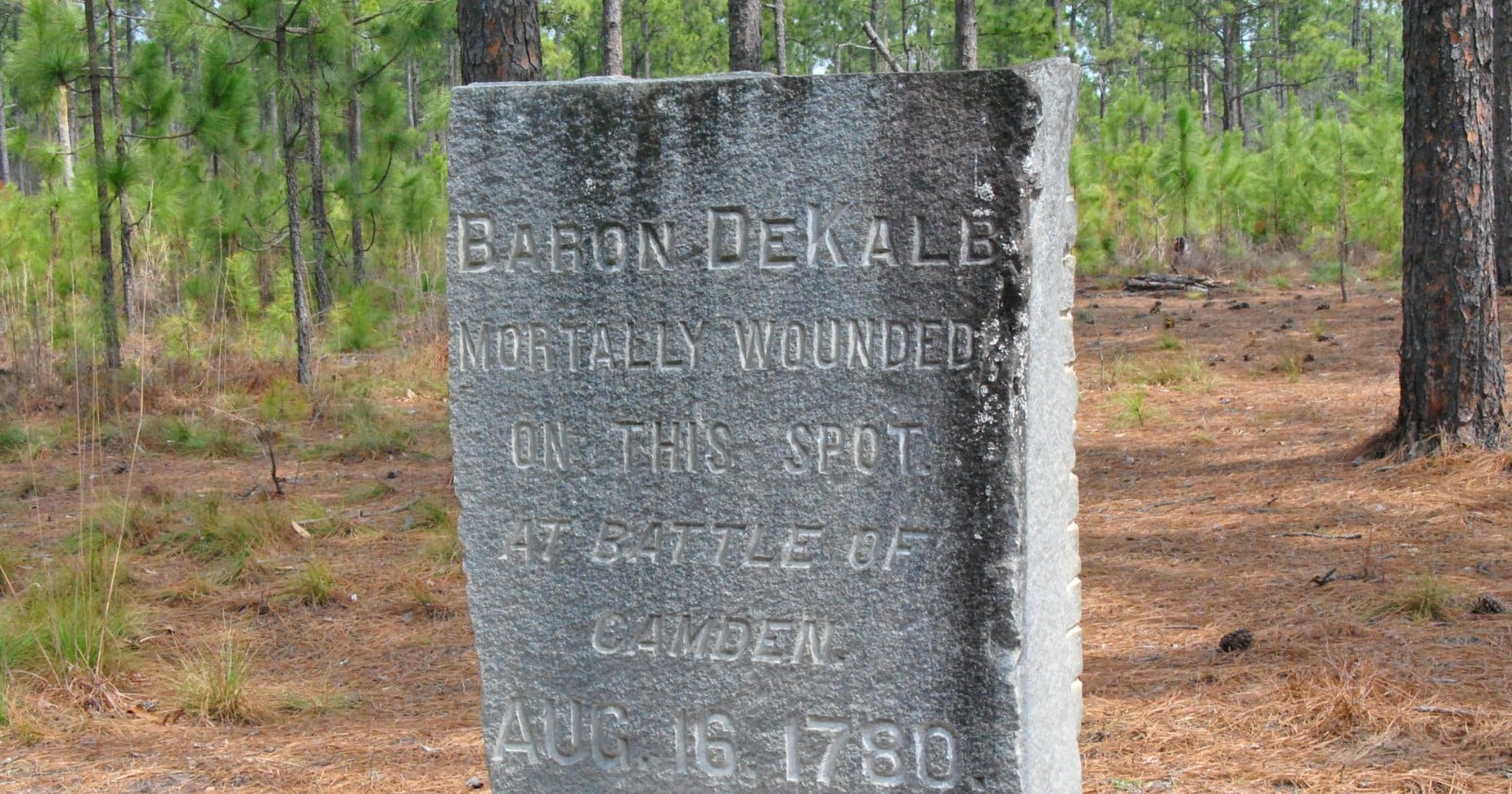
The grave was about 14 inches deep and no more than four feet wide when archaeologists reached it in 2022, and it held five soldiers. Working the Camden battlefield in South Carolina, they widened the opening and found what the South Carolina Battleground Preservation Trust’s account calls “not one, not two, but a total of five soldiers”. They were known as Camden 9A through 9E, and Continental USA buttons and other artifacts identified them as Continentals.
On 18 June 2026, in Baltimore, one of those five got his name back. FHD Forensics, a Texas forensic genetic genealogy company, told a small gathering of his relatives that Camden 9B had been Private John Pumphrey of Anne Arundel County, Maryland, killed at the Battle of Camden on 16 August 1780. The DNA came from a fragment of his skull.
The dig that lifted them
The recovery began as a rescue. The late Doug Bostick, then executive director of the Battleground Preservation Trust, pushed to lift soldiers from graves that the Trust says were threatened by erosion and other hazards, and the project went into the ground in the autumn of 2022.
The plan was to open six graves.
Eight were found and excavated, and they held fourteen soldiers: twelve who fought for the new republic and two who fought for the king. Steve Smith, a research professor at the South Carolina Institute of Archaeology and Anthropology, and James Legg, a public archaeologist there, have worked the Camden battlefield for nearly thirty years. They located Pumphrey’s remains in 2020 and lifted them two years later. Dr Madeline Atwell and Dr William Stevens of the Richland County Coroner’s Office worked the recovery and performed the examinations.
They had not expected names. “We were aware that unmarked graves were present on the site,” Legg said, “but we had no notion that there was any prospect of identifying anyone.”
The fourteen were honoured in April 2023, at Bethesda Presbyterian Church in Camden and at the battlefield itself. The Continentals were laid to rest in the Presbyterian Burial Grounds, which the historic Quaker Cemetery in Camden manages, beneath headstones the Trust describes as marked Unknown.
The record is not tidy here. FHD Forensics dates the reburial to 2024 in its press release and to 2023 on its project page. The Trust’s June 2026 dispatch places the Continentals in the burial grounds, while the 2023 event material on the same Trust page had announced that the men would be reinterred in the locations where they were found on the battlefield. This account takes 2023, which both the project page and the Trust’s own 2023 event material give, and the burial grounds, which the dispatch gives.
The autosomal match was not enough
The ancient DNA was extracted and sequenced by Astrea Forensics in Santa Cruz, California. FHD, contracted by the Historic Camden Foundation, then had to reach living people whose DNA still carried a readable signal from a teenager who died in 1780, something its own project page describes as a dream it was chasing.
In December 2024 the team uploaded what it calls some of the oldest autosomal DNA profiles in the world to databases that allow this kind of matching. Autosomal matches are the ordinary currency of consumer genealogy, and because autosomal DNA is roughly halved with each generation, they thin out fast at this sort of distance.
Two other lines closed the case. FamilyTreeDNA facilitated a research upload of Pumphrey’s data to its database of users who had opted in to this kind of comparison. Separately, Cyndi Despault, FHD’s operations manager, says FamilyTreeDNA’s Y-DNA services were “crucial to our success at confirming this soldier’s surname”. Senior genetic genealogist Valerie Kemp found X chromosome connections running back to Pumphrey’s mother, the link credited with making the whole picture cohere.
The press release says three different types of DNA matching were required, without listing them as such. The upload is labelled autosomal only on the project page; the Y-DNA and X chromosome work appear in the release.
The boy the genealogy produced
The genealogy raised a question the team then had to answer. Its researchers traced Pumphrey’s ancestors to prominent founding families of Anne Arundel County, and then asked themselves, in the release’s words, “why a young boy from a prosperous family would have chosen to go to war”.
The answer they settled on is that he was orphaned. “Our soldier was orphaned at age 10, so it makes sense he would have journeyed to Baltimore to enlist in part for guaranteed clothes and food,” said Allison Peacock, the company’s president. FHD makes the orphan claim in three separate places, its release, its project page and Peacock’s own words in the university’s announcement, and the Trust’s account does not mention it at all. The age of 10 is the thinner part: it appears in that Peacock quote and nowhere else. Rebecca Hamilton, the project’s legal genealogist, interpreted colonial Maryland legal documents for the case, and those are the likely source of the age, though no document is cited.
The project page borrows a line from Caroline Cox’s Boy Soldiers of the American Revolution to put the difficulty: “Boys who died submitted no pension requests. They are harder for us to see.”
He enlisted on 5 January 1777 into Maryland’s 7th Regiment, and he fell three and a half years later. Reading the growth plates in his knees, Atwell and Stevens estimated that he was 13 to 15 years old when he joined, which would have made him one of the youngest members of the Maryland Line. He was still a teenager when he died.
By the Trust’s account, Rick Wise, who runs the Battleground Preservation Trust, emphasised the gravity of the moment when he travelled to Maryland to tell the family, noting that it was the first time in nearly 246 years the name Private John Pumphrey had been spoken out loud for his relatives to hear. Tears flowed from them as he detailed the harrowing experiences of Pumphrey and the Maryland troops, who marched at Brandywine, Germantown, Valley Forge, Monmouth Courthouse and Camden. He went on to describe how Pumphrey and his comrades held the line there against overwhelming odds.
The superlative and the villain
The press release calls the case “thought to be one of the oldest John Doe genetic genealogy identifications ever”. The project page puts the Camden work among “what are believed to be the oldest” such identifications in the United States. Peacock’s own blog post opens its title with “America’s oldest John Doe”, with no hedge at all.
One detail in the release goes further than the release supports. It says a man buried a few yards from Pumphrey carried Y-DNA that, passed down to his son, helped confirm the identification, and that this man’s paternal ancestor was “the family villain whose actions surely led to John Pumphrey dying in battle at such a young age”. The Y-DNA contribution is a claim about the investigation. The causal claim about the ancestor sits on Peacock’s own blog post, which the release points readers to instead of evidencing it.
The team did not know whether it would work
The reason this identification matters beyond one family is methodological. Investigative genetic genealogy is usually put to work on remains that are years or decades old, where the genetic distance to living relatives is short. Kemp says the team set out not knowing whether it could identify someone whose living genetic relatives would be, in her phrase, “so many generations distant”.
Legg’s assessment after the fact is the ambitious one. “It may be that nearly any ‘unknown’ remains from the Revolution, the Civil War, or later might be identified,” he said. That is a hypothesis about future cases, and it rests on a single success from an identification effort Kemp dates to 2023, carried by several funders and by stretches of work the team did unpaid.
Research on Camden 11A was scheduled to begin in July 2026. More than three hundred and thirty Continentals were among the roughly four hundred men the release says fell on the Camden battlefield that day, and the Trust says about four hundred still lie there in shallow unmarked graves.
“Beneath the marble headstones marked ‘Unknown,’ they waited,” the Trust wrote. The project counts hundreds of Pumphrey’s many times great nieces, nephews and cousins living today, and it was relatives of his who helped meet the final costs of the work that gave him his name.