
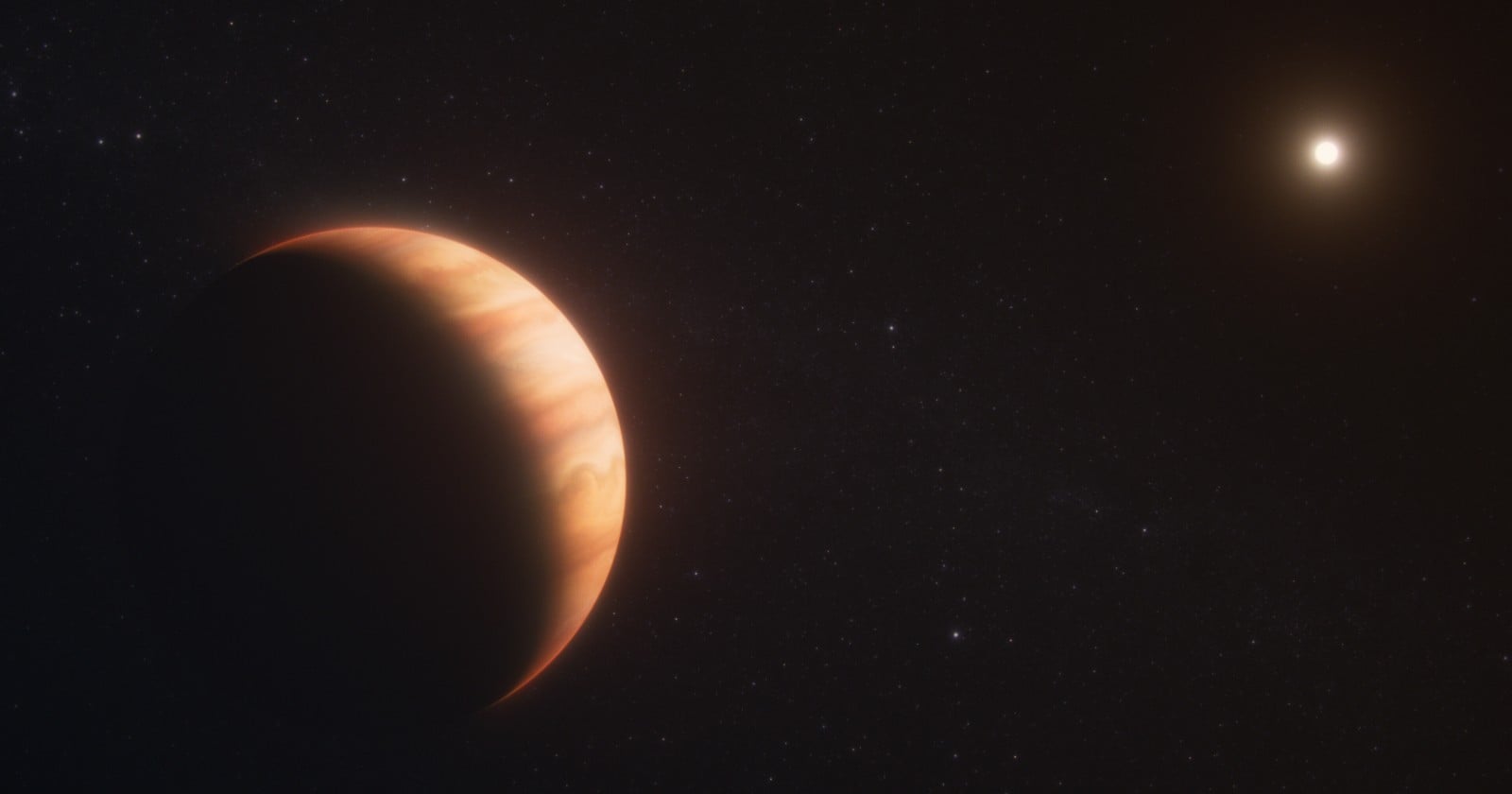
A gas giant called WD 1856 b has done something no planet was supposed to survive. Its star aged, swelled into a red giant, and collapsed into a white dwarf, the burned-out cinder a Sun-like star leaves behind. The planet is still there. And with the James Webb Space Telescope, astronomers have now read its atmosphere, the first time anyone has detected an atmosphere on a planet orbiting a white dwarf.
The detection, published on 1 July in Nature, found hydrocarbons, most likely methane, along with a haze of tiny particles and a faint glow of heat rising from the planet’s night side. That leftover warmth turned out to be the clue that explained how a world could outlive the star that should have destroyed it.
A planet larger than the star it circles
WD 1856 b is roughly the size of Jupiter. The white dwarf it orbits, WD 1856+534, is only about the size of Earth. That makes for one of the strangest silhouettes in the sky: a planet seven times wider than its own star. “The planet is about the size of Jupiter, but the white dwarf it orbits is the size of Earth, so the planet is seven times larger than its star,” said lead author Ryan MacDonald of the University of St Andrews. When it crosses in front of the white dwarf, it blocks more than half the star’s light.
A white dwarf is what most stars become at the end of their lives. Once a Sun-like star burns through its fuel, it puffs up into a red giant, sheds its outer layers, and leaves behind a dense, Earth-sized core with no fusion left to power it. That core glows only from stored heat, cooling slowly over billions of years. WD 1856+534 has been cooling for roughly six billion years already.
The system sits about 80 light-years away. WD 1856 b was found in 2020 with NASA’s TESS satellite and the retired Spitzer Space Telescope, and it whips around the dead star once every 34 hours, at a distance fifty times closer than Earth orbits the Sun. That closeness is the puzzle. A planet sitting that near would have been swallowed and torn apart while the star was still a bloated red giant. Somehow this one is intact.
What Webb saw as the planet crossed the star
The technique is transmission spectroscopy: when the planet passes in front of the star, a sliver of starlight filters through its atmosphere, and the gases there stamp their fingerprints onto that light. Split the light into its colors and the missing wavelengths name the molecules. Webb watched one such transit on 27 April 2023 with its Near-Infrared Spectrograph, in a mode called PRISM that trades fine detail for a wide sweep of color. The whole observation lasted about two hours; the transit itself took eight minutes.
In that light, the team found the signatures of hydrocarbons, with methane the most probable, making up roughly seven percent of the atmosphere, alongside small cloud particles that hang in the air as haze. “We saw the telltale signatures of small cloud particles and hydrocarbons, most likely methane, which is the first time we have seen an atmosphere on a planet transiting a dead star,” said co-author Victoria Boehm of Cornell University.
Then came the oddity. The planet blocked less infrared light than it should have. The only sensible explanation is that WD 1856 b was adding infrared light of its own, glowing with heat from its night side. That glow is what let the astronomers take the planet’s temperature.
The heat that should not be there
WD 1856 b turned out to be warm: about 126 degrees Celsius, roughly 260 degrees Fahrenheit. If the faint white dwarf were its only heat source, it should be far colder, closer to 160 kelvin, well below freezing. Something else had warmed it, and there is no source powerful enough nearby to be doing so now.
So the heat has to be a leftover, residual warmth from an event in the planet’s past. Using models of how objects like WD 1856 b shed heat over time, the team ran its temperature backward and worked out when the warming most likely happened: between three and five and a half billion years after the star became a white dwarf. That timing points away from the idea that the planet rode out the red giant in place. Instead it suggests the planet spent the dangerous years on a wide, safe orbit and only later migrated inward to where it sits today.
Christopher O’Connor of Northwestern University, who traced the temperature history, laid out the two candidate stories. “The big question is how WD 1856 b ended up where it is today, and there are two theories. One is that the planet was swallowed by the host star as it was dying, and managed to survive on the inside. The other is that migration took place due to the gravitational effect of other objects in the system. The white dwarf is part of a triple star system, and the companion stars could have influenced WD 1856 b’s orbit.” As the planet fell inward, he added, the white dwarf’s gravity would have heated it sharply, “and it has been cooling ever since.”
Where the certainty runs out
All of this rests on one planet and a single two-hour pass in front of its star. The chemical signatures are statistically strong, but the data favor hydrocarbons in general and methane in particular rather than proving them outright; the phrase the researchers keep is “most likely methane.” The planet’s mass is pinned only to a range, somewhere between four and eleven times Jupiter’s, and the upper end brushes the fuzzy border where giant planets shade into failed stars. The paper treats WD 1856 b as a planet, but that range is worth remembering.
The migration story is a reconstruction. The heating date comes from cooling models projected backward, and the two scenarios, late migration versus survival through the red giant, are not fully settled; the timing simply makes migration the better bet. And the headline framing, that this is a preview of our own solar system’s death, is an analogy rather than a forecast. Our Jupiter sits far from the Sun in a very different system. What WD 1856 b offers is one worked example of how a gas giant can end up orbiting a stellar corpse, not a script for what ours will do.
That framing is still the reason the result carries weight. In about five billion years the Sun will run low on fuel, swell past a hundred times its present size, and settle into a white dwarf of its own. Mercury, Venus, and possibly Earth are unlikely to survive that. The fate of the outer giants is the open question, and until now there was no way to watch it play out anywhere.
The astronomers are not finished with this one. Boehm’s team has already recorded four more Webb transits of WD 1856 b to probe its chemistry in more depth, observations that could firm up which hydrocarbons are present and how the haze forms. For now the first read of a planet’s air around a dead star raises as many questions as it answers, which is usually where the interesting work begins.
