
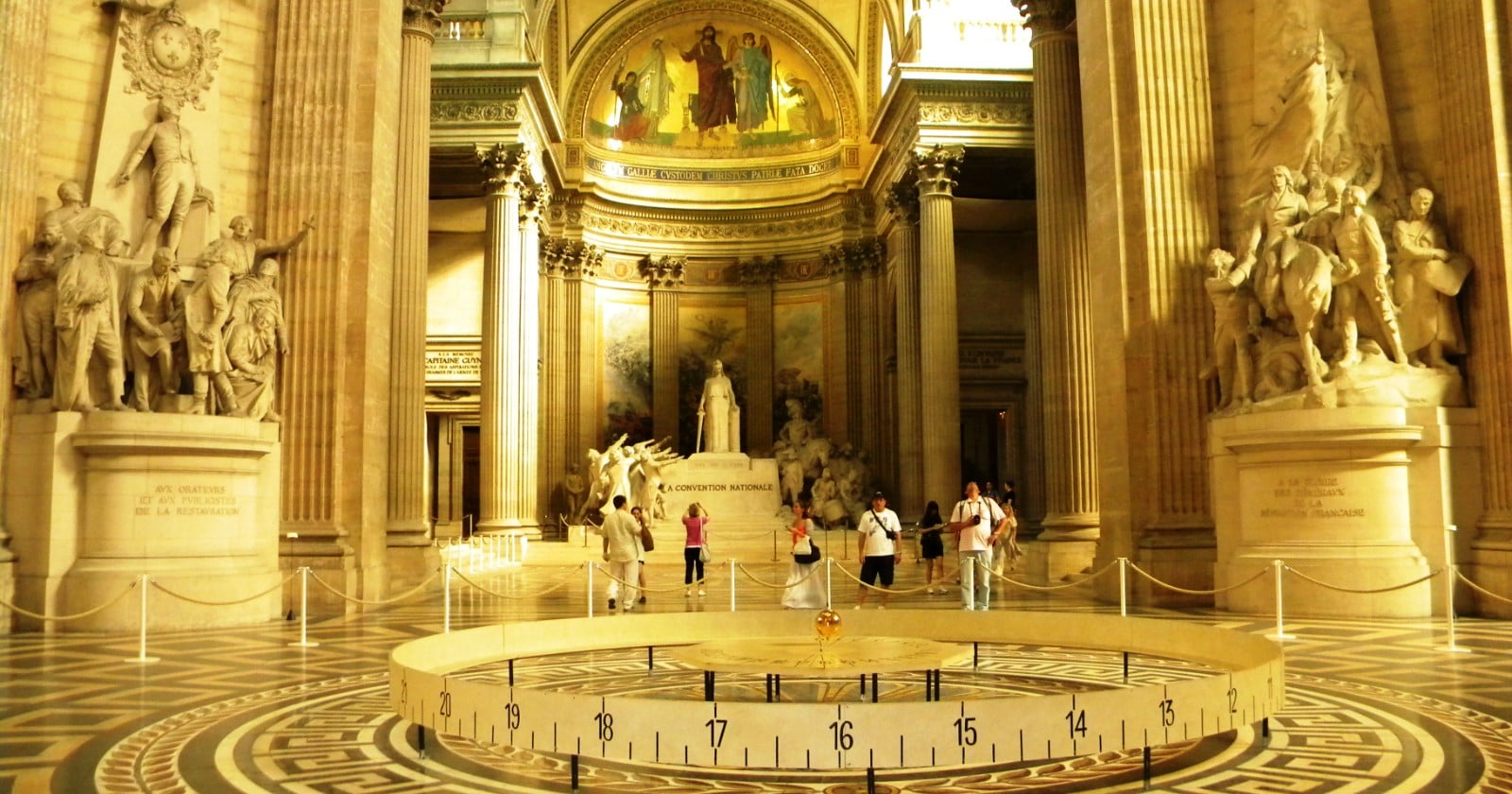
Under the dome of the Panthéon in Paris, a heavy metal ball hangs from a wire more than sixty metres long and swings slowly back and forth. Nothing steers it. Yet over the course of a morning, the line it traces on the floor creeps steadily around, as if an invisible hand were rotating the whole apparatus a few degrees each hour. Set up carefully enough, the swinging bob will knock over a ring of small pins one by one, going the long way around the circle.
The pins are not being pushed. The pendulum keeps swinging in the same fixed plane it started in. What moves is the floor, the building, the city and the whole of France, carried around by the spin of the Earth. When the physicist Léon Foucault first showed this in 1851, it was the first simple, direct demonstration that the general public could watch with their own eyes and see the planet turning. Astronomers had been certain of the Earth’s rotation for generations. Foucault made it visible in a single room.
Why a swinging weight betrays a spinning planet
The physics rests on a stubborn habit of moving things. A pendulum, once set going, wants to keep swinging in the same plane, because nothing in the back-and-forth motion pushes it sideways. Hold that idea fixed and let the ground turn underneath, and the pendulum’s plane will seem, to anyone standing on that ground, to rotate the other way.
The clearest case is the North Pole. Imagine a pendulum swinging directly above it. The plane of its swing stays locked on the distant stars while the Earth completes one full turn beneath it in a day. To an observer standing on the ice and turning with the planet, the pendulum appears to sweep through a complete circle, 360 degrees, in about 24 hours. Nobody pushed it. They simply rode a turning platform underneath a swing that held its own direction.
Move the pendulum toward the equator and the effect weakens, because the ground there is no longer turning flat beneath the swing but tipping edge-on to it. At the equator itself the swing and the spin line up so completely that the plane never appears to drift. Latitude, in other words, is not a detail of the experiment. It is the dial that sets how fast the swing turns, and it is the reason a pendulum in Paris behaves differently from one in Quito or one at the Pole.
That is the whole trick, and it is why the effect counts as proof. There is no astronomy in it, no need to watch the stars or the sun. A weight, a wire and a patient morning are enough to feel the ground move. That is also why it took so long to arrive. Earlier attempts to catch the Earth in the act had leaned on hard astronomical measurements or on the tiny sideways drift of falling weights, effects so small they were swamped by error. Foucault’s pendulum turned a delicate question into something a person could stand under and watch.
The demonstration of 1851
Foucault was an unlikely person to settle a centuries-old question. He had dropped out of medical school and made his name in photography and instrument-making rather than theory. Working at home in early 1851, he hung a small pendulum and watched its swing drift, then moved the test to a larger stage. He sent scientists in Paris a note promising, in effect, a chance to see the Earth turn, and on 3 February 1851 the pendulum turned before them in the Meridian Room of the Paris Observatory.
The public spectacle came weeks later. Under the dome of the Panthéon, Foucault suspended a bob of about 28 kilograms on a steel wire roughly 67 metres long, drew it carefully to one side and released it so that it swung in a clean plane. A point on the bob traced lines in sand spread on the floor. Hour by hour, the lines fanned around, and Parisians filed in to watch the direction shift. The demonstration made Foucault famous and sent copies of his pendulum swinging in observatories and museums around the world, where many still hang today.
The reason it landed so hard was that it asked almost nothing of the crowd. There was no equation to follow and no telescope to trust. A visitor only had to accept that a swinging weight holds its direction, watch the line on the floor move anyway, and draw the obvious conclusion about what must be turning instead. For a fact that had lived in books and calculations since Copernicus and Galileo, that shift, from something argued to something seen, was the whole achievement.
Why the pendulum does not turn once a day
The version of this fact that circulates most widely is also wrong in a specific way. A Foucault pendulum does not swing all the way around once every 24 hours. That full daily turn happens only at the poles.
The rate depends on where the pendulum hangs, and it follows a clean rule: the plane rotates at the Earth’s spin rate multiplied by the sine of the latitude. At the poles, latitude 90 degrees, the sine is one and the pendulum turns a full circle in a sidereal day, about 23 hours and 56 minutes. Drop toward the equator and the effect fades. In Paris, at close to 49 degrees north, the plane turns a little over 11 degrees an hour, so a full rotation takes roughly 32 hours, not 24. At the latitude of Cairo or New Orleans, near 30 degrees, it is slower still, about 7.5 degrees an hour. And at the equator, latitude zero, the sine is zero and a Foucault pendulum does not appear to rotate at all. In the southern hemisphere the whole motion runs the other way, counter-clockwise instead of clockwise.
So the pendulum does not read out the length of the day. It reads out latitude. With a little trigonometry, the rate at which the swing turns reveals how far from the equator it hangs, which is a stranger and more useful fact than the tidy 24-hour story it is often flattened into.
There is a further honesty owed to the experiment. The effect is real but delicate, and a badly started pendulum can fake it. If the bob is released even slightly off, so that it traces a thin ellipse instead of a straight line, that ellipse will slowly turn on its own for reasons that have nothing to do with the Earth. Nineteenth-century experimenters knew this and fussed over the release, often burning through a thread holding the bob at rest so that it began from a dead stop. A modern museum pendulum usually gets a gentle electromagnetic nudge each swing to fight friction. Its ring of pins and long wire are chosen to keep the honest, planetary drift well clear of the spurious kind.
That delicacy is not a weakness in the demonstration but a condition of it. A carefully swung weight, left alone, turns at a rate set by its place on a rotating globe, exactly as the mathematics of a spinning Earth requires and in no other way.
That was the point Foucault wanted a crowd to feel rather than take on trust. The invitation he is said to have sent still reads as the plainest description of what the pendulum offers anyone who stops to watch it long enough: you are invited to see the Earth turn.
