

Volume I records that the study was directed by a letter of 20 March 1959, from the US Army’s chief of research and development, Lieutenant General Arthur G. Trudeau, to the chief of Ordnance. The letter reproduced at the front of the volume is a follow-up to that one, written because representatives of the Army Ballistic Missile Agency had asked for guidance on where the money would come from. In it Trudeau called the expeditious development of the proposal “of critical importance to the U. S. Army of the future” and said that view was “apparently shared by the Chief of Staff”, citing his expeditious approval and enthusiastic endorsement of initiating the study. Then he addressed the money.
“In this time of limited budget, additional monies are unavailable,” Trudeau wrote. “Current programs have been scrutinized rigidly and identifiable ‘fat’ trimmed away. Thus high study costs are prohibitive at this time.” He left it to the recipient’s discretion to find the funds inside his own office, asked for results by 15 May, and instructed that no agency outside the Army be contacted until after the results had been presented to the Department of Defense, and that no public release be made concerning the project.
What came back, on 9 June 1959 by the date printed on its own title page, was the two-volume Project Horizon report, whose Volume I is the public-domain scan read for this piece: a proposal to put two men on the lunar surface in April 1965 and a permanent twelve-man outpost there by November 1966, for six billion dollars, launched from a new site the study assumed would be built in Brazil.
Every Technical Service in the Army
Volume I assigns responsibility for preparing the study to the commanding general of the Army Ordnance Missile Command. Volume II, the technical half, it says was prepared by a working group drawn from the Army Ballistic Missile Agency’s Future Projects Design Branch and augmented by representatives of each of the Army’s seven Technical Services, who became resident members of the ABMA group for the duration. Major General John B. Medaris, who commanded the Army Ordnance Missile Command, described the method without much ceremony in an Army history of the project: “It was a team project. We grabbed every specialist we could get our hands on in the Army.”
Volume I was the summary and the non-technical case. Volume I calls the report “a limited feasibility study”, and sets out a governing philosophy it names enlightened conservatism: one must vigorously pursue research to advance the state of the art, but nothing in a major systems design should be more advanced than the job requires, because “an unsophisticated success is of vastly greater importance than a series of advanced and highly sophisticated failures that ‘almost worked.'”
Quarters heated by their own lights
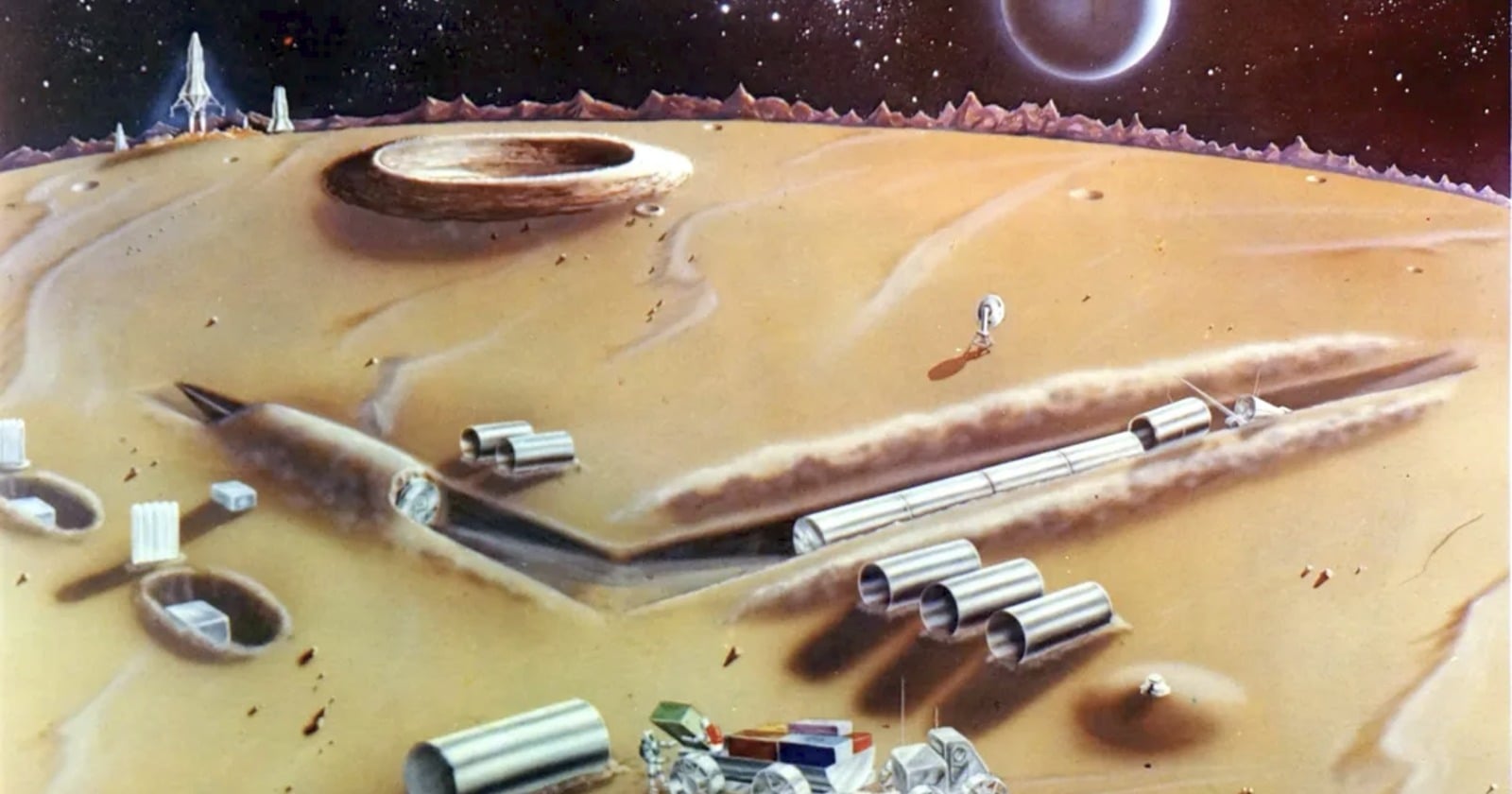
The outpost was to be assembled from cylindrical metal tanks ten feet across and twenty feet long, buried under lunar material. Burial bought uniform temperature, meteoroid protection, insulation, radiation shielding and, in the report’s own list of reasons, security.
Each cylinder was to be a double-walled “thermos bottle type” vacuum tank with a special insulating material in the space between the walls, and the report notes in passing that the vacuum “is easily maintained simply by venting the tank to the lunar void”. Despite an ambient subsurface temperature the report gives as forty degrees below zero Fahrenheit, its investigators calculated that the waste heat from an adequate internal lighting system would nominally supply essentially all the heat needed to keep the quarters at a comfortable room temperature.
Two nuclear reactors, sunk into holes, were to power the construction camp. Two more were to be added for the completed outpost, and the original camp quarters converted into laboratories. Empty cargo and propellant containers were to be reassembled on the surface for “storage of bulk supplies, weapons, and life essentials such as insulated oxygen/nitrogen tanks”.
The build-up was scheduled in stages. Cargo deliveries begin in January 1965. Two men land in April 1965 in a vehicle with an immediate return-to-Earth capability, live in its cabin, and spend their time confirming what unmanned probes had reported and checking the site. A nine-man construction crew arrives in July 1965, and the camp is to be made operational within fifteen days of active work starting. The complement grows to twelve by November 1966, six of the twelve expected to spend a large part of their time on general maintenance and life support. Tours were capped at a year, and the titular head of the outpost through the construction period was to be whoever’s primary speciality was construction.
Surface work called for what the report describes as a body conformation suit with a substantial outer metal surface, the first of five reasons being uncertainty that fabrics could hold pressure. Weight was less of an obstacle than it sounds: a man and suit weighing 300 pounds on Earth, the study observes, weigh 50 on the Moon. Food would be pre-cooked at first, with early attention to be given to the hydroponic culture of salads.
The study assumed Brazil
The study surveyed the Atlantic Missile Range and the Pacific Missile Range to see whether either could support the programme, and the results of that survey, in the report’s words, “indicated that, all things being considered, neither site was suitable.”
Volume I does not itemise why those two failed; it says only that the detailed site study sits in Volume II, which this copy does not reproduce. A later chapter does list some of the disadvantages of the existing sites the United States then controlled: all of them were so placed as to limit firing times “to but a few days each month” and to require a wasteful expenditure of available energy, the latter because none sits close to the equator, and most such complexes were “rapidly becoming saturated” with weapons research and development firings inside their existing boundaries. Horizon needed an equatorial site with eight launch pads, acquired and under construction almost immediately, because lead time on the site was one of the most critical items in the whole schedule.
Two candidates stood out. “Two sites stand out when compared to others Brazil and Christmas Island,” the report says, in a sentence the scan renders without its punctuation, adding that cost and early availability might decide between them. For the purposes of the study, it assumed Brazil.
Firings are not rockets
The transport plan turned on a single judgement about hardware. A direct flight from Earth to the lunar surface carrying two men and their return vehicle would need a six-stage rocket with twelve million pounds of lift-off thrust. No such vehicle would exist in time. The report puts it conditionally, and the conditions are the whole argument: if the United States is to have a manned lunar outpost by 1966, and at the same time give the first men arriving on the moon the desired return capability, then the orbital approach “is mandatory, since a 12-million pound thrust vehicle will not be available to meet the required schedule.”
So Horizon sent all its personnel, and roughly a third of its cargo, through a 96-minute equatorial Earth orbit, where a crew of about ten would transfer propellant into a spent upper stage before it departed for the Moon. The remaining cargo went direct. Direct flight could soft-land about 6,000 pounds; the orbital route could soft-land about 48,000, which the report notes is close to the minimum weight of a fully fuelled, preassembled Earth-return vehicle sitting on the surface waiting for its crew. Transit time either way was put at 50 to 60 hours, and terminal guidance was expected to hold the three-standard-deviation landing error to about a kilometre and a half.
By the end of 1967, the study calculated, some 252 people would have been carried into Earth orbit, 42 would have gone on to the Moon and 26 would have come back, and some 756,000 pounds of useful cargo would have been delivered to the lunar surface. Doing that would have taken 229 Saturn firings. It would not have taken 229 rockets: because boosters were to be recovered and reused, the report puts the number of Saturn boosters required to support the programme at “not 229 but only 73”.
The total, across eight and a half years, was estimated at six billion dollars, an average the report gives as approximately 700 million a year, which it points out is less than two per cent of the annual defence budget of the day.
A feasibility study, and only Phase I
Horizon was never an approved programme. It was a feasibility study, in its own words a limited one, and by the Army’s own account it “did not proceed beyond the feasibility study”. Only Phase I was ever completed. Phase II, the detailed development and funding plan, was costed at 5.4 million dollars and never ran.
The launch numbers do not reconcile between the report and the summary the Army now publishes, though the cargo figures do. The Army’s own history of the project says 75 Saturn II rockets would carry the 245 tons of construction materials and equipment, and that a further 64 Saturn rockets would then be needed annually to keep the outpost supplied. That tonnage is Volume I’s own figure relabelled: 245 short tons is 490,000 pounds exactly. It is the rocket counts that do not line up. Volume I gives 61 Saturn I launchings plus a Saturn II count that the scan destroys for the build-up through November 1966; the average rate for the two types together is 5.3 launchings a month, and together they deliver some 490,000 pounds of useful cargo. No Saturn II figure is printed here, because this copy cannot supply one. What Volume I does state separately is the 229 firings and 73 boosters above. Those are different scopes being quoted as though they were one number.
Two smaller mismatches sit in the same pair of documents. The Army’s history describes a “10-20 person lunar station”, which is the crew size the March requirement asked for, and the June report settled on twelve. Its 64 resupply rockets are annual, where Volume I schedules 64 launchings for the first operational year specifically, December 1966 through 1967.
The two documents bound into Volume I also do not use the same estimate for the Soviet Union. The requirement draft records an intelligence estimate that the Soviets “could land on the moon by 1968”. The report’s own chapters twice say the intelligence community “agrees that the Soviet Union may accomplish a manned lunar landing at any time after 1965”.
The detail that Wernher von Braun put Heinz-Hermann Koelle in charge of the study comes from the Army’s history article. It is not in Volume I.
Forwarded for such use as may be desired
The covering letter was regraded unclassified under a Form DA 1575 dated 21 September of a year the scan renders illegibly, over the name of a Lieutenant Colonel Donald E. Simon. Elsewhere in the volume a page carries a stamp regrading it confidential again in March 1962, followed by an undated further downgrade by authority of the chief of research and development.
By then the report had already been handed away. On 25 March 1960, Medaris was advised that “Project HORIZON has been forwarded by the secretary of the army to the secretary of defense, who has further transmitted it to NASA for such use as may be desired.” After the first presentations, officials had directed that the document be rewritten around a strictly civilian mission, as responsibility for the space programme moved from the Army to the newly created NASA.
The outpost was never built. The argument underneath it is the part still worth reading: that the rocket you need for a direct flight is the one you will not have, and that the way around it is to fuel your Moon rocket in orbit, near the equator, rather than build a bigger one. Horizon reached that conclusion in under three months, on money its sponsor had already refused to add to, and then went to another agency to be read.