
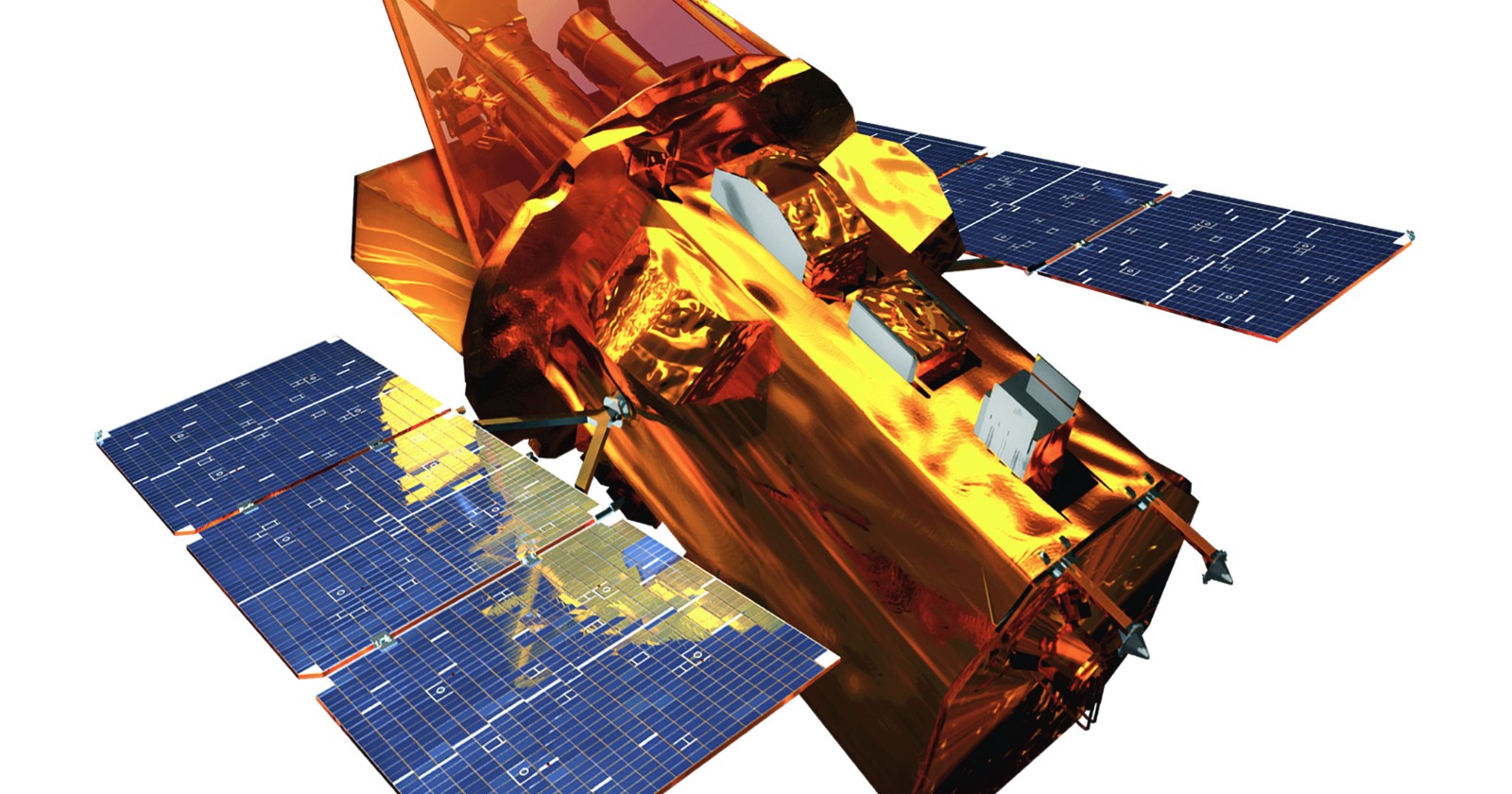
A robotic spacecraft built by a Flagstaff, Arizona, startup is preparing to chase down one of NASA’s space telescopes and boost it into a higher orbit. Katalyst Space Technologies’ craft, called LINK, is set to launch later this month aboard an air-launched Northrop Grumman Pegasus XL rocket from Kwajalein Atoll in the Marshall Islands, then rendezvous with NASA’s Neil Gehrels Swift Observatory and raise its altitude.
The target is a telescope that cannot save itself. After 21 years in orbit, Swift is sinking. The spacecraft carries no thrusters of its own, and its low Earth orbit has been decaying for years as it brushes against the top of the atmosphere. A recent stretch of heightened solar activity made the problem worse, puffing the atmosphere outward, thickening the drag, and pulling Swift down faster than NASA had planned for.
A telescope built to chase explosions
Swift launched in 2004 to study gamma-ray bursts, the most powerful explosions in the universe. NASA describes it as a kind of cosmic dispatcher: when a sudden, violent event flares somewhere in the sky, Swift pins down where it happened and alerts other observatories to swing around and look. Over two decades it has fed discoveries about exploding stars, flares from distant galaxies, comets, asteroids, and even high-energy lightning on Earth.
Goddard Space Flight Center in Greenbelt, Maryland, manages the mission, with partners that include Penn State, Los Alamos National Laboratory, the UK Space Agency, the University of Leicester, and the Italian Space Agency. Losing the telescope to an uncontrolled reentry would end all of that.
A race against the clock
Rather than let Swift fall, NASA decided to try something it had never done with a science satellite. In September 2025 the agency awarded Katalyst a $30 million contract, routed through its Small Business Innovation Research program, to mount a robotic boost on a compressed schedule. NASA framed the speed itself as the point, calling the effort a way to prove it can go from concept to implementation in under a year.
“This is a forward-leaning, risk-tolerant approach for NASA,” said Shawn Domagal-Goldman, the acting director of NASA’s Astrophysics Division at the time of the award, who noted that boosting Swift is both cheaper than building a replacement and a way to extend satellite servicing to “a new and broader class of spacecraft.” The clock is real: without a boost, NASA expects Swift to reenter the atmosphere in the fall of 2026, and for the rescue to have its best chance the telescope needs to stay above roughly 185 miles, about 300 kilometers. To buy time, controllers suspended Swift’s science observations and reoriented the spacecraft to cut its drag, a change the mission had never made before.
Why an air-launched rocket
The choice of a Pegasus XL is itself a consequence of the rush. Swift sits in an unusually low-inclination orbit of 20.6 degrees, which is hard to reach from U.S. launch pads, where most small rockets are confined to steeper angles. Pegasus solves that by skipping the pad entirely: Northrop Grumman’s modified L-1011 aircraft, named Stargazer, carries the rocket aloft and releases it in midair, letting it start its climb from tens of thousands of feet and from a location chosen to match Swift’s path.
A first, if it works
NASA has been careful about what it is claiming. By the agency’s own description, a successful boost would be the first time a commercial robotic spacecraft captures a government satellite that is uncrewed, or not originally designed to be serviced in space. That qualifier matters. Robotic servicing has been demonstrated before on craft fitted with docking targets or otherwise built to be approached; Swift was not. LINK, an 880-pound spacecraft that grips its target with three robotic arms, will have to dock with an observatory that was never built to cooperate with a visiting robot, over a maneuver NASA expects to unfold across several months.
It is also, for now, an attempt rather than a sure thing, and the schedule remains soft. NASA has described the launch as targeted for later in June while cautioning that shifting solar activity could still move the timing. Whether the boost works or not, it is a test of a capability NASA says it will need as satellites pile up in orbit and more of them, someday, may be worth saving rather than discarding.
