
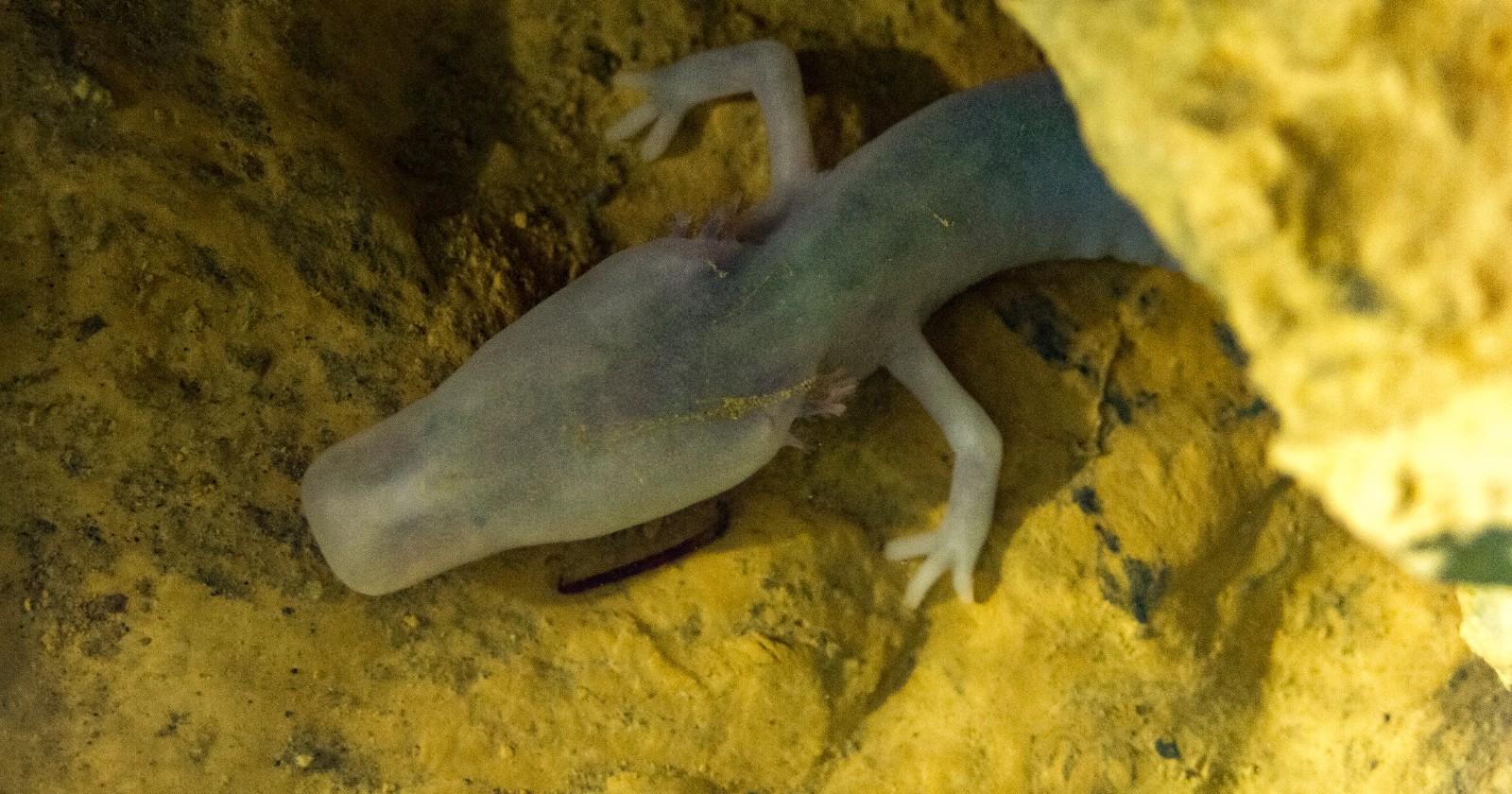
In the flooded caves of Slovenia and Croatia lives a pale, blind salamander the size of a pencil, weighing only fifteen to twenty grams. It is called the olm, or the “human fish,” for its skin the color of pale flesh. Despite being small, an animal that biology usually pairs with a short life, the olm is projected to live for more than a hundred years.
That figure comes from one of the longest-running animal records in science, and it carries a puzzle. The two mechanisms researchers most often use to explain long-lived animals, a slow metabolism and powerful protection against cellular wear, do not look unusual in the olm. A 2011 study laid out the numbers and concluded plainly that this little salamander is a challenge to the standard theories of why animals age.
A pencil-sized animal with a century-long life
The olm is the only cave-adapted vertebrate in Europe. Living in permanent darkness has reshaped it: its skin lost its pigment, its eyes degenerated, and it keeps larval features such as external gills into adulthood. It measures roughly twenty-five to thirty centimeters and colonized its underground world an estimated twenty million years ago.
Its longevity has been noticed for centuries, with captive olms surviving more than seventy years in zoos. But anecdotes are not data, and a cave animal that breeds rarely is hard to study in the wild. The breakthrough came from a single facility built to imitate the olm’s home.
In 1952 a cave at Moulis in southern France was fitted with riverbed-like basins that reproduced the olm’s natural habitat, and a breeding program began at the end of that decade. It remains the only such program in the world to succeed. Nearly sixty years on it holds more than four hundred animals, and births and deaths there have been recorded every week since 1958.
What sixty years of records show
From that long ledger the 2011 team reconstructed the olm’s life history, and the pace of it is extraordinary. Females reach maturity at an average age of about 15.6 years and lay eggs only once every 12.5 years, a clutch of roughly thirty-five eggs at a time. Almost everything about the animal runs in slow motion.
The survival numbers are the heart of the finding. Adult olms have an annual survival rate of 0.984, meaning fewer than two in a hundred die in a given year, and that rate shows no decline with age. From this the researchers calculated an average adult lifespan of 68.5 years. The oldest animals in the collection were at least 48 years old and probably closer to 58, with no sign of the drop in survival that usually marks old age.
Stretching those survival odds forward, the team estimated that a quarter of olms alive at age six should still be living past 85. Using a conservative method drawn from other animals with steady, age-independent death rates, they put the species’ maximum lifespan at around 102 years. For an amphibian that weighs less than a slice of bread, that is staggering. The next longest-lived amphibian, the Japanese giant salamander, weighs more than 25 kilograms, over a thousand times as much.
The paradox of how it ages
Long life in animals usually comes with explanations. Bigger bodies tend to live longer, and so do animals that burn energy slowly or that defend their cells well against the damaging byproducts of metabolism. The olm fits the first expectation backward, living far longer than its tiny size predicts, and it is a clear outlier when its lifespan is plotted against its weight.
So the researchers checked the other two explanations. A slow metabolism is the obvious candidate, and salamanders as a group are sluggish, low-energy animals. Yet when the olm is compared with other amphibians rather than with mammals or birds, its basal metabolic rate is not unusual for its weight. It is not burning energy remarkably slowly compared with its relatives.
The second candidate is protection against reactive oxygen species, the corrosive molecules that normal respiration produces and that damage DNA, proteins and fats over a lifetime. Animals that live long are often expected to scavenge or repair that damage especially well. But the olm shows neither standout antioxidant activity nor high cellular damage even at 28 years of age. Neither of the two most-cited mechanisms, the study concluded, explains why this animal lives so long. The authors could only hypothesize that the olm produces energy with unusual efficiency, generating less damage in the first place rather than cleaning it up better.
Where the hundred-year figure comes from
It is worth being clear about what the study measured and what it projected. No one has watched a single olm live for a hundred years. The oldest documented animals are in their late forties to perhaps late fifties, and the century-plus figure is a statistical projection built from the colony’s steady, age-independent survival rate, on the explicit assumption that the olm does not begin to age before then.
That assumption is the load-bearing part, and the data behind it are real but bounded. They come from one captive colony, fed more regularly than wild olms would be, so the researchers note their estimated turnover may even run a little fast compared with nature. The “no senescence” conclusion rests on not yet detecting a decline in survival, which is not the same as proving one can never appear. A truly verified maximum lifespan would require following individuals of known age for longer than anyone yet has, and the program, though decades old, is still younger than the lifespans it is trying to measure.
What is solid is the shape of the finding. The olm is a genuine outlier in the relationship between body size and lifespan among amphibians, and the conventional metabolic and antioxidant explanations do not account for it. Whether the true ceiling is 80 years or 120, the animal sits well outside what its size should allow, and the reason remains open.
An open question in the dark
The olm spends its long life almost motionless in cold, dark water, eating little, breeding once a decade or so, and apparently sidestepping the slow failure that catches most animals. Researchers describe it not as a solved curiosity but as a promising model for understanding how senescence might be delayed in a backboned animal.
For now the century-old salamander keeps its secret. The records show that it lives far longer than it should, and the usual reasons do not apply. Somewhere in the chemistry of an animal that barely moves is a way of growing old so slowly that science has not yet learned to name it.
