

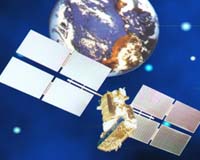
India and Russia will sign two joint agreements this week to launch and develop satellites for a space-based global navigation system.
The agreements, which are expected to be finalized during Russian Prime Minister Mikhail Fradkovs visit to New Delhi on Thursday and Friday, would solidify the Indo-Russian accord signed during President Vladimir Putins visit to India during December 2004, in which India would participate in operating and commercializing GLONASS, the ex-Soviet Global Navigation Satellite System.
With 17 satellites currently in orbit, GLONASS constitutes Russias alternative to the U.S. Global Positioning System, which is controlled by the Pentagon, and Putin has ordered his space agency to fully commercialize GLONASS by 2008.
The accord also approves a group of Russian navigation satellites launched aboard Indian rockets at the countrys Satish Dhawan Space Center. The idea is to accelerate formation of a navigational satellite cluster to be marketed ahead of the European Galileo project.
“We have signed a deal (that) would enable both (the Indian Space Research Organization) and NASA for future joint space explorations, including Mars and other inter-planetary missions,” said K Kasturirangan, the former chairman of ISRO, now the director of the National Institute of Advanced Studies.
The deal would also enable ISRO to carry a U.S. payload aboard its maiden Moon mission, Chandrayan-1, Kasturirangan said, adding that both space agencies were working on the project.
During a summit in Moscow last December, India and Russia signed an agreement to safeguard satellite technology and intellectual property rights to pave the way for free flow of technology when GLONASS is commercialized.
That summit cleared the way for the use of GLONASS by the Indian Armed Forces.
