
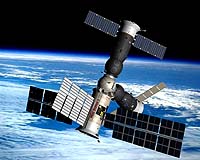
Russian plans to build the world’s first privately-operated space station to accommodate tourists got a boost Tuesday when Deputy Prime Minister Ilya Klebanov backed the project.
“If all financial means required can be found, I think the (space) station will be built,” Klebanov said, as quoted by Russian news agencies.
He added that the plan was “totally feasible from a technical point of view,” although he conceded that “the project’s financial aspect isn’t clear yet.”
The Russian-American firm MirCorp said last week that it planned to launch a private space station for space tourists, scientists working for private companies or film crews in 2004.
It said it had signed an agreement with the Russian space firm Energiya and the Russian space agency.
The Mini Station 1, a project using Russian space technology, would be able to accommodate three people for up to 20 days at a time.
The space station, with a lifespan of 15 years, would transport its passengers to and from Earth on Russian Soyuz craft and use automatic Progress cargo vessels for supplies.
The firm noted that it was moving to commercialize space on its own so as not to interfere with the International Space Station (ISS) and the more formal scientific research going on there.
But Russia’s space agency on Thursday played down hopes for such a space station, calling into question the financial feasibility of the project.
“This is a project which for the moment has no investors or potential clients,” space agency spokesman Sergei Gorbunov told AFP, adding that the project organizers were “too optimistic.”
Gorbunov said launching such a project would require at least 40 million dollars.
All rights reserved. ¿ 2000 Agence France-Presse. Sections of the information displayed on this page (dispatches, photographs, logos) are protected by intellectual property rights owned by Agence France-Presse. As a consequence, you may not copy, reproduce, modify, transmit, publish, display or in any way commercially exploit any of the content of this section without the prior written consent of Agence France-Presse.
