
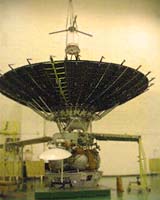
The Russian Federal Space Agency (Roscosmos) has announced plans to launch the Radioastron laboratory for observing extra-galactic objects in 2007, Vremya Novostei, a Russian daily has reported.
Radioastron will be able to study massive black holes inside both remote and neighboring galaxies’ nuclei- stellar-mass black holes inside the Milky Way Galaxy, neutron stars and the terrestrial gravitation field.
Scientists also hope to spot new super-powerful energy sources using Radioastron.
The project was co-authored by Nikolai Kardashev, a full-time member of the Russian Academy of Sciences.
The radio telescope, he said, will function in conjunction with other orbital telescopes. Their interaction will help create a huge system over a vast distance, roughly equal to that between the Earth and the Moon.
“As a result, we will obtain high-resolution images of black holes and neighboring galaxies. The resolution of such images will exceed that of the human eye by 20 million times,” Kardashev said.
“This is an international project. However, Russia will assemble most scientific equipment and other hardware,” Kardashev explained.
Radioastron features extremely sensitive equipment that has already been tested at specialized R&D centers. The Lavochkin science and production association has produced a model of the radio telescope.
Launching Radioastron was last discussed more than 20 years ago, but Kardashev said it never got off the ground because of inadequate funding.
Nikolai Sanko, who heads the department of instrument-packed spacecraft, said it would take over 1.5 billion rubles to complete the project, financed by the state.
