
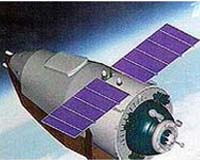
Russia is ramping up its efforts to promote participation in its own next generation spacecraft. The move comes after 40 years of making the Model T of the space race, the Soyuz, but now Russia wants to move on to a new spaceship dubbed the Kliper.
As a people only transporter, the Kliper is somewhat billed as the Model U of the new space race, spiced up with an “internationale” feel to it as Russia reaches out to Europe, India, China, Japan, Canada and Brazil.
With a fully operational spacecraft in orbit on crew rescue duty today, and a replacement coming down the production line, Russia is quite possibly the sleeping giant of the space industry in the 21st century. Untroubled by the concerns of the Western Nanny States, Russia can pretty much do what as it wants too.
In unpublished comments to SpaceDaily last year, Ariancespace CEO Jean-Yves Le Gall said that a clear goal of the Soyuz cooperation was to move forward to a manned capacity and use the European spaceport in South America for that purpose.
The intentions of the United Kingdom and its plans for the news space race remain unresolved.
Reporting in The Guardian newspaper on the weekend Robin McKie wrote that, “Not every nation will be willing to provide its share of the cash. France, Germany and Italy will most likely be enthusiastic.
But Britain will probably decline. For the past two decades the UK has refused to put money into manned space programmes and as a result has no representatives among the ESA’s 14-strong astronaut corps.”
According to The Guardian, the decision on ESA’s involvement with Kliper will be made in December, when European government ministers responsible for space will meet to decide whether to commit to the project.
‘I am fairly confident they will say yes,’ said Daniel Sacotte, the ESA’s director of human space flight. ‘It’s not just that Kliper is a good political deal or that it provides us with a powerful piece of technology. It will give us a vision, a scientific goal that young Europeans badly need today.’
And at a mere 100 million Euro a year, the decision is probably one of the most cost effective space transport investments anyone has yet be offered a ground floor buy in on.
