

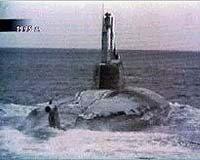
Russian specialists have finalized plans to raise parts of the heavily-damaged bow of the Kursk nuclear submarine from the bottom of the Barents Sea in a bid to determine what sank the vessel, the head of a company involved in the operation said.
The bow’s lifting by mid-summer should help establish what happened inside the submarine at the moment of the disaster, the Interfax news agency quoted Igor Spasky, the head of the Rubin company, as saying.
The Kursk’s front was sliced off before the main portion of the submarine was hoisted off the seabed in October and brought ashore in order to give the 118 seamen who perished in the August 2000 disaster a land burial.
The nuclear-powered submarine sank following a series of explosions in its bow.
While the main portion of the sub was raised by Dutch company Mammoet, only Russian companies will be involved in lifting the bow in July or August, officials said.
Officials said in January that only fragments of the Kursk’s front could be safely lifted, because there were fears that several heavily-damaged torpedoes stored in the bow’s arsenal might accidentally explode.
The rest of the wreck will then be sealed off so that it does not damage surrounding fishing waters.
The head of the Russian navy Admiral Vladimir Kuroyedov said last month that preliminary findings showed the fuel used for the torpedoes on the Kursk was too volatile and had caused the explosion that sank the sub.
The fuel somehow caught fire, setting off the deadly series of blasts that sent the submarine to the seabed on August 12, 2000, Kuroyedov said.
