

The Spirit rover passed its 401st sol, or Martian day, Thursday, marking 311 more sols than its original mission design, NASA officials said.
After more than 13 Earth months on the red planet, Spirit’s solar panels have collected a fine layer of dust, which has reduced its energy levels, but the golf-cart-sized rover continues to operate normally.
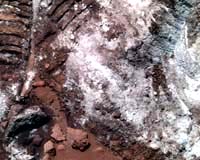
In its most recent mission, Spirit found a class of water-affected rock on Mars that contains more sulfate salt than any other rock the rover has discovered.
The rock, which mission scientists at NASA’s Jet Propulsion Laboratory nicknamed Peace, is part of an outcropping in the Columbia Hills, which rim Gusev Crater, the vast flat plain where Spirit landed in January 2004.
“Where did the salt come from?” asked Stephen Squyres, principal scientists for Spirit and its twin rover, Opportunity
“We have two working hypotheses we want to check by examining more rocks. It could come from liquid water with magnesium sulfate salt dissolved in it, percolating through the rock, then evaporating and leaving the salt behind.
“Or it could come from weathering by dilute sulfuric acid reacting with magnesium-rich minerals that were already in the rock. Either case involves water.”
So far, Spirit has traveled about 2.75 miles (4.4 kilometers) across the Martian surface.
