

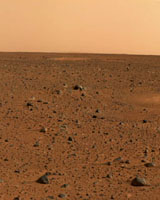
The first full-color snapshots of Mars have surpassed all expectations and shown the so-called the red planet actually boasts subtle shades of blue and ochre, NASA scientists said Tuesday.
The image, actually a mosaic of 12 images taken by a high definition camera, is of such high quality that NASA was able to zoom in on details of stones and pebbles in the reddish brown sand in front of the robot.
The 12-million-pixel image is “three or four times better than any previous mission,” said Jim Bell, who is in charge of the “PanCam.”
The picture is so close to reality that “it is approximately the color you would see” with your eyes.
“They are the highest resolution pictures of Mars ever obtained,” offering “exquisite detail, a wonderful mix of both smooth and angular rocks, some a few tens of centimeters across,” said Bell.
The mission’s principal investigator Steve Squyres said a peak some 25 to 30 kilometers (15.5-18.5 miles) away was visible from the photo and also described the surfaces of the rocks as “remarkably smooth.”
Bell noted that the rocks had more blue tones than the rest of the visible Mars-scape, which appeared largely reddish.
The image, covering a 45 degree angle, offers just a segment of the full 360-degree panorama, he said. Other photos in the series have not yet been transmitted back to Earth.
The first of two Mars Exploration Rovers (MER-A) came to rest on the red planet on Sunday, and all of its delicate instruments were found to be in perfect working order.
The robot remains on the rover landing platform but is scheduled to start its journey moving across Martian terrain at the start of next week.
A second, identical robot — MER-B — is scheduled to touch down on the opposite side of Mars January 25.
Two eyes of the camera, 30 centimeters (12 inches) apart, sit 1.5 meters (4.9 feet) above ground level on the rover’s mast to provide full-circle panorama photos in a 24 frame by three frame mosaic that offer “a combined image full of fine detail.”
And in a telephone call Tuesday, US President George W. Bush “complimented the team,” said Charles Elachi, head of NASA’s Jet Propulsion Laboratory in Pasadena, California
“It was a wonderful phone call, humorous and exciting,” Elachi said.
“We had a little chat about quantum physics and the string theory,” he said.
Some 280 NASA scientists are adjusting their body clock to Mars time in order to monitor the two robot probes.
