
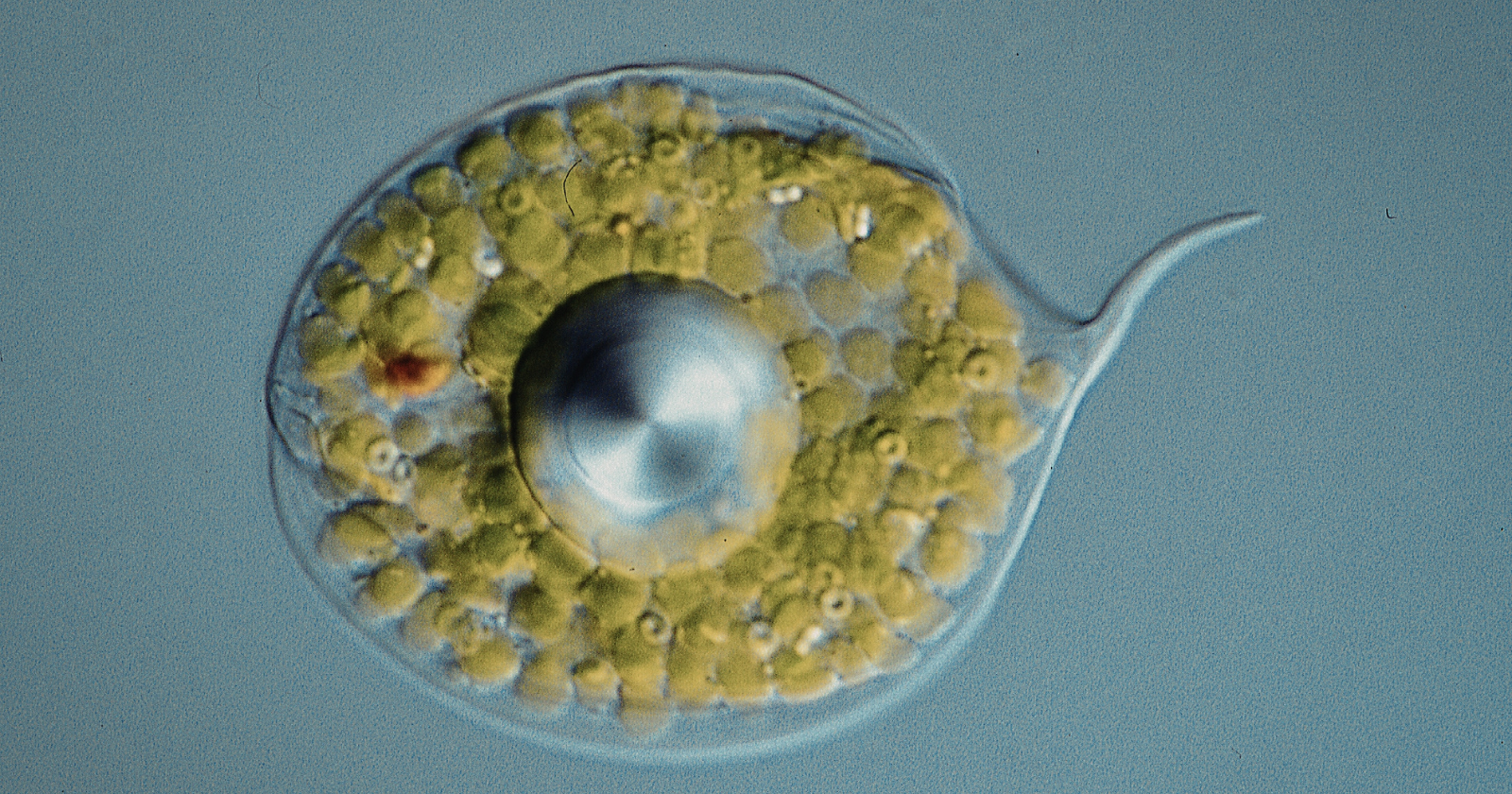
Roughly two billion years ago, one single-celled organism ended up living permanently inside another. The descendants of that arrangement now power nearly every plant and animal on Earth.
One of the most consequential events in the history of life on Earth may have begun as something like a failed meal. Somewhere between 1.5 and 2 billion years ago, one single-celled organism engulfed another. The intended meal survived. The two cells settled into an arrangement that proved more useful than digestion, and the bacterium that almost became food became, over the next several hundred million years, the mitochondrion: the energy-producing organelle that now sits inside nearly every cell of nearly every plant, animal, fungus, and protist on Earth.
This is the endosymbiotic theory of mitochondrial origin. It is one of the most thoroughly supported propositions in evolutionary biology. The specific details, including exactly when the merger happened and exactly which bacterial lineage was involved, are still actively debated. The general account is not.
What the evidence looks like
Mitochondria carry their own DNA, separate from the DNA in the cell’s nucleus. In humans, this mitochondrial genome is small, around 16,500 base pairs encoding 37 genes. It is organised as a single circular molecule, structurally closer to a bacterial chromosome than to anything in the rest of the eukaryotic cell. The mitochondrion replicates this DNA on its own schedule, partitions copies between daughter mitochondria, and uses its own machinery, its own ribosomes, its own transfer RNAs, to translate the genes its DNA still carries.
Mitochondria also divide by splitting in two, the way bacteria reproduce. They are bounded by two membranes rather than one. The inner membrane, in chemical composition, more closely resembles a bacterial cell membrane than a eukaryotic one. Their ribosomes are bacterial in size and structure. That bacterial resemblance is one reason some antibiotics that target bacterial ribosomes, including tetracycline and chloramphenicol, can also interfere with mitochondrial protein synthesis.
A 2015 phylogenomic study in Nature’s Scientific Reports sums up the consensus position: mitochondria evolved only once, from bacteria living within their host cells, probably around two billion years ago, and the bacterial ancestor sat within the alphaproteobacteria, a diverse group of modern free-living and parasitic bacteria. Beyond that, the picture gets contested.
What is still being argued about
Pinpointing the exact alphaproteobacterial lineage closest to the mitochondrial ancestor is, on the same Scientific Reports paper, “highly debated.” Some analyses place mitochondria close to the order Rickettsiales, which today includes obligate intracellular parasites such as Rickettsia. A 2018 PNAS study argued that mitochondria branched off from a proteobacterial lineage before the divergence of all currently sampled alphaproteobacteria, which would mean the closest living relative may not be in any group we have yet sequenced.
The timing is also a range, not a single number. Most current estimates fall between roughly 1.5 and 2 billion years ago. The earliest unambiguous fossils of eukaryotic cells, which by definition would already contain mitochondria, are around 1.6 billion years old, so the merger has to have happened before that. The exact upper bound is open.
The identity of the host cell is also unsettled. A 2017 Nature paper by Zaremba-Niedzwiedzka and colleagues described the Asgard archaea, a group of uncultivated archaeal lineages (Loki-, Thor-, Odin-, and Heimdallarchaeota) whose genomes carry an unusual abundance of proteins formerly considered unique to eukaryotes. The current standard account has an archaeal cell related to this Asgard group engulfing the alphaproteobacterial ancestor. Whether the host already had something resembling a nucleus, or whether the nucleus developed later, is one of the active arguments in early eukaryote biology.
Why the merger mattered
What is not in dispute is that the result changed what was possible.
Mitochondria are the main site of oxidative phosphorylation, the process by which most eukaryotic cells extract energy from food. The chemistry is more efficient than the fermentation pathways available to most prokaryotes, and the architecture of mitochondria, with thousands of copies per cell folded into highly creased inner membranes, helped give eukaryotic cells an energetic architecture very different from that of bacteria and archaea.
In a 2010 Nature paper, Nick Lane and William Martin argued that this energetic difference is the precondition for the rest of complex life. On their account, mitochondrial acquisition allowed eukaryotes to support roughly 200,000 times more energy per gene than prokaryotes could, lifting an energy ceiling that had constrained bacterial and archaeal biology for the previous two billion years and making possible the build-up of large genomes, intricate cell structures, multicellularity, and eventually everything that came after. The argument is not universally accepted in detail. The broader point that mitochondria represent an unusual energetic asset is widely shared.
What is still inside you
Almost every cell in nearly every plant, animal, fungus, and protist on Earth contains mitochondria, in numbers ranging from one to several thousand depending on cell type. A human heart muscle cell contains around 5,000. A liver cell contains around 1,000 to 2,000. Each mitochondrion still carries its small remnant of bacterial DNA, descended in an unbroken line from the genome of an organism that lived more than 1.5 billion years ago and was, briefly, on the inside of another cell for the wrong reasons.
In humans and almost all animals, mitochondria are inherited only from the mother. Egg cells pass them on. Sperm cells contain mitochondria too, but paternal mitochondria are usually excluded or destroyed after fertilisation. The mitochondrial DNA in any person’s cells right now traces back, by a continuous chain of maternal cell divisions, to the original endosymbiotic event.
The merger that produced mitochondria does not get the attention of the asteroid that ended the dinosaurs, or of the oxygenation of Earth’s atmosphere that preceded it by several hundred million years. On any honest accounting, it should. The lineage of that almost-eaten bacterium is now inside nearly every complex cell on this planet.
