

The risks of proliferation are “too high” if Iran persists in its current nuclear policy, the foreign ministers of the EU troika – Britain, France and Germany – said in a joint article in Le Monde newspaper Thursday.
“If Iran persists down the road that it is following today, the risks of proliferation are too high,” wrote Jack Straw, Philippe Douste-Blazy and Joschka Fischer.
“There are serious reasons to suppose that Iran’s nuclear ambitions are not exclusively peaceful …. No economic logic justifies the existence of the installations that are at the heart of the dispute,” they wrote.
“Iran has no nuclear power station capable if using the fuel which it wants to produce,” the ministers said.
“Central Asia and the Middle East, which are among the most fragile regions in the world, risk being destablised. Other states could well try to develop their own capacities. The Non-Proliferation Treaty would be seriously affected,” they wrote.
The ministers accused Iran of bad faith for “violating” the so-called Paris agreement of November 2004 under which Teheran was to suspend uranium enrichment in return for the promise of economic and scientific cooperation.
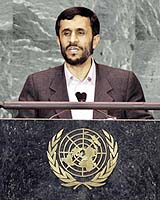
And they said that President Mahmoud Ahmadinejad’s weekend speech at the UN — in which he insisted on Iran’s right to develop nuclear technology — “failed to take into account the concerns of the international community”.
“We deliberately tried to avoid any comment that could increase tensions, in spite of Iran’s violation of the Paris agreement, but in his speech on September 17 before the General Assembly, President Ahmadinejad showed absolutely no flexibility, speaking of ‘nuclear apartheid,'” they said.
