
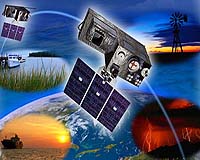
Northrop Grumman and Raytheon have teamed to compete to build the next generation geostationary weather and environmental system for the National Oceanic and Atmospheric Administration (NOAA).
Geostationary operational environmental satellites (GOES) provide environmental data products to the commercial, education and public sectors to protect lives, property and the environment, and to foster economic growth. GOES imagery and data has been a mainstay of weather observations and forecasting since 1975 and is featured on weather reports worldwide.
The next-generation system, GOES-R, will take a major step forward with the deployment of new technologies and data products.
GOES-R will monitor the Earth’s environment with improved spatial, spectral and temporal resolution, producing about 50 times the amount of data than is provided by the current GOES spacecraft and serving as the basis for new environmental products and services.
“We’ve created a ‘best-in-class’ team with extensive experience in the design, development and integration of large, complex environmental systems,” said Maureen Heath, Northrop Grumman Space Technology vice president of civil space.
“We have a finely-honed relationship with Raytheon, developed over the past several years working closely to develop the nation’s newest and most technologically sophisticated polar-orbiting environmental system. We plan to draw on the lessons learned to create an affordable, low-risk geostationary system for NOAA and the user community.”
Northrop Grumman and Raytheon are currently developing the National Polar-orbiting Operational Environmental Satellite System for NOAA.
“The team of Raytheon and Northrop Grumman Space Technology brings an unparalleled body of experience, depth and understanding that will be pivotal in developing an approach that clearly represents the best geostationary system value solution for NOAA, the nation and the user community,” said Ray Kolibaba, Raytheon Intelligence and Information Systems vice president, Space Systems.
Under the teaming agreement, Northrop Grumman will be the prime contractor, managing and integrating the system and building the space segment. Raytheon will be responsible for development of the ground segment.
