

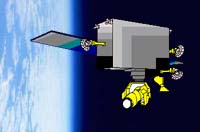
The TRW/Raytheon Space Based Infrared System Low (SBIRS Low) team progressed its system design effort with the successful completion of the second of three major program milestones, the System Design Review (SDR). SBIRS Low is the low-Earth orbiting component of the next generation missile early warning and tracking system.
The team showcased its progress in exploiting its combined expertise in space and missile defense systems with process and technological innovations to meet system requirements.
Some 300 SBIRS constituents from the Air Force and Department of Defense agencies gathered at TRW’s Space Park facility were also briefed about the team’s risk reduction accomplishments and major activities planned for the remainder of the program.
“SBIRS Low is a critical piece of America’s missile defense architecture,” said Patrick Caruana, TRW vice president and SBIRS Low program manager.
“As such, the nation demands a team that will deliver both fresh solutions coupled with domain knowledge and experience. We once again demonstrated that the TRW/Raytheon team is the team that will credibly deliver an innovative, affordable solution.
“With SDR under our belt, we’re focusing our energy on leveraging our successes towards the next program milestone, preliminary design review,” he added. Preliminary design review is scheduled for early 2002. Last year, the TRW/Raytheon team completed the requirements definition phase of SBIRS Low.
The team is performing comprehensive ground demonstrations design to reduce risk and verify system performance under a 38-month program definition and risk reduction contract awarded in August 1999 to define requirements and complete conceptual designs for an operational SBIRS Low system. The TRW/Raytheon team includes Aerojet, Motorola, Agilent, Honeywell, Ball Aerospace & Technologies, Sparta and PRA.
SBIRS Low is the low-Earth orbiting component of the SBIRS system of systems (SoS). The SoS is also comprised of satellites in geosynchronous orbit, sensors on satellites in highly elliptical orbit, ground data processing and control systems, and brings surveillance capabilities to bear against evolving threats.
