
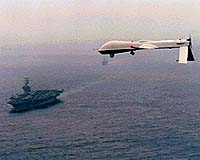
Raytheon Company has successfully integrated and demonstrated its SeaVue maritime surveillance radar and AAS-52 Multi-spectral Targeting System (MTS-A) aboard a General Atomics Aeronautical Systems Mariner unmanned aerial vehicle (UAV), a derivative of the Generals Atomics Predator B UAV.
“The successful April flight demonstration from El Mirage, Calif., is a perfect example of what a motivated team can accomplish,” said Jack Kelble, president of Raytheon Space and Airborne Systems. “In order to meet an important demonstration request, we installed and integrated the SeaVue and MTS-A mission systems, and then performed the necessary flight verification tests in only three weeks. This is a remarkable engineering achievement.”
In addition to demonstrating the Mariner UAV’s performance and operational flexibility at various altitudes, the flight highlighted the sensors’ combined maritime surveillance capabilities and network connectivity when operating together on one platform. This flight demonstrated many of the capabilities outlined in the U.S. Navy’s Broad Area Maritime Surveillance requirement.
The SeaVue family of radars is designed to detect small maritime targets in high seas and provide superior maritime situational awareness. The system’s flexible architecture enables it to meet a wide variety of surveillance requirements and support multiple missions.
Depending on the configuration, typical missions include maritime surface search and target tracking, ship imaging and classification, overland mapping, search and rescue, weather avoidance and navigation, harbor and economic zone surveillance, and environmental monitoring such as oil spill detection and ice flow mapping.
SeaVue was designed as a light weight, low cost, surveillance radar that can be easily installed on smaller aircraft, helicopters, and unmanned vehicles. To date, more than 100 SeaVue radar systems are in operation around the world.
The AAS-52 MTS-A is a multi-use electro-optical, infrared, and laser detecting-ranging-tracking set, developed and produced for use in military systems. Using state-of-the-art digital architecture, this advanced electro- optical/infrared (EO/IR) system provides long-range surveillance, target acquisition, tracking, rangefinding, and laser designation for all tri-service and NATO laser-guided munitions.
As a premier mission systems integrator, Raytheon’s family of unmanned technologies provides customers with netted solutions for Intelligence, Surveillance, and Reconnaissance (ISR), Precision Engagement, and Homeland Security operations.
