

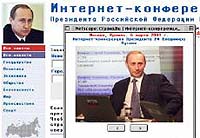
The United States’ unilateral withdrawal from the 1972 ABM Treaty “will entail legal consequences that do not depend on Russia,” Russian President Vladimir Putin said during an Internet press conference on Tuesday.
“The ABM Treaty is like an axle to which a number of agreements on international security are attached,” Putin said. “If we remove this axle, those agreements will automatically fall apart, destroying the entire present-day security system.”
In accordance with the Law on the Ratification of the START II Treaty by the Russian parliament, Putin continued, that treaty is to be applied only if the ABM Treaty is being observed. Consequently, if the ABM Treaty is violated, Russia, automatically and in accordance with the law, “will not have to observe the quantitative limitations in the sphere of missile defense.”
Asked if Russia will cut short the talks on the limitation of strategic armaments if the U.S. continues to insist on the creation of a national missile defense system, the president responded that Russia “does not plan to give an ultimatum to anyone.” “We want to remain in the negotiating process and are counting on this,” he said.
“Judging from the reaction of the new American administration, our American partners are in the same mood, which inspires a certain optimism,” he added.
Asked again if Russia will walk away from the talks if the ABM Treaty is violated, Putin said, “We are prepared to continue the talks. We just think that things should not be pushed that far.”
“We should look for such ways to deal with our current concerns about international security, within the framework of negotiations, that would allow us not to ruin the existing system of international relations, and determine the degree, level and character of the threats common to the U.S. and for Russia, Europe and other regions of the world. And, having done so, think together how to neutralize these threats together, without filling each other with uncertainty and suspicion,” Putin argued.
The president also said he does not think it will be more difficult for him to maintain good relations with U.S. President George W. Bush than with his predecessor Bill Clinton. “I do hope that common sense and a deep understanding of national interests in the sphere of security will lead us and our American partners to a positive search and to joint end results,” he said.
 Copyright 2001 Interfax. All rights reserved. The material on this page is provided by Interfax and may not be published, broadcast, rewritten or redistributed.
