
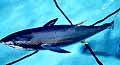
Hi-tech satellite tags which automatically ‘pop-up’ and float to the surface are being used for the first time to track southern bluefin tuna.
The tags will be used to track the large-scale migrations of the heavily- fished species.
The prototype tags combine satellite technology with data-logging capabilities, so that researchers can study the tuna’s migration patterns without having to recapture tagged fish, according to John Gunn of CSIRO Marine Research.
“Importantly, improving our understanding of the species biology and behaviour will allow us to better estimate the probability of the population recovering,” says Mr Gunn.
“After monitoring the fishes’ movements and behaviour every minute for several months, the new-generation tags are designed to release from the fish, float to the surface and relay a summary of this information to a satellite,” says Mr Gunn.
“In the past, we have relied on fishers, who catch tagged tuna, to return the tags to us for analysis. This has meant that only a proportion of the tags released are returned, and that a lot of data is still at sea”
Mr Gunn says that CSIRO has had tremendous support in this research, and is still receiving tags from fishers internationally. “But the new technology will allow us to retrieve information on the vast majority of tagged tuna in the future,” he says.
Made and donated by Wildlife Computers Pty Ltd in Seattle, the satellite tags can record a megabyte of information.
The first tag was released earlier this month and is programmed to release from the tuna in November this year, which corresponds with the time southern bluefin tuna are known to spawn in the waters between Indonesia and north-west Australia.
“With the species at historically low levels, it is important to find out how often adults spawn,” he says.
“At the moment we do not know whether individual tuna spawn every year, but with the pop-up tag technology we now have the tool to examine this critical question.
“The tags will also tell us the depths the fish swam to and the water temperatures it encountered during the four and a half months the tag was attached to the fish.”
Fishing quotas for southern bluefin tuna are agreed to each year by the Commission for the Conservation of Southern Bluefin Tuna (CCSBT), of which Australia is a member.
The goal of the Commission is to return the parent stock of the species to pre-1980 levels by the year 2020.
Australia (quota 5265 tonnes), Japan (quota 6065 tonnes) and New Zealand (quota 420 tonnes) all fish for southern bluefin tuna under quotas set by the Commission, based on advice from scientific assessments from the three countries.
A large part (4000 tonnes) of the global catch of SBT is by nations such as Indonesia, Taiwan and Korea that are fishing outside the quota system.
Ninety percent of the world’s southern bluefin tuna is consumed in Japan where fresh sashimi fetches up to A$100/kg. Fully grown fish can reach weights of more than 200 kg.
