

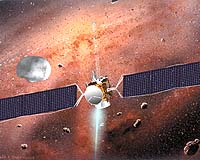
The Dawn mission officially started in September, 2002. During January, the mission team at JPL and Orbital Sciences Corp. reached full staffing levels and contracts for science team support were signed.
The European team members at DLR (Berlin) and IFSI (Rome) have begun work on the framing cameras and mapping spectrometer, respectively. We are now sailing smoothly towards our Preliminary Mission and Systems Review in April, followed by the Preliminary Design Review (PDR) in August, 2003. The PDR is also the official mission confirmation review.
Any successful journey requires careful route planning and efficient packing, and Dawn is no exception. Our journey will take us on a trip of 5. 5 billion kilometers over eight years, with major stopovers at Vesta and Ceres. Thus careful planning of the spacecraft trajectory is critical to mission success.
The Dawn mission design and navigation team has been hard at work doing just that, and a report of their progress by Marc Rayman is featured in this newsletter.
The mission team is now reviewing the availability, cost and performance of the payload and spacecraft systems and making sure everything fits within the mission’s technical and cost resources.
Thus far no technical obstacles have been identified, but we did have to abandon our plan to use a lightweight composite tank for the xenon propellant, and instead will carry a heavier but more reliable titanium tank with composite overwrap.
The Dawn Science Team will be meeting in Houston, Texas on March 16 (in conjunction with the Lunar and Planetary Science Conference) and in Nice, France on April 5 (in conjunction with the joint European Geophysical Society / American Geophysical Union meeting), to verify the mission plans and requirements, and begin planning for the mission operations and data analysis. A paper describing the mission will appear in Planetary and Space Science later this year.
