
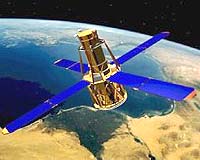
Orbital Sciences Corporation announced that it successfully launched the National Aeronautics and Space Administration’s (NASA’s) High Energy Spectroscopic Imager (HESSI) satellite into its targeted orbit aboard the company’s Pegasus rocket earlier today.
The scientific satellite was accurately delivered into its targeted orbit approximately 370 miles (595 kilometers) above the Earth. Today’s mission, which originated from Cape Canaveral, Florida, was the 31st Pegasus flight, a depth of experience unmatched by any other commercial small launch vehicle.
At approximately 2:29 p.m. EST, the company’s L-1011 Pegasus carrier aircraft took off from Cape Canaveral and followed a flight path to a predetermined launch point off the Florida coast.
A short-term degradation of one of the communications links between the mission control center and the airborne launch crew required a recycle of the launch sequence, which took about 30 minutes to perform.
On the second attempt, the Pegasus rocket was released at approximately 3:58 p.m. and, following a planned five-second free fall, ignited its first stage rocket motor.
Approximately nine and a half minutes later, Pegasus accurately deployed the HESSI satellite into its near- circular orbit, inclined 38 degrees to the equator. Preliminary information indicates that the main operating systems of the HESSI satellite are working as planned in the early stages of its mission.
Mr. David W. Thompson, Orbital’s Chairman and Chief Executive Officer, said, “This mission once again highlights the Pegasus launch system’s outstanding record of reliability. We are very pleased to continue our 2002 space mission operational campaign with such a successful outcome. We wish NASA and the University of California at Berkeley team the greatest of success in their important solar imaging mission.”
Pegasus is the world’s leading launch system for the deployment of small satellites into low-Earth orbit. Its patented air-launch system, in which the rocket is launched from beneath Orbital’s “Stargazer” L-1011 carrier aircraft over the ocean, reduces cost and provides customers with unparalleled flexibility to operate from virtually anywhere on Earth with minimal ground support requirements.
For the HESSI launch, the Florida Space Authority provided logistical and facility support for Orbital’s launch team, which is primarily based in California and Virginia.
In order to understand what triggers a solar flare and how it explosively releases energy, scientists need to identify the kinds of particles being accelerated, locate the regions where the acceleration occurs, and determine when the particles get accelerated.
The most direct tracer of these accelerated particles is the X-ray and gamma ray radiation they produce as they travel through the solar atmosphere.
The spacecraft’s sole instrument, an imaging spectrometer, will construct flare images from patterns of light and shadows, that are produced by high-energy radiation as it passes through the instrument’s grids while the spacecraft rotates.
Inside solar flare explosions, magnetic fields twist, snap and recombine, blasting particles to almost the speed of light and firing solar gas to tens of millions of degrees.
This intense action causes the solar atmosphere to sizzle with high-energy X-rays and gamma rays and drives proton and electron particles into the solar system. Radiation and particles from solar flares can sometimes affect orbiting spacecraft.
HESSI was originally scheduled for launch in July 2000, but was postponed after the satellite suffered damage during vibration testing. Since then, flight delays due to launch vehicle failures have affected the launch date. However, officials have since cleared the way for next Tuesday’s scheduled launch.
In order for scientists to understand the physical processes and conditions within flares, they will use the spectrometer aboard HESSI to create images of the gamma rays and highest energy X-rays emitted by each flare.
These images will be the first to simultaneously measure the location and energy content of radiation from the flare material and should improve predictability of flare occurrences at the Sun and the subsequent consequences we experience here on Earth.
Working together with several other solar spacecraft such as the Solar and Heliospheric Observatory (SOHO), Geostationary Operational Environmental Satellites (GOES), and Transition Region and Coronal Explorer (TRACE) for flare radiation, as well as Wind, Advanced Composition Explorer (ACE), Ulysses, and Voyager for particle detection, HESSI will provide scientists with vital insight into the impulsive energy release and particle acceleration processes at the Sun.
The HESSI mission costs about $85 million, which includes the spacecraft, launch vehicle, mission operations and data analysis. The Explorers Program Office at NASA Goddard Space Flight Center, Greenbelt, Md., will provide mission management and technical oversight under the auspices of NASA’s Office of Space Science in Washington.
