
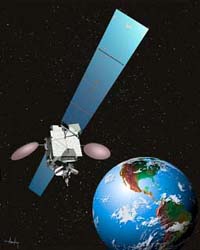
PanAmSat has inaugurated key video, radio and Internet services over the new Galaxy IVR satellite, its latest North American spacecraft, following flawless in-orbit maneuvers and testing.
PanAmSat also announced that its Galaxy XI satellite is en route to its final destination at 91 degrees west longitude, completing a North American satellite network that includes 10 active spacecraft and one in-orbit C-band spare for seamless backup services.
“With Galaxy IVR active in our lineup of North American satellites, PanAmSat can now claim the largest, most comprehensive satellite network in the region,” said R. Douglas Kahn, PanAmSat’s president and chief executive officer.
“Galaxy IVR, which delivers digital video, high-speed Internet transmissions and leading radio programming, joins 10 other spacecraft in PanAmSat’s North American fleet, including an in-orbit spare, enabling the company to offer the most flexible and reliable services available.”
Among the numerous customers employing Galaxy IVR are National Public Radio (NPR) and Hughes Networks Systems, which uses the satellite to transmit AOL Plus direct to consumers’ homes via DirecPC. AT&T Broadband also uses the spacecraft to deliver digital bouquets of cable programming to cable system operators across the United States.
In addition, plans are already underway to take advantage of the new spacecraft for the delivery of live Olympic coverage to North American broadcasters via the Galaxy 3DTM service.
Galaxy 3D is a bundled domestic digital delivery platform on Galaxy IVR that offers television broadcasters, programmers and business network managers a one-stop shopping resource for end-to-end digital video, audio and data transmission services among more than a dozen North American cities.
Galaxy IVR, a Hughes-built HS 601 HP model spacecraft that was launched to 99 degrees west longitude on April 18, 2000, contains 24 C-band and 24 Ku-band transponders.
Galaxy XI, which served as the interim spacecraft at 99 degrees, is now migrating to 91 degrees, where it will replace the Galaxy VI and Galaxy VII satellites.
Galaxy VI will move to 74 degrees west longitude, where it will serve as the C-band spare satellite for the Galaxy cable neighborhood. Galaxy VII will also relocate to new orbital location.
