

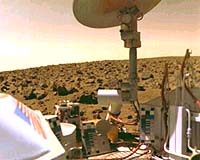
With the continuing success and spectacular images of NASA’s two Mars Exploration Rovers, Spirit and Opportunity, it might be easy to overlook the passing of a historic milestone this week of a previous mission to the red planet – the twin Viking landers.
Still, the Viking mission – which comprised four spacecraft, two orbiters and two landers, with each orbiter-lander tandem known collectively as Viking 1 and Viking 2 – managed to log some impressive achievements, and their longevity remains to be surpassed.
On Aug. 20, 1975, NASA launched Viking 1 from Kennedy Space Center in Florida. Its primary mission was to obtain high-resolution images of the Martian surface, characterize the structure and composition of the atmosphere and soil, and search for evidence of life.
Thirty years ago this week, on June 19, 1976, the Viking 1 entered orbit around Mars, and spent its first month imaging the surface and transmitting those images back to ground controllers, who were trying to find appropriate landing sites.
Then, on July 20, 1976, the Viking 1 lander separated from the orbiter and touched down at Chryse Planitia, at 22.48 degrees north latitude and 49.97 degrees west. After transmitting images for seven years, two months and four days, the stationary probe apparently ran out of power on Nov. 13, 1982, and stopped transmitting.
NASA launched Viking 2 on Sept. 9, 1975. Taking a less direct route, it entered Mars orbit Aug. 7, 1976. A little less than four weeks later, on Sept. 3, the lander touched down at Utopia Planitia at 47.97 degrees north and 225.74 degrees west. It continued to transmit images for a mere three years, eight months and four days, its last transmission received April 11, 1980.
During their photographic operations, the landers also took Martian surface samples and analyzed them for composition and signs of life, studied atmospheric composition and meteorology, and deployed seismometers.
In all, the two landers sent back more than 1,400 images of the Martian surface, and they outlasted their counterparts in orbit. Neither found the slightest hint of life on Mars, either extant or paleontological.
The mission did, however, provide scientists with their most complete view of Mars to date. The orbiters imaged volcanoes, lava plains, immense canyons, cratered areas, wind-formed features and even some evidence of surface water.
The Vikings showed, for the first time, how the red planet appears to be divisible into two main regions: its northern low plains and southern cratered highlands. This information paved the way for landing sites for Spirit and Opportunity, and for the Phoenix and Mars Science Laboratory missions yet to come.
