

Controllers have placed the Opportunity rover in a restricted mission-planning mode this week due to the downlink coming too late in the Earth day to allow planning of a drive for the next Martian day, or sol.
Nevertheless, the team at Jet Propulsion Laboratory built three drives for the week and sent Opportunity a total drove 83.2 meters (273 feet). The general direction of the drive is southeast to avoid a large dune field due south. As of sol 788, Opportunity was estimated to be 1,557 meters (just under one mile) from Victoria Crater – its next destination.
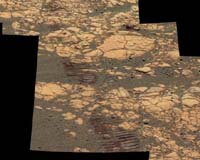
On the way to Victoria, Opportunity is encountering a terrain that consists of large sand ripples and patches of flat-lying rock outcrops, as shown in this image. Whenever possible, rover planners are trying to keep Opportunity on the pavement for best mobility.
The false-color mosaic was assembled using images acquired by the panoramic camera on Opportunity’s 784th sol (April 8). The camera used its 753-nanometer, 535-nanometer and 432-nanometer filters. The view shows a portion of the outcrop named Bosque, including rover wheel tracks, fractured and finely-layered outcrop rocks and smaller, dark cobbles littered across the surface.
