

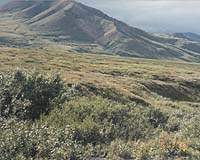
An oil pipeline leak on Alaska’s North Slope has spewed up to 220,000 liters (58,000 gallons) of crude onto the tundra, causing one of the region’s worst spills, officials said Thursday.
The leak, apparently caused by metal corrosion, was detected in the United States’ largest oil field a week ago and forced the shutdown of a pipeline in the Prudhoe Bay field to allow for repairs and a clean-up.
Officials confirmed that — while the leak is miniscule compared to the spillage caused by the Exxon Valdez shipping disaster in 1989 — it could turn out to be the worst spill ever on Alaska’s North Slope.
“We don’t know exactly how much has been leaked, but so far 1,395 barrels (58,590 gallons) of liquids have been collected, most of crude that it is mixed with snow,” Linda Giguere of Alaska’s Department of Environmental Conservation told AFP.
“It has covered a 1.93 acres (0.77 hectares) of snow-covered tundra at the end of a frozen lake,” the spokeswoman said, pointing out that the biggest crude leak on the North Slope was a 39,850-gallon (127,500-litre) spill in 1989.
The leak was detected on March 2 by a British Petroleum (BP) worker in the Prudhoe field, which lies about 1,040 kilometers (650 miles) north of Alaska’s biggest city, Anchorage.
Giguere said that officials were racing to get an exact estimate of the extent of the spill and to establish how much of the murky liquid collected was crude and how much was snow, but she said most of it would likely be crude.
Alaska’s worst ever oil spill took place after the Exxon Valdez tanker ran aground in Prince William Sound, south of Anchorage, on March 24, 1989.
The Exxon Valdez was laden with 11 million gallons (41.8 million liters) of crude when it hit a reef at night, unleashing one of the world’s worst environmental disasters.
Source: Agence France-Presse
