

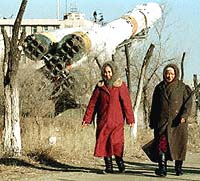
Russia’s space agency has established that space activities connected with the Baikonur cosmodrome do not impact directly on the health of nearby residents.
The statement followed a report in the British weekly science journal Nature that toxic rocket fuel is causing serious illness among children living in Russia’s Altai republic.
The report quoted a study made by Russian scientists that said child disorders of the blood and endocrine glands in polluted areas are twice the regional average.
Some of the territories located along the rockets’ flight trajectories are affected by the Semipalatinsk former nuclear testing range, the agency said. Moreover, the people in these regions are mostly poor.
At the same time, however, the agency confirmed that heptyl, a substance used for space launches, harms the environment.
“There are no grounds for replacing the launchers’ fuel with another (kind of fuel), because other kinds of fuel also harm the environment,” the statement said.
Specialists from the space agency and representatives from the space and rocket industries are conducting work to improve the ecological characteristics of existing launch vehicles, the statement said.
“Thus, in a Proton M (rocket), the amount of fuel left in the separating sections has been considerably reduced,” it added.
The Baikonur cosmodrome, 330 miles southwest of Astana, the Kazakh capital, is now leased from Kazakhstan by the Russian government.
