
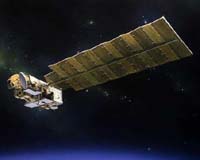
Northrop Grumman has moved the Aura satellite to Space Launch Complex 2 at Vandenberg Air Force Base, Calif., bringing NASA’s third major Earth Observing System spacecraft one step closer to its launch no earlier than July 10. The three-minute launch window opens at 3:01 a.m.
The Space Technology sector-built Aura satellite will be integrated onto a Delta II rocket built by The Boeing Company in a series of steps that includes physically attaching the satellite to the launch vehicle, performing a final electrical checkout and completing mechanical closeouts. Aura was delivered to Vandenberg in April and has been fueled for launch.
“All elements have come together and we’re ready to go,” said Dana Southwood, Northrop Grumman’s Aura program manager. “In just a few short weeks, we’ll get to see Aura begin its on-orbit life and mission. We’ve been working long and hard to make that happen and we’re looking forward to the launch.”
Aura’s four instruments will monitor the Earth’s ozone, air quality and climate, taking comprehensive measurements of the composition, chemistry and dynamics of the Earth’s upper and lower atmosphere. The satellite will help reveal the processes that connect local and global air quality, and will also track the extent to which Earth’s protective ozone layer is recovering.
As members of Northrop Grumman’s family of spacecraft, the Aura spacecraft and its sibling, Aqua, were designed to provide low-jitter, precision pointing and longevity for scientific and remote sensing payloads. Northrop Grumman was able to apply the lessons learned while building Aqua to Aura, improving efficiencies and significantly lowering costs on the second satellite.
Aqua has been sending data on hydrological processes back to Earth since its launch two years ago. During its mission, Aqua has captured dramatic events such as fires in Australia and the United States, snowstorms in the Arctic, sandstorms in the Persian Gulf area and typhoons in the East China Sea.
