
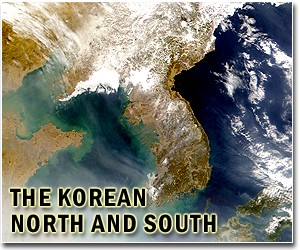
North Korea denounced South Korea and the United States Tuesday for planning anti-submarine drills in the Yellow Sea, describing them as a “nuclear war rehearsal”.
South Korea and the United States had planned a joint naval exercise from September 5 to 9 but it was delayed due to a typhoon.
Military officials were not available for comment but Yonhap news agency said the exercise would begin as early as next week.
Rodong Sinmun, the North’s ruling party newspaper, accused the United States of mobilising a nuclear-powered aircraft carrier “to make the joint military exercises a nuclear war rehearsal”.
“A serious situation, in which an all-out war may break out by any accident, is now prevailing in the Korean peninsula,” it said.
“However, the US war maniacs are ceaselessly beefing up armed forces and staging war games in this acute hotspot, which may drive the situation to an unpredictable grave phase.”
The North’s army and people “can never remain an onlooker”, the newspaper said, adding they would “go all-out to display the stamina of (North Korea) if the enemies dare provoke”.
Relations soured dramatically this year after the South accused the North of torpedoing one of its warships and killing 46 sailors in March. The North denied involvement and threatened retaliation.
South Korea has staged a flurry of military drills — either alone or with the United States — as a show of force against North Korea.
earlier related report
US official says China onboard on N.KoreaWashington (AFP) Sept 20, 2010 –
China, North Korea’s main ally, agrees with the United States that denuclearization talks can only resume if Pyongyang shows its seriousness about past agreements, a senior US official said Monday.
China has called for the resumption of talks on ending North Korea’s nuclear program and faced strong criticism from some US lawmakers, who believe Beijing has not done enough to prod its neighbor.
But Deputy Secretary of State James Steinberg, who recently met with China’s chief nuclear negotiator, said Washington and Beijing agreed that North Korea needed to adhere to a 2005 denuclearization agreement before new talks.
“I think that there is a recognition that there is simply little value in moving forward without some very concrete indication that the North Koreans are interested in implementing the 2005 statement,” Steinberg said.
“And the Chinese were very clear on that. There was no disagreement at all,” Steinberg told a forum at the Woodrow Wilson International Center for Scholars.
“They realize that given what’s happened on a number of fronts — both with the actions of the North Koreans last year and then following the Cheonan — that we are not simply going to go back to talking,” he said.
North Korea last year tested a long-range missile and a nuclear bomb and stormed out of six-nation denuclearization talks, which involve China, Japan, the two Koreas, Russia and the United States.
In March, South Korea’s Cheonan ship sank, killing 46 sailors. The United States and South Korea say that North Korea torpedoed the vessel, making it the deadliest incident on the peninsula in decades.
China has not endorsed the findings of the Cheonan probe and its state media has urged the United States, South Korea and Japan not to “bully” North Korea.
On Thursday, Chinese foreign ministry spokeswoman Jiang Yu said Beijing and Washington both wanted dialogue to “create conditions for the early resumption of the six-party talks.”
In the 2005 agreement and a related statement in 2007, North Korea agreed to give up its nuclear weapons in return for security guarantees and badly needed aid.
In New York, US Secretary of State Hillary Clinton sought ideas Monday from Chinese Foreign Minister Yang Jiechi about how to engage diplomatically with both North Korea and Iran in a bid to curb their nuclear ambitions, her spokesman said.
But Clinton, who met Yang on the sidelines of the UN General Assembly, also discussed the need to fully implement existing UN Security Council sanctions against both countries for their defiance, Philip Crowley told reporters.
Clinton sought “Chinese ideas on how to successfully engage both countries, at the same time reaffirming that we will continue to fully implement both (sanctions) resolutions,” Crowley said without elaborating.
In addition to voting for the sanctions resolution against North Korea last year, China voted for a sanctions resolution against Iran this year. However, it has opposed further unilateral sanctions against Tehran by countries like South Korea. China is a major trade partner with Iran.
Crowley said Clinton and Yang also discussed plans for Robert Einhorn, the State Department’s special adviser for nonproliferation and arms control, to visit Beijing next week.
