
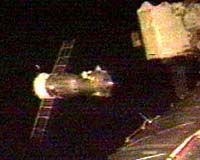
A Russian Soyuz spacecraft bringing back three astronauts from the International Space Station (ISS) landed Sunday in Kazakhstan, Russian space officials announced. The Soyuz TMA-4 vessel touched down near the city of Arkalyk in the Kazakh steppe at 0035 GMT with US astronaut Michael Fincke and his Russian colleagues Gennady Padalka and Yuri Shargin on board.
“Everything went according to plan, they landed at the scheduled time and in the scheduled area,” mission control’s spokesman Valery Lyndin told AFP.
All three were in fine health and smiling as the rescue team extracted them from the craft, Fincke taking the time to call home and talk to his daughter.
The team was to undergo medical tests in the mobile hospital at the site.
Some 40 helicopters and airplanes were on standby to make sure the landing is safe, federal space search-and-rescue department’s chief Vladimir Popov said as quoted by the ITAR-TASS news agency.
All teams were also equipped with satellite telephones, to avoid a problem search like in May 2003, when the cosmonauts’ capsule touched down 500 kilometers (300 miles) away from the scheduled zone and could not be located for two hours.
Padalka and Fincke, who had been on the station since April, were replaced by Russian cosmonaut Salizhan Sharipov and US astronaut Leroy Chiao, due to stay on for another 180 days to carry out experiments and keep the increasingly controversial space station operational.
The team brought results and samples from over 40 experiments, including high-quality pictures of the Earth taken by Shargin that would allow scientists to better monitor natural cataclysms, space officials said.
“The team completed all their tasks. Padalka and Fincke had to tackle many problems – repair spacesuits in orbit, make several spacewalks, do some repairs on the ISS, and they did brilliantly,” the federal space agency’s chief Anatoly Perminov said after the landing as quoted by the ITAR-TASS news agency.
The new ISS crew will conduct 41 scientific, medical, biological and technical experiments, including one focusing on research for a vaccination against the virus that causes AIDS, space officials said.
The new two-man crew, who have trained together for the past several months at the Star City facility outside Moscow, are also scheduled to make two space walks, one in December and one in February, while aboard the ISS.
Those space walks are to be used for preparing the ISS for the planned docking next year of the new European ATV space cargo vessel.
Chiao and Sharipov will be the 10th long-term crew aboard the ISS since the launch of its first module on November 20, 1998.
