

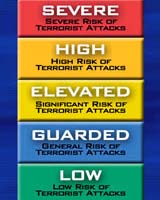
A new color-coded national threat alert system is in place in the United States to help Americans better prepare for potential terrorist attacks, Homeland Security chief Tom Ridge said Tuesday.
The Homeland Security Advisory System uses five colors to signal different threat levels: severe (red), high (orange), elevated (yellow), guarded (blue) and low (green), Ridge said at a news conference here.
The current level of alert is yellow. Americans are unlikely to see green until terrorist networks worldwide have been dismantled, he said.
The choice of color “is based on the information we have” from the intelligence community, Ridge said.
The system “is designed to measure and evaluate terrorists threats and communicate them to the public,” he said. “It empowers government and citizens to take action, to address the threat.”
In the future, Attorney General John Ashcroft will be responsible for announcing the threat level to the public, Ridge said.
The level of alert may vary in different regions of the United States, he added.
Under the new system, “for the first time threat conditions will be coupled with protective measures,” Ridge said.
For example, under a severe or red threat level, authorities will ban airplanes from taking off, and mobilize the Army, the National Guard, the police, information services and hospitals.
But state governors will have some leeway in deciding which protective measures to apply within their purview, he said.
The system will not eliminate risk but its goal is “to coordinate our efforts to be prepared, to make America safer and more aware,” Ridge said.
Responding to the announcement, security specialist Roy Godson applauded the graduated nature of the alert system.
“It is better to have some distinction so you know we are not always in a crisis,” said Godson, a professor at Georgetown University in Washington.
“If you keep telling the people they are on a high state of alert, after a few times, they won’t pay attention,” he said.
The US government has declared a general state of high alert five times since the September 11 terrorist attacks.
“This is very foolish,” exclaimed counter-terrorism expert Robert Jervis of Columbia University in New York, in a separate reaction to the announcement.
“If you tell me it’s going to rain today, I’ll know what to do: I’ll take an umbrella. But if you tell me it’s an orange alert, what should I do?
“Do I have to look into every trash can to see if there is a nuclear bomb?
“Does it mean every time I see an Arab, I should ask him if he is planning to do any harm?”
Tuesday marks the start of a 45-day trial period during which the public is invited to give feedback and ideas for improvements to the system.
