
At its annual meeting at Lowell Observatory in Flagstaff, Arizona, the American Association of Variable Star Observers announced a new exoplanet database that will archive long-term follow-up information on interesting planets orbiting stars outside the solar system and allow for powerful collaborations between professional and amateur astronomers.
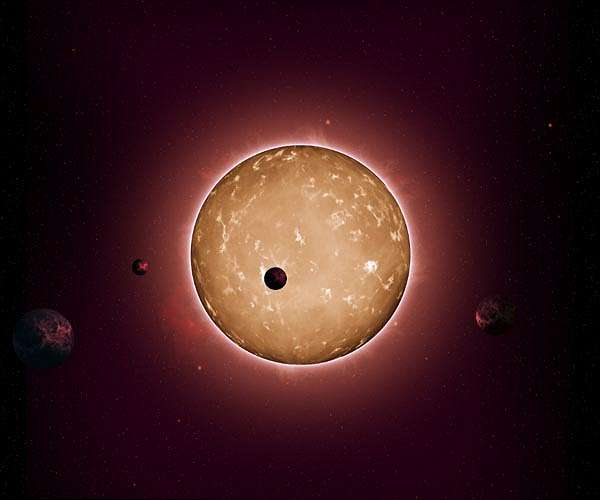
Though exoplanets are difficult to directly observe, data about them can be collected by watching for telltale variations in the light coming from the stars they orbit. Called the transit method because it involves taking a series of images of a star as an exoplanet “transits” across its face, this technique has been used by amateur astronomers to successfully and accurately detect exoplanets for more than a decade.
Observers record the periodic dimming of a star. The duration and the amount of the dimming, as well as how frequently it happens, tell astronomers about the size of the planet relative to the size of the star, the size and period of the planet’s orbit, and potentially other useful information.
Dennis Conti, Ph.D., who founded and chairs the AAVSO’s Exoplanet Section, began observing exoplanets in 2015. When he first heard about the transit method, he could hardly believe it was possible. “I thought, there’s no way for someone with a backyard telescope to detect a planet going around a distant star,” he says.
Since then, the group of ground-based observers collecting data on exoplanets has grown. In 2016, Conti coordinated more than 40 amateurs to assist in a professional astronomer’s effort to characterize the atmospheres of 15 exoplanets. In 2017, Conti began teaching an exoplanet observing course through the AAVSO that has educated more than 120 people, ranging from professional astronomers to astronomy instructors to high school students. He authored a guide to exoplanet observing that has been downloaded in more than 60 countries around the world.
This growing network of ground-based observers can make valuable contributions to professional astronomical endeavors, Conti explains. For example, as powerful as the Hubble Space Telescope is, it can’t observe a full exoplanet transit because as the telescope orbits the Earth, its view of the target planet gets blocked. With ground-based observations that can take place at various times and geographies, however, a complete transit can be captured.
Collecting exoplanet data is particularly vital now because of missions such as NASA’s Transiting Exoplanet Survey Satellite (TESS), which launched in April 2018 and will identify thousands of exoplanet candidates during its two-year survey. During the first one to two years of its mission, TESS follow-up observations will be submitted to NASA’s own database. The TESS Follow-Up Observing Program has collaborated with a trained group from the AAVSO, and recently adopted the organization’s guidelines for best practices.
Additionally, amateur astronomer observations submitted to the AAVSO Exoplanet Database for confirmed TESS exoplanets will help refine the ephemerides of those planets, which leads to a more accurate understanding of planet features such as size and orbit.
“This emphasizes the value that nonprofessionals bring to the field of science,” says Stella Kafka, Ph.D., AAVSO Executive Officer.
“People with moderate means can contribute from the ground to the knowledge base of the community. In principle, one can see the AAVSO as an international collaboration between professional and non-professional astronomers, working together to understand some of the most exciting phenomena in the universe.”
The AAVSO built its Exoplanet Database because existing databases archived only limited information about an exoplanet observation, are focused on data acquired by specific space or ground-based missions, or both, Conti explains. “It became clear that amateurs had no satisfactory place to archive the type of exoplanet observation data that would be useful for professionals to analyze their results,” he says.
This database is designed to store data robustly and to be easy to search, either by specific exoplanet or by star system. It is a place where amateur astronomers following established procedures can make their exoplanet transit observations available to the broader community of researchers. It also allows for long-term archiving of observations, which is useful for refining information about exoplanets over time and represents a valuable scientific legacy for the AAVSO.
This type of data can also reveal transit-timing variations, slight changes that could indicate that an observed exoplanet’s orbit is being affected by the gravitational pull of another, potentially undiscovered, planet in the system.
“The AAVSO has always been at the forefront of collecting and curating observations of variable stars. In the 21st century there is perhaps no more important class of variable stars than those with transiting exoplanets. Amateur astronomers have a vital role to play in monitoring and studying exoplanets in this way, and I am thrilled that the AAVSO is continuing to take a leadership role in aiding amateur astronomers in this important endeavor,” says Kristine Larsen, Ph.D., AAVSO president.
