
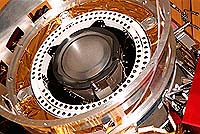
Aerojet has successfully completed manufacture and integration testing of the Xenon Propellant Management System (PMS) and Digital Control Interface Unit (DCIU) simulator for Phase 1 of the NASA Evolutionary Xenon Thruster (NEXT) ion engine development program.
Once manufacture of the PMS and DCIU simulator was completed at Aerojet’s Redmond, Wash. Facility, the hardware was delivered to NASA’s Glenn Research Center (GRC) in Cleveland, Ohio, where integration tests were successfully performed with an engineering model 40-cm ion thruster and a Breadboard power processing unit.
The NEXT program is a two-phase effort to develop a next generation high power six-kilowatt ion thruster system for NASA space science missions. Aerojet is a major subcontractor for both the xenon thrusters and feed system.
“Ion engines are critical to future long duration space missions because of their high specific impulse performance,” said Scott Neish, vice president of Aerojet’s Redmond Operations. “The NEXT PMS provides throttleable control of all three xenon flow inputs to the ion thruster and represents a significant reduction in mass and volume over the current state-of-the-art NSTAR design.”
The NEXT thruster discharge and neutralizer cathode flow rates are controllable over a wide range making it possible for the thruster to effectively throttle from two to six kilowatts. The internal volume of the PMS is reduced by greater than an order of magnitude, limiting residual gas losses when the thruster is turned off and significantly improving the engine throttle rate. The PMS is designed to provide three-percent accuracy of flow rate and have a total mass under 18 kilograms for a three thruster system. This compares with 9.2 kilograms for a single thruster xenon feed system on the NSTAR Deep Space 1 (DS-1) system.
NEXT utilizes design knowledge gained from the DS-1 spacecraft — the first space science mission to successfully use an ion thruster as the primary propulsion system. NEXT has significantly increased power compared to that of the ion thruster on DS-1, as well as provide increased efficiency and system performance characteristics.
NEXT is funded by the In-Space Propulsion Program in the Solar System Exploration Division of NASA’s Office of Space Science. The In-Space Propulsion Program is managed by the Office of Space Science at NASA Headquarters in Washington, D.C. and implemented by the Marshall Space Flight Center in Huntsville, Ala.
In June 2002 NASA’s Office of Space Science awarded approximately $21 million to GRC to develop a next generation ion propulsion system. Aerojet was awarded its share of the contract through GRC in August 2002.
“This work provides the basis for an advanced PMS design to be carried forward into Phase 2 of the NEXT program,” said Charles Elliot, Aerojet’s lead manufacturing engineer for the NEXT program.
Phase 2 is a two-and-a-half year option to complete hardware development, integrate the components into a full-scale system and perform thruster wear tests.
Other members of NASA’s NEXT team include the Jet Propulsion Laboratory, Pasadena, Calif., Boeing Electron Dynamic Devices, Torrance, Calif.; Applied Physics Laboratory, Laurel, Md.; University of Michigan, Ann Arbor, Mich.; and Colorado State University, Fort Collins, Colo.
