
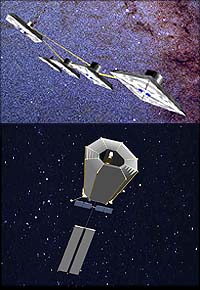
NASA’s budget request for fiscal year 2007 includes postponement or abandonment of several key space-exploration programs, including the James Webb Space Telescope, which is intended as a partial replacement for the aging Hubble, and the Terrestrial Planet Finder, the giant telescope expected to be able to take photographs of Earthlike planets orbiting distant stars.
NASA disclosed the postponements in its 451-page full budget document, saying there will be “a deferral of the start of TPF until after this budget horizon. The James Webb Space Telescope budget reflects on-going replanning for a launch date of no earlier than 2013.” The agency’s revised budget plans also call for deferring SIM PlanetQuest – formerly called the Space Interferometry Mission – a precursor to the TPF.
“SIM is being replanned, to be completed in spring 2006 (with a) launch of no earlier than 2015-2016, a change of approximately three years,” the NASA document said, and added that “the Terrestrial Planet Finder project has been deferred indefinitely.”
The agency also disclosed that a proposed addition of four smaller telescopes to the giant twin Keck instruments in Hawaii “will not be undertaken.”
In related matters:
+ NASA affirmed its budget includes full funding for a space shuttle servicing mission to the Hubble Space Telescope, probably in late 2008 or early 2009 – although that still depends on whether the agency can solve the existing problems with the orbiter and certify it ready for safe return to flight.
+ The Stratospheric Observatory for Infrared Astronomy (SOFIA) budget reflects a program review this year to assess what NASA describes as ongoing project concerns. “NASA will conduct a review of the SOFIA project in early 2006 and coordinate the Agency’s analysis and position on SOFIA with the German Aerospace Center according to the memorandum of understanding between the two agencies.”
+ The Gamma-ray Large Area Space Telescope (GLAST) budget reflects an adjustment to accommodate an eight-month delay in instrument delivery, and NASA has adjusted the Universe Discovery and Universe Explorer budgets to reflect the confirmation baselines for the Kepler and WISE missions.
+ NASA will postpone indefinitely the Dawn mission to examine two large asteroids, Ceres and Vesta, orbiting in the main belt between Mars and Jupiter. “Dawn has had technical, schedule and cost problems,” the agency said. “The project is currently in a stand-down mode, while an independent assessment team evaluates the project technical and management issues.”
+ The agency has placed an indefinite deferral of the Beyond Einstein program, which will affect the start of the LISA and Constellation-X missions.
Responding to the announced indefinite postponement of TPF, the Planetary Society released a statement Monday saying the agency’s budget “seriously damages the hugely productive and successful robotic exploration of our solar system and beyond.” In addition, the statement said, NASA’s budget “slashes funding for the fundamental space science that makes such missions possible and turns raw data into discoveries.”
