
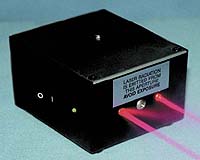
A new NASA-developed camera accessory uses twin lasers to shoot photos that can precisely measure damage to the space shuttle. The device also has applications in crime-scene investigations and other areas. Kim Ballard, an electrical design engineer at Kennedy Space Center developed the Laser Scaling and Measurement Device for Photographic Images.
It helps scientists determine the exact scale of any damages to the shuttle’s external tank when viewing the spacecraft on its launchpad. The device is a half-pound black box powered by a single battery that attaches directly to a camera’s tripod. Two lasers, an inch apart, shoot from the box when a photo is taken.
The lasers provide reference points that allow anyone examining the photos to understand just how big or small objects really are. When the images are loaded into Microsoft Word-compatible software, they are displayed on a monitor and their constituent objects are measured via reference points computed based on their distance away from the camera.
“I think that the greatest contribution that the device’s software offers to law enforcement is it ‘un-cuffs’ the investigator’s hands with digital image evidence by providing fast and accurate measurements of anything in a crime-scene photo, not just the intended target,” Ballard said.
Jeffrey Kohler, of Arctic Slope Regional Corporation Aerospace, in Anchorage, Alaska – a company that supports NASA’s Innovative Partnership Office – and colleagues reviewed the laser device’s potential for commercial markets. “Forensics was at the top of the list,” he said.
Detectives can use the technology to view photos of pieces from crime scenes such as blood-spatter patterns and graffiti. They can view the images from different angles – diagonally, horizontally and vertically – to improve their analysis and understand the scenes, Kohler explained, adding that law-enforcement agencies already have begun ordering the device.
Ballard said the FBI recently asked him to add more capabilities to the accessory’s software to allow forensics experts to zoom in and out of images to measure blood-spatter details across a wall as well as specific areas. Also at the FBI’s request, he said, NASA created the images in different formats for various computers.
