
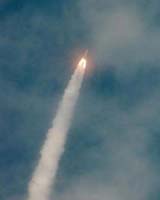
The N version of NASA’s Geostationary Operational Environmental Satellite series launched on schedule Thursday evening from Space Launch Complex 37 at Cape Canaveral Air Force Station. The Boeing Delta IV rocket carrying the satellite lifted off at the beginning of its launch window, at 6:11 p.m. Eastern Time.
After GOES-N reaches its geosynchronous orbit of approximately 22,300 miles and receives its post-launch checkout, mission controllers will place the satellite in an on-orbit storage mode, where it will stand ready to replace any existing operational GOES satellite in case of failure.
GOES-N is the latest in a series of Earth monitoring satellites developed for the National Oceanic and Atmospheric Administration. The GOES series provides continuous monitoring, which is required for intensive data analysis.
GOES-N will provide a constant vigil for the atmospheric triggers for severe weather conditions such as tornadoes, flash floods, hailstorms and hurricanes.
The GOES series N-P is the next series of weather, solar and space science satellites developed jointly by NASA and NOAA, with mission management by Goddard Space Flight Center in Greenbelt, Md., and spacecraft construction by Boeing.
