
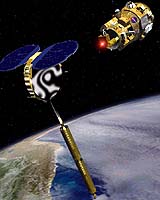
The Demonstration of Autonomous Rendezvous Technology (DART) spacecraft that was successfully launched Friday at 10:25 a.m. PDT from Vandenberg Air Force Base, Calif., experienced an on orbit anomaly late Friday.
After a successful rendezvous, acquisition of the target spacecraft, and approach to within approximately 300 feet, DART placed itself in the retirement phase before completing all planned proximity operations, ending the mission prematurely.
NASA is convening a mishap investigation board to determine the reason for the DART spacecraft anomaly.
A teleconference with DART project managers was scheduled for 11 a.m. PDT.
The DART spacecraft was a flight experiment attempting to establish autonomous rendezvous capabilities for the U.S. space program.
While previous rendezvous and docking efforts have been piloted by astronauts, the DART spacecraft completed the rendezvous and acquisition with no human intervention, relying on a variety of sensors and analyses to complete these functions.
Updates
Mission Not Accomplished For NASA’s Self-Docking DART Spacecraft
Washington (AFP) April 16, 2005 – The mission of NASA’s automated, self-docking DART spacecraft — considered a step toward lunar and Mars missions — has failed, the US space agency said Saturday.
DART, short for Demonstration of Autonomous Rendezvous Technology, was launched Friday from Vandenberg Air Force Base in California with a boost from a Pegasus rocket but suffered a glitch in orbit that forced NASA to scrap the mission.
DART is designed to find another spacecraft in space, rendezvous and dock, without human guidance. The space agency wants to test the craft as a cost-cutting measure in President George W. Bush’s initiative to return humans to the moon and pursue manned exploration of Mars.
“After a successful rendezvous, acquisition of the target spacecraft and approach to within approximately 300 feet (91 meters), DART placed itself in the retirement phase before completing all planned proximity operations, ending the mission prematurely,” NASA said in a statement Saturday.
NASA said it was “convening a mishap investigation board to determine the reason for the DART spacecraft anomaly.”
